Comprehensive Guide to Catalysts and Catalysis in Chemistry
Understanding Catalysts: Definition and Characteristics
What Are Catalysts and How Do They Function?
In chemical processes, catalysts are substances that modify the speed of a reaction by providing an alternative reaction pathway with a lower activation energy. They do not initiate reactions but facilitate the breaking and forming of chemical bonds, making reactions proceed more efficiently. Importantly, catalysts remain unchanged after the reaction, allowing them to be reused multiple times.
They can exist in solid, liquid, or gaseous states. Common solid catalysts include metals, metal oxides, sulphides, halides, and semi-metals like boron, aluminium, and silicon. Liquid and gaseous catalysts are often used in pure form or dissolved in suitable solvents.
The interaction between catalysts and reactants can involve various mechanisms such as acid-base reactions, redox processes, coordination complex formation, or free radical generation. For solid catalysts, surface properties and crystal structures play a crucial role in their activity.
Example: Consider the catalytic decomposition of hydrogen peroxide using manganese dioxide as a catalyst. The catalyst speeds up the reaction without being consumed, demonstrating the typical behavior of catalysts.
Classification of Catalysts and Their Roles
Types of Catalysts and Their Effects on Reaction Rates
Catalysts are broadly categorized based on their influence on reaction rates:
Positive Catalysts: These increase the reaction rate by lowering the activation energy, resulting in a higher product yield. For example, iron oxide in the Haber process enhances ammonia production.
Negative Catalysts: Also known as inhibitors, these decrease the reaction rate by raising the activation energy. Acetanilide slows down the decomposition of hydrogen peroxide, acting as a negative catalyst.
Promoters: Substances that enhance the effectiveness of catalysts without directly participating in the reaction. Molybdenum acts as a promoter in the Haber process.
Poisonous Catalysts: These substances reduce catalyst activity by binding to active sites. For instance, barium sulphate poisons palladium in the hydrogenation of alkynes, stopping the reaction at the alkene stage (Lindlar’s catalyst).
Example: In the synthesis of ammonia, adding molybdenum as a promoter increases the efficiency of the iron catalyst, leading to a higher yield of ammonia under the same conditions.
Exploring Catalysis: Mechanisms and Types
Heterogeneous Catalysis: Different Phases in Action
Heterogeneous catalysis occurs when the catalyst and reactants exist in different physical states. Typically, a solid catalyst interacts with gaseous or liquid reactants. The process involves adsorption of reactants onto the catalyst surface, formation of an activated complex, and subsequent desorption of products.
For example, in the Haber process, nitrogen and hydrogen gases react over solid iron oxide catalyst to form ammonia. Similarly, in the contact process for sulfuric acid production, vanadium pentoxide catalyzes the oxidation of sulfur dioxide gas.
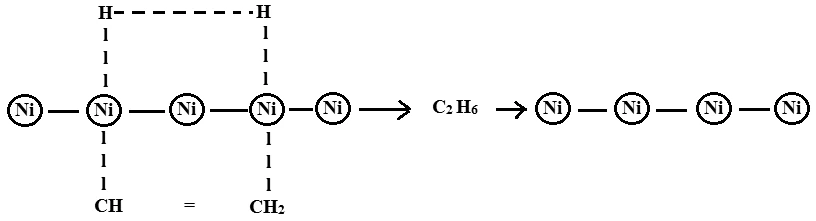
Diagram illustrating the steps in heterogeneous catalysis
Example: Hydrogenation of ethene to ethane on nickel surface involves adsorption of ethene and hydrogen, formation of an activated complex, and desorption of ethane, demonstrating heterogeneous catalysis.
Homogeneous Catalysis: Same Phase Interactions
In homogeneous catalysis, both the catalyst and reactants are in the same phase, usually liquid or gas. This allows for uniform interaction and often involves the formation of intermediate compounds that facilitate the reaction.
Examples include the acid-catalyzed hydrolysis of ethyl acetate and the oxidation of sulfur dioxide in the lead chamber process where nitric oxide acts as a gaseous catalyst.
Example: In the lead chamber process, nitric oxide catalyzes the oxidation of sulfur dioxide to sulfur trioxide by forming nitrogen dioxide as an intermediate, which then reacts further to regenerate nitric oxide.
Autocatalysis: Self-Accelerating Reactions
Autocatalysis refers to reactions where one of the products acts as a catalyst, accelerating the reaction as it proceeds. This self-catalyzing behavior leads to an increase in reaction rate over time without adding an external catalyst.
Example: The decomposition of arsine gas produces arsenic, which then catalyzes further decomposition of arsine, exemplifying autocatalysis.
Example: In the oxidation of oxalic acid by potassium permanganate, the Mn2+ ions formed act as autocatalysts, speeding up the reaction as it progresses.
Specialized Catalysts and Their Applications
Electrocatalysts in Fuel Cells
Electrocatalysts are crucial in electrochemical reactions, especially in fuel cells, where they accelerate half-reactions at electrodes. Platinum nanoparticles supported on carbon are commonly used to enhance oxygen reduction reactions, improving fuel cell efficiency.
Example: Platinum-based electrocatalysts facilitate the reduction of oxygen to water in hydrogen fuel cells, increasing the reaction rate and energy output.
Photocatalysts: Light-Activated Catalysts
Photocatalysts absorb light energy to reach an excited state, enabling or accelerating chemical reactions that might otherwise be slow or require harsh conditions. This property is exploited in environmental and energy applications.
Summary Table: Key Points on Catalysts and Catalysis
Aspect | Description | Example |
|---|---|---|
Positive Catalyst | Increases reaction rate by lowering activation energy | Iron oxide in Haber process |
Negative Catalyst | Decreases reaction rate by raising activation energy | Acetanilide in H2O2 decomposition |
Promoter | Enhances catalyst activity without direct reaction | Molybdenum in ammonia synthesis |
Poison | Reduces catalyst effectiveness by blocking active sites | Barium sulphate in Lindlar’s catalyst |
Heterogeneous Catalysis | Catalyst and reactants in different phases | Ammonia synthesis with solid iron catalyst |
Homogeneous Catalysis | Catalyst and reactants in the same phase | Hydrolysis of ethyl acetate with acid catalyst |
Autocatalysis | Product acts as catalyst to accelerate reaction | Oxalic acid oxidation by KMnO4 |
Electrocatalyst | Enhances electrode reactions in fuel cells | Platinum nanoparticles in hydrogen fuel cells |
Photocatalyst | Activated by light to speed up reactions | Titanium dioxide in pollutant degradation |
Turnover Number (TON) | Number of reactant molecules converted per catalyst molecule | Used to quantify catalyst efficiency |
Glossary of Important Terms
Term | Definition |
|---|---|
Catalyst | A substance that changes the rate of a chemical reaction without being consumed. |
Activation Energy | The minimum energy required for a reaction to proceed. |
Adsorption | The adhesion of atoms, ions, or molecules from a gas, liquid, or dissolved solid to a surface. |
Promoter | A substance that increases the activity of a catalyst without being a catalyst itself. |
Poison | A substance that decreases catalyst activity by binding to active sites. |
Heterogeneous Catalysis | Catalysis where catalyst and reactants are in different phases. |
Homogeneous Catalysis | Catalysis where catalyst and reactants are in the same phase. |
Autocatalysis | A reaction where one of the products acts as a catalyst. |
Turnover Number (TON) | The number of substrate molecules converted per catalyst molecule. |
Electrocatalyst | A catalyst that increases the rate of electrochemical reactions. |
Frequently Asked Questions
How does a positive catalyst influence a chemical reaction?
A positive catalyst accelerates a reaction by lowering the activation energy, allowing more reactant molecules to convert into products faster.
What role does a catalyst poison play in the Rosenmund reaction?
In the Rosenmund reaction, catalyst poison like barium sulphate prevents over-reduction by deactivating some active sites on palladium, stopping the reaction at the aldehyde stage.
What are the essential steps in heterogeneous catalysis?
Key steps include adsorption of reactants on the catalyst surface, formation of an activated complex, product formation, and desorption of products from the catalyst.
Why are promoters important in the Haber process?
Promoters enhance the activity of the catalyst, increasing ammonia yield by improving catalyst efficiency without being consumed.
What is the significance of autocatalysis in chemical reactions?
Autocatalysis allows a product to catalyze its own formation, increasing the reaction rate as more product forms, leading to self-acceleration.