Fundamentals of Carbon and Its Diverse Compounds
Unique Bonding and Chain Formation in Carbon
Understanding Carbon's Ability to Form Complex Structures
Carbon atoms are remarkable due to their tetravalent nature, allowing each atom to form four covalent bonds. This enables the creation of extensive chains and ring structures, a phenomenon known as catenation. This property is fundamental to the vast diversity of organic compounds found in nature.
Additionally, carbon can form multiple bonds such as double and triple bonds (pπ-pπ interactions) with itself and other electronegative elements like oxygen and nitrogen. These bonding capabilities contribute to the formation of various allotropes and complex molecules essential for life.
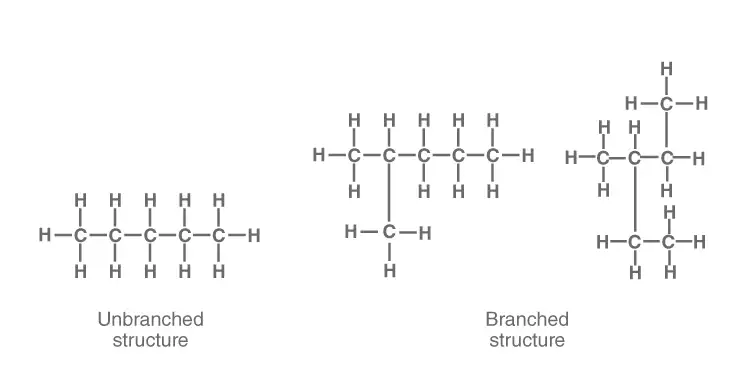
Illustration of Carbon's Catenation Property
Example Problem
Calculate the number of covalent bonds formed by 3 carbon atoms in a straight chain where each carbon is bonded only to carbon and hydrogen atoms, assuming each carbon forms four bonds.
Solution:
Each carbon atom forms 4 bonds. In a straight chain of 3 carbon atoms:
Between carbon atoms: 2 C–C bonds (since 3 atoms connected linearly have 2 bonds)
Remaining bonds are with hydrogen atoms.
Total bonds formed by carbon atoms = \(3 \times 4 = 12\)
Bonds between carbons = 2
Therefore, bonds with hydrogen = \(12 - 2 = 10\)
Hence, the molecule has 2 C–C bonds and 10 C–H bonds.
Varied Physical Forms of Carbon: Allotropes
Exploring Different Structural Forms of Carbon
Carbon exists in multiple physical forms called allotropes, which differ in their atomic arrangement and physical properties but share similar chemical behavior. The primary allotropes include diamond, graphite, graphene, fullerenes, and carbon nanotubes.
These allotropes exhibit unique characteristics such as hardness, electrical conductivity, and molecular geometry, making carbon versatile in various applications.
Diamond: The Hardest Carbon Form
Diamond features a three-dimensional network where each carbon atom is tetrahedrally bonded to four others, resulting in exceptional hardness and high thermal conductivity.
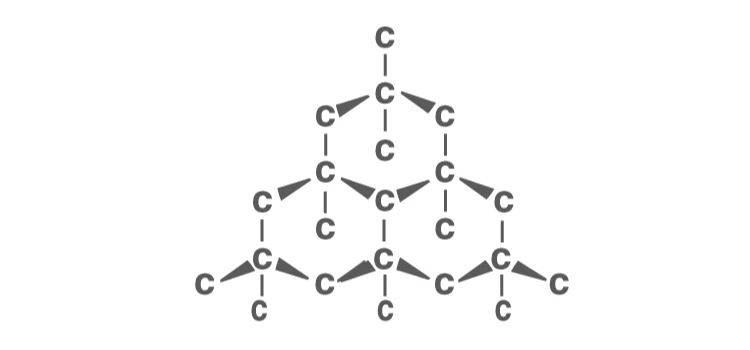
Crystal structure of Diamond
Example Problem
Explain why diamond is an excellent thermal conductor despite being an electrical insulator.
Answer:
Diamond's strong covalent bonds form a rigid lattice that efficiently transmits vibrational energy (phonons).
Absence of free electrons prevents electrical conductivity.
Thus, heat is conducted through lattice vibrations, making diamond a superb thermal conductor but an electrical insulator.
Graphite: Layered Carbon with Electrical Conductivity
Graphite consists of layers of carbon atoms arranged in hexagonal sheets. Each carbon atom bonds to three others, leaving one free electron per atom, which allows electrical conduction along the layers.
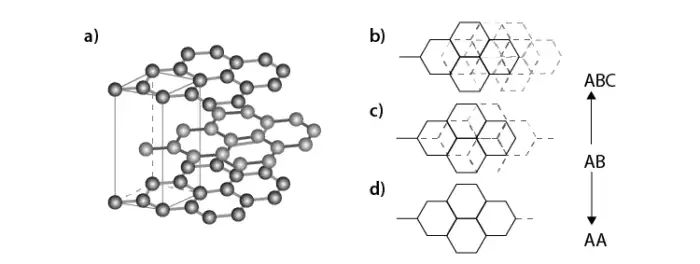
Layered structure of Graphite
Example Problem
Why does graphite act as a lubricant?
Answer:
Graphite layers are held together by weak van der Waals forces.
These layers can slide over each other easily, reducing friction.
This property makes graphite an effective solid lubricant.
Graphene: Single-Atom-Thick Carbon Sheet
Graphene is a single layer of carbon atoms arranged in a two-dimensional honeycomb lattice. It exhibits extraordinary electrical conductivity and mechanical strength due to the presence of delocalized pi electrons.
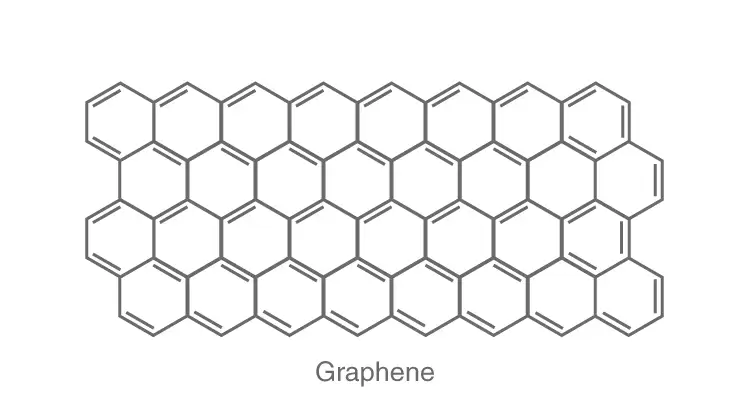
Honeycomb lattice of Graphene
Example Problem
Describe one key property of graphene that makes it suitable for electronic devices.
Answer:
Graphene has very high electron mobility, allowing fast electron transport.
This property enables high-speed electronic components and sensors.
Fullerenes: Spherical Carbon Molecules
Fullerenes are carbon allotropes composed of carbon atoms arranged in closed hollow spheres or ellipsoids, with fused rings of five to seven atoms. The most common fullerene is C60, resembling a soccer ball.
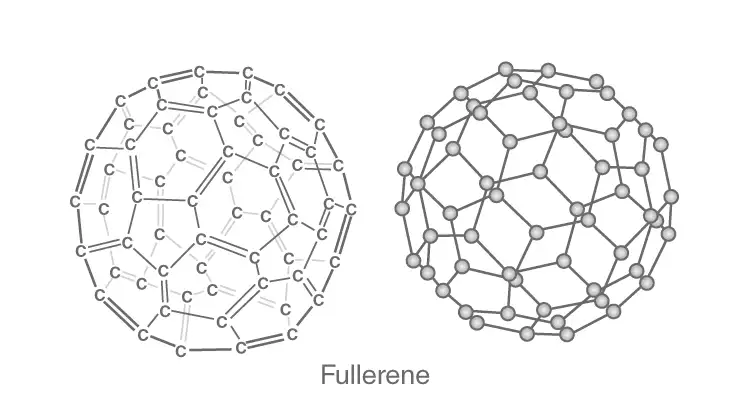
Structure of Fullerene C60
Example Problem
What structural feature distinguishes fullerenes from graphite?
Answer:
Fullerenes have closed cage-like structures with pentagonal and hexagonal rings.
Graphite consists of flat, layered hexagonal sheets.
Carbon Nanotubes: Cylindrical Carbon Structures
Single-wall carbon nanotubes are cylindrical allotropes formed by rolling graphene sheets into tubes. They combine properties of fullerenes and graphene, exhibiting exceptional strength and electrical conductivity.
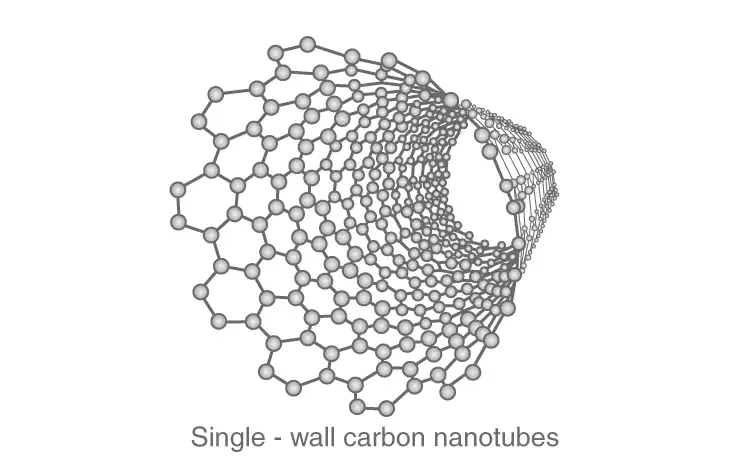
Single-wall carbon nanotubes
Example Problem
Explain why carbon nanotubes are considered for use in nanotechnology applications.
Answer:
They have high tensile strength and electrical conductivity.
Their nanoscale dimensions allow integration into tiny devices.
These features make them ideal for sensors, electronics, and materials engineering.
Varieties of Carbon Compounds and Their Applications
Classification of Carbon-Based Molecules
Carbon forms a wide range of compounds by bonding with various elements. These include:
Hydrocarbons: Compounds containing only carbon and hydrogen, such as methane (\(CH_4\)), ethane (\(C_2H_6\)), ethene (\(C_2H_4\)), and benzene (\(C_6H_6\)).
Carbon-Oxygen Compounds: Includes carbon dioxide (\(CO_2\)), carbon monoxide (\(CO\)), and carbon trioxide (\(CO_3\)).
Carbon-Sulfur Compounds: Examples are carbon disulfide (\(CS_2\)) and carbonyl sulfide (\(OCS\)).
Carbon-Nitrogen Compounds: Such as cyanogen (\((CN)_2\)), hydrogen cyanide (\(HCN\)), and cyanogen chloride (\(CNCl\)).
Carbon-Halogen Compounds: Includes carbon tetrafluoride (\(CF_4\)), carbon tetrachloride (\(CCl_4\)), carbon tetrabromide (\(CBr_4\)), and carbon tetraiodide (\(CI_4\)).
Example Problem
Identify the type of carbon compound in the molecule \(CCl_4\) and state one of its common uses.
Solution:
\(CCl_4\) is a carbon-halogen compound known as carbon tetrachloride.
It is commonly used as a solvent and in fire extinguishers (historically).
Practical Uses of Carbon and Its Derivatives
Carbon compounds are integral to many industries and biological processes:
Hydrocarbons serve as primary fuels for energy.
Polymers like polyethylene and polystyrene are synthesized from carbon-based monomers.
Diamond is utilized in cutting tools and jewelry due to its hardness.
Graphite is employed in pencils, lubricants, and electrodes for electrochemical cells.
Glucose, a carbon-based sugar, is the main energy source for living cells.
Various uses of carbon compounds
Example Problem
Explain why graphite is preferred over diamond for use in pencils.
Answer:
Graphite's layered structure allows sheets to slide off easily, leaving marks on paper.
Diamond is too hard and does not leave marks easily.
Quick Reference: Key Points on Carbon and Its Compounds
Aspect | Details |
|---|---|
Atomic Number | 6 |
Atomic Mass | 12.01 g/mol |
Group in Periodic Table | 14 |
Catenation | Ability to form long chains and rings with carbon atoms |
Common Allotropes | Diamond, Graphite, Graphene, Fullerene, Carbon Nanotubes |
Hydrocarbons | Compounds of carbon and hydrogen (e.g., methane, ethane) |
Carbon-Oxygen Compounds | CO, CO₂, CO₃ |
Carbon-Sulfur Compounds | CS₂, OCS |
Carbon-Nitrogen Compounds | HCN, (CN)₂ |
Carbon-Halogen Compounds | CCl₄, CF₄ |
Glossary of Important Terms
Term | Definition |
|---|---|
Catenation | The ability of an element to form bonds with itself, creating chains or rings. |
Allotrope | Different physical forms of the same element with distinct structures. |
Tetravalent | Having four valence electrons available for bonding. |
Hydrocarbon | A compound consisting only of carbon and hydrogen atoms. |
Graphene | A single layer of carbon atoms arranged in a hexagonal lattice. |
Fullerene | A spherical or ellipsoidal carbon molecule composed of fused rings. |
Carbon Nanotube | Cylindrical nanostructures made from rolled graphene sheets. |
Isotope | Atoms of the same element with different numbers of neutrons. |
pπ-pπ Bonding | Overlap of parallel p orbitals forming double or triple bonds. |
Radiocarbon Dating | Method to determine the age of organic materials using carbon-14 isotope. |
Frequently Asked Questions
Why is carbon considered essential for life?
Carbon's ability to form stable, diverse compounds makes it the backbone of all biological molecules, supporting life processes.
Are all materials made from carbon?
Not all materials contain carbon, but most living organisms and many synthetic materials are carbon-based.
What are common uses of carbon in daily life?
Carbon is used in fuels, plastics, lubricants, pencils, cutting tools, and as a key element in biological molecules.
What are the main categories of carbon compounds?
Hydrocarbons, carbon-oxygen compounds, carbon-sulfur compounds, carbon-nitrogen compounds, and carbon-halogen compounds.
Which allotrope of carbon is the hardest?
Diamond is the hardest known allotrope of carbon due to its strong three-dimensional covalent bonding.