Fundamentals of Atoms and Molecules
Understanding the Basic Units of Matter
Defining the Atom and Its Composition
Atoms are the fundamental units that constitute all matter. They are incredibly tiny and consist of even smaller particles known as protons, neutrons, and electrons. These subatomic particles combine to form atoms, which then join with other atoms to create the substances we encounter daily. An atom is the smallest unit that retains the chemical properties of an element and does not exist independently but rather forms ions and molecules.
The nucleus, located at the center of an atom, contains protons and neutrons. Protons carry a positive charge, neutrons are neutral, and electrons, which orbit the nucleus in defined shells, carry a negative charge. The number of protons in the nucleus defines the atomic number of an element, while the sum of protons and neutrons gives the atomic mass.
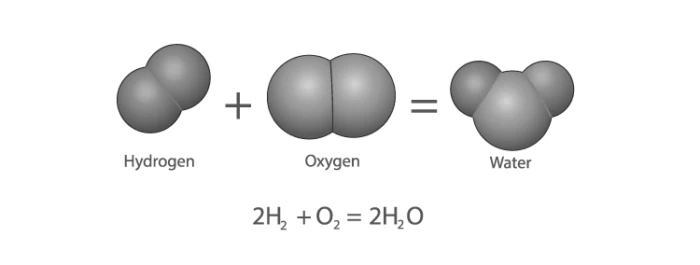
Illustration of Atoms and Molecules
Example: Calculating Atomic Mass
Consider an atom with 15 protons and 16 neutrons. Calculate its atomic mass.
Solution:
The atomic mass is the total number of protons and neutrons:
\[ \text{Atomic Mass} = 15 + 16 = 31 \text{ u} \]
Therefore, the atomic mass of this atom is 31 atomic mass units (u).
Estimating Atomic Dimensions and Structure
The size of an atom is extraordinarily small, far beyond direct observation. When millions of atoms are stacked, they can form a layer as thin as a sheet of paper. The atomic radius, which is the distance from the nucleus to the outermost electron shell, is typically measured in nanometers (nm), where \(1 \text{ m} = 10^{9} \text{ nm}\).
Atoms consist mainly of empty space, with most of their mass concentrated in the nucleus. Electrons orbit the nucleus in shells or energy levels, and the arrangement of these electrons determines the atom's chemical behavior.
Example: Converting Atomic Radius Units
An atom has an atomic radius of 0.15 nm. Express this radius in meters.
Solution:
Using the conversion \(1 \text{ m} = 10^{9} \text{ nm}\),
\[ 0.15 \text{ nm} = 0.15 \times 10^{-9} \text{ m} = 1.5 \times 10^{-10} \text{ m} \]
Thus, the atomic radius is \(1.5 \times 10^{-10} \text{ m}\).
Dalton’s Atomic Theory: Key Principles
Dalton’s atomic theory laid the foundation for modern chemistry by proposing that matter is composed of indivisible atoms. Key points include:
Atoms are the smallest units of matter and cannot be created or destroyed in chemical reactions.
All atoms of a given element are identical in mass and properties, while atoms of different elements differ.
Atoms combine in simple whole-number ratios to form compounds.
Example: Applying Dalton’s Theory
Explain why water (H₂O) always has two hydrogen atoms for every oxygen atom.
Answer:
According to Dalton’s theory, atoms combine in fixed whole-number ratios.
Water molecules consist of two hydrogen atoms bonded to one oxygen atom.
This fixed ratio ensures water’s consistent chemical properties.
Exploring Molecules and Their Formation
What Constitutes a Molecule?
A molecule is the smallest unit of a compound that retains the chemical properties of that compound. It consists of two or more atoms bonded together through chemical bonds, typically by sharing electrons. The concept of valency describes an element’s ability to combine with others, determined by the number of electrons in its outer shell.
Atoms within a molecule are held together by forces such as covalent bonds, where electrons are shared, or ionic bonds, where electrons are transferred. Molecules can be composed of identical atoms, like oxygen (O₂), or different atoms, like water (H₂O).
Representation of Molecular Structures
Example: Identifying Molecules
Determine whether the following are molecules: N₂, NaCl, and C₆H₁₂O₆.
Solution:
N₂: Two nitrogen atoms bonded covalently; it is a molecule.
NaCl: Ionic compound formed by sodium and chlorine ions; not a molecule but a compound.
C₆H₁₂O₆: Glucose molecule composed of carbon, hydrogen, and oxygen atoms bonded covalently; it is a molecule.
Examples and Characteristics of Common Molecules
Some familiar molecules include:
Water (H₂O)
Nitrogen (N₂)
Ozone (O₃)
Calcium oxide (CaO)
Glucose (C₆H₁₂O₆)
Table salt (NaCl) – an ionic compound, not a molecule
These molecules differ in complexity and bonding types but all represent the smallest units retaining their compound’s properties.
Examples of Different Molecules
Example: Molecular Composition
Explain why glucose (C₆H₁₂O₆) is considered a molecule despite containing multiple elements.
Answer:
Glucose consists of carbon, hydrogen, and oxygen atoms bonded covalently.
The atoms form a stable, discrete unit with specific chemical properties.
Thus, glucose is a molecule representing a compound with multiple elements.
Interactions Between Atoms and Molecules
Atoms and molecules interact through forces arising from electron transfer or sharing. For example, in sodium fluoride (NaF), the sodium atom donates an electron to fluorine, resulting in positively charged sodium ions and negatively charged fluoride ions. These oppositely charged ions attract each other strongly through electrostatic forces, forming an ionic bond.
The strength of these forces depends on the distance between ions and follows Coulomb’s law, where the force varies inversely with the square of the distance between charges.
Ionic Bond Formation in Sodium Fluoride
Example: Calculating Ionic Force
Calculate the electrostatic force between a sodium ion (+1 charge) and a fluoride ion (-1 charge) separated by a distance of \(2 \times 10^{-10} \text{ m}\). Use Coulomb’s law:
\[ F = k \frac{|q_1 q_2|}{r^2} \]
where \(k = 8.99 \times 10^9 \text{ Nm}^2/\text{C}^2\), \(q_1 = +1.6 \times 10^{-19} \text{ C}\), \(q_2 = -1.6 \times 10^{-19} \text{ C}\), and \(r = 2 \times 10^{-10} \text{ m}\).
Solution:
\[ F = 8.99 \times 10^9 \times \frac{(1.6 \times 10^{-19})^2}{(2 \times 10^{-10})^2} = 8.99 \times 10^9 \times \frac{2.56 \times 10^{-38}}{4 \times 10^{-20}} = 8.99 \times 10^9 \times 6.4 \times 10^{-19} = 5.75 \times 10^{-9} \text{ N} \]
The electrostatic force between the ions is approximately \(5.75 \times 10^{-9} \text{ N}\).
Summary and Key Concepts
Term | Definition |
|---|---|
Atom | Smallest unit of matter retaining chemical properties of an element. |
Molecule | Smallest unit of a compound made of two or more atoms bonded chemically. |
Proton | Positively charged particle in the nucleus of an atom. |
Neutron | Neutral particle in the nucleus contributing to atomic mass. |
Electron | Negatively charged particle orbiting the nucleus in shells. |
Atomic Number | Number of protons in an atom’s nucleus. |
Atomic Mass | Sum of protons and neutrons in the nucleus, measured in atomic mass units. |
Valency | Combining capacity of an element based on electrons in outer shell. |
Covalent Bond | Bond formed by sharing electrons between atoms. |
Ionic Bond | Bond formed by transfer of electrons creating charged ions. |
Glossary of Important Terms
Term | Meaning |
|---|---|
Atom | Basic unit of matter with chemical properties of an element. |
Molecule | Group of atoms bonded together representing a compound. |
Proton | Positively charged particle in the atomic nucleus. |
Neutron | Neutral particle in the nucleus contributing to mass. |
Electron | Negatively charged particle orbiting the nucleus. |
Atomic Number | Number of protons in an atom’s nucleus. |
Atomic Mass Unit (amu) | Unit to express atomic mass, defined relative to carbon-12. |
Valency | Element’s ability to combine with others based on outer electrons. |
Covalent Bond | Bond formed by sharing electrons between atoms. |
Ionic Bond | Bond formed by electron transfer creating charged ions. |
Frequently Asked Questions
How do atoms combine to form molecules?
Atoms form molecules by sharing or exchanging electrons through chemical bonds, primarily involving electrons in their outermost shells.
What distinguishes a molecule from a compound?
A molecule is the smallest unit of a compound with chemical properties, formed by covalent bonds. Compounds can be ionic or molecular; ionic compounds like NaCl are not molecules but consist of ions.
Is ozone considered a molecule?
Yes, ozone (O₃) is a molecule made of three oxygen atoms bonded covalently, possessing distinct chemical properties.
Can a molecule consist of a single atom?
No, molecules are formed by two or more atoms chemically bonded. Single atoms alone do not constitute molecules.
What is the structure of an atom?
An atom has a central nucleus containing protons and neutrons, surrounded by electrons arranged in shells or energy levels.