Understanding the Arrhenius Equation and Its Applications
Fundamentals of the Arrhenius Equation
Defining the Relationship Between Reaction Rate and Temperature
The Arrhenius equation establishes a mathematical link between the rate constant of a chemical reaction, the absolute temperature, and a factor known as the pre-exponential or frequency factor. This factor represents how often reactant molecules collide with the correct orientation to react. The equation reveals how reaction rates depend on temperature changes.
The Arrhenius equation is expressed as:
\[ k = A e^{-\frac{E_a}{RT}} \]
Where:
- k is the rate constant of the reaction.
- A is the pre-exponential factor, indicating the frequency of effective collisions.
- e is Euler’s number, the base of natural logarithms.
- E_a is the activation energy required for the reaction (energy per mole).
- R is the universal gas constant.
- T is the absolute temperature in Kelvin.
If activation energy is given per molecule instead of per mole, the Boltzmann constant replaces the gas constant in the formula. This equation was introduced by Svante Arrhenius in 1889, providing a foundation for understanding temperature effects on reaction rates.

Example Problem
Calculate the rate constant for a reaction with an activation energy of 85 kJ/mol and a pre-exponential factor of 8 M-1s-1 at 350 K.
Given:
- \(E_a = 85\,000 \text{ J/mol}\)
- \(A = 8 \text{ M}^{-1}\text{s}^{-1}\)
- \(T = 350 \text{ K}\)
- \(R = 8.314 \text{ J/mol·K}\)
Using the logarithmic form:
\[ \ln k = \ln A - \frac{E_a}{RT} \]
Calculate each term:
\[ \ln A = \ln 8 \approx 2.08 \]
\[ \frac{E_a}{RT} = \frac{85\,000}{8.314 \times 350} \approx 29.2 \]
Therefore,
\[ \ln k = 2.08 - 29.2 = -27.12 \]
Converting back to \(k\):
\[ k = e^{-27.12} \approx 1.66 \times 10^{-12} \text{ M}^{-1}\text{s}^{-1} \]
The rate constant at 350 K is approximately \(1.66 \times 10^{-12} \text{ M}^{-1}\text{s}^{-1}\).
Visualizing the Arrhenius Equation Through Graphs
Interpreting Rate Constant Variations with Temperature
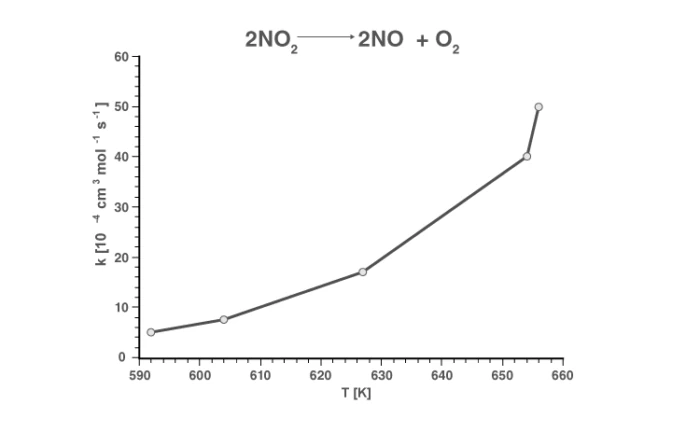
For reactions such as the breakdown of nitrogen dioxide (\(2 \text{NO}_2 \rightarrow 2 \text{NO} + \text{O}_2\)), the rate constant increases as temperature rises. Plotting the rate constant \(k\) against temperature \(T\) shows this trend clearly, demonstrating the temperature dependence of reaction speed.
Arrhenius Plot: A Straight Line Representation
Taking the natural logarithm of the Arrhenius equation transforms it into a linear form:
\[ \ln k = \ln A - \frac{E_a}{RT} \]
Rearranged as:
\[ \ln k = -\frac{E_a}{R} \times \frac{1}{T} + \ln A \]
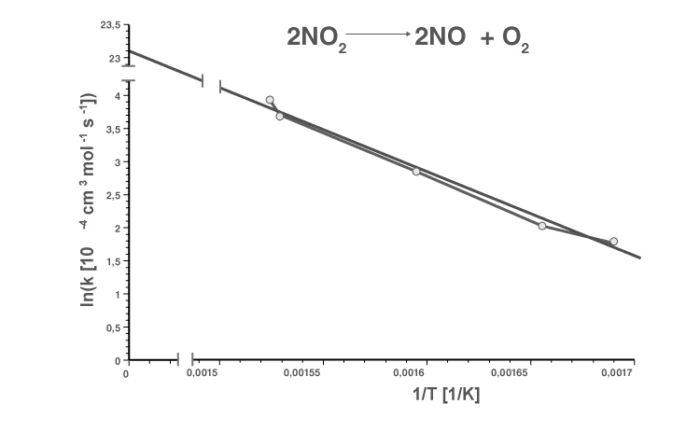
This equation resembles the straight line formula \(y = mx + c\), where:
- \(y = \ln k\)
- \(x = \frac{1}{T}\)
- Slope \(m = -\frac{E_a}{R}\)
- Intercept \(c = \ln A\)
Plotting \(\ln k\) against \(1/T\) yields the Arrhenius plot, which is a straight line. This plot is useful for determining activation energy and the pre-exponential factor experimentally.
Example Problem
Given the rate constants of a reaction at two temperatures, find the activation energy.
Data:
- \(T_1 = 620 \text{ K}\), \(k_1 = 3.0 \times 10^{-8} \text{ M}^{-1}\text{s}^{-1}\)
- \(T_2 = 820 \text{ K}\), \(k_2 = 2.1 \times 10^{-7} \text{ M}^{-1}\text{s}^{-1}\)
- \(R = 8.314 \text{ J/mol·K}\)
Using the formula without \(A\):
\[ \ln \left(\frac{k_1}{k_2}\right) = -\frac{E_a}{R} \left(\frac{1}{T_1} - \frac{1}{T_2}\right) \]
Calculate the left side:
\[ \ln \left(\frac{3.0 \times 10^{-8}}{2.1 \times 10^{-7}}\right) = \ln(0.143) \approx -1.94 \]
Calculate the temperature difference term:
\[ \frac{1}{620} - \frac{1}{820} = 0.001613 - 0.001220 = 0.000393 \text{ K}^{-1} \]
Rearranging for \(E_a\):
\[ E_a = -\frac{R \times \ln(k_1/k_2)}{\frac{1}{T_1} - \frac{1}{T_2}} = -\frac{8.314 \times (-1.94)}{0.000393} \approx 41\,000 \text{ J/mol} \]
The activation energy is approximately 41 kJ/mol.
Influence of Catalysts and the Pre-Exponential Factor
How Catalysts Modify Reaction Rates
Catalysts function by reducing the activation energy required for a reaction to proceed. This reduction is directly incorporated into the Arrhenius equation, resulting in a higher rate constant and thus a faster reaction.
Since the rate constant depends exponentially on \(-E_a/RT\), even a small decrease in activation energy causes a significant increase in the reaction rate. However, catalyzed reactions show less sensitivity to temperature changes compared to uncatalyzed ones because their activation energies are lower.
Understanding the Pre-Exponential Factor \(A\)
The pre-exponential factor \(A\) represents the frequency of collisions with the correct orientation for reaction. It can be expressed as:
\[ A = \rho Z \]
Where:
- \(Z\) is the collision frequency between molecules.
- \(\rho\) is the steric factor, accounting for the orientation of molecules during collisions.
The value of \(A\) varies with the type of reaction and temperature and must be determined experimentally. Its units depend on the reaction order; for example, for a second-order reaction, \(A\) has units of \(\text{L mol}^{-1} \text{s}^{-1}\), while for a first-order reaction, it is \(\text{s}^{-1}\).
Deriving the Arrhenius Equation Without the Pre-Exponential Factor
By comparing rate constants at two temperatures \(T_1\) and \(T_2\) with corresponding rate constants \(k_1\) and \(k_2\), the pre-exponential factor can be eliminated:
\[ \ln k_1 = \ln A - \frac{E_a}{RT_1} \]
\[ \ln k_2 = \ln A - \frac{E_a}{RT_2} \]
Subtracting these gives:
\[ \ln \left(\frac{k_1}{k_2}\right) = \frac{E_a}{R} \left(\frac{1}{T_2} - \frac{1}{T_1}\right) \]
This form is useful for calculating activation energy when rate constants at two temperatures are known.
Example Problem
A reaction has an activation energy of 95 kJ/mol and a pre-exponential factor of 12 s-1. Calculate the rate constant at 320 K.
Given:
- \(E_a = 95\,000 \text{ J/mol}\)
- \(A = 12 \text{ s}^{-1}\)
- \(T = 320 \text{ K}\)
- \(R = 8.314 \text{ J/mol·K}\)
Calculate \(\ln A\):
\[ \ln 12 \approx 2.48 \]
Calculate \(\frac{E_a}{RT}\):
\[ \frac{95\,000}{8.314 \times 320} \approx 35.7 \]
Calculate \(\ln k\):
\[ \ln k = 2.48 - 35.7 = -33.22 \]
Convert to \(k\):
\[ k = e^{-33.22} \approx 3.9 \times 10^{-15} \text{ s}^{-1} \]
The rate constant at 320 K is approximately \(3.9 \times 10^{-15} \text{ s}^{-1}\).
Quick Reference: Key Formulas and Concepts
| Concept | Formula / Description |
|---|---|
| Arrhenius Equation | \(k = A e^{-\frac{E_a}{RT}}\) |
| Logarithmic Form | \(\ln k = \ln A - \frac{E_a}{RT}\) |
| Arrhenius Plot | Plot of \(\ln k\) vs. \(\frac{1}{T}\) is a straight line with slope \(-\frac{E_a}{R}\) |
| Activation Energy from Two Rate Constants | \(\ln \left(\frac{k_1}{k_2}\right) = \frac{E_a}{R} \left(\frac{1}{T_2} - \frac{1}{T_1}\right)\) |
| Pre-exponential Factor | \(A = \rho Z\), where \(\rho\) is steric factor and \(Z\) is collision frequency |
| Effect of Catalyst | Reduces \(E_a\), increasing \(k\) exponentially |
Glossary of Important Terms
| Term | Definition |
|---|---|
| Activation Energy (\(E_a\)) | Minimum energy required for a reaction to occur |
| Rate Constant (\(k\)) | Proportionality constant in the rate equation |
| Pre-exponential Factor (\(A\)) | Frequency of effective collisions between reactants |
| Universal Gas Constant (\(R\)) | Constant relating energy scale to temperature, \(8.314 \text{ J/mol·K}\) |
| Boltzmann Constant (\(k_B\)) | Relates energy per molecule to temperature |
| Steric Factor (\(\rho\)) | Fraction of collisions with correct molecular orientation |
| Collision Frequency (\(Z\)) | Number of collisions per unit time per unit volume |
| Arrhenius Plot | Graph of \(\ln k\) versus \(1/T\) used to find \(E_a\) and \(A\) |
| Catalyst | Substance that lowers activation energy without being consumed |
| Euler’s Number (\(e\)) | Base of natural logarithms, approximately 2.718 |
Frequently Asked Questions
What is the Arrhenius equation and how is it used?
The Arrhenius equation relates the rate constant of a reaction to temperature and activation energy, allowing prediction of how reaction rates change with temperature.
Which principle underlies the Arrhenius equation?
It is based on collision theory, which states that only collisions with sufficient energy and proper orientation lead to reactions.
How does a catalyst affect the Arrhenius equation?
A catalyst lowers the activation energy \(E_a\), increasing the rate constant \(k\) and speeding up the reaction.
What do the terms \(A\) and \(E_a\) represent in the equation?
\(A\) is the pre-exponential factor indicating collision frequency and orientation, while \(E_a\) is the activation energy needed for the reaction.
Why does the rate constant increase exponentially with temperature?
Because the rate constant depends on \(e^{-\frac{E_a}{RT}}\), a small increase in temperature reduces the exponential term’s magnitude, causing \(k\) to rise rapidly.