Comprehensive Overview of Aluminium Sulphate (Al₂(SO₄)₃)
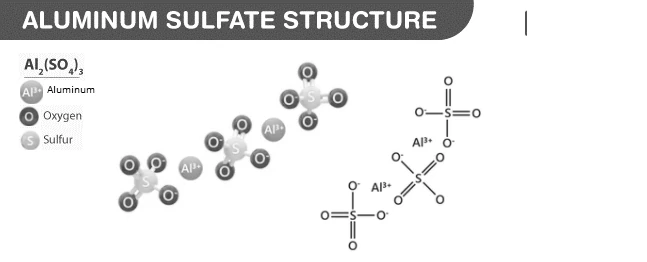
Fundamental Characteristics and Molecular Arrangement of Aluminium Sulphate
Understanding the Molecular Composition and Physical Traits
Aluminium sulphate, chemically represented as Al₂(SO₄)₃, is an inorganic salt widely recognized for its white crystalline appearance in its dry state. When dissolved in water, it forms a clear, colourless solution. This compound is non-flammable and generally considered safe under normal handling conditions. It is soluble in water but does not dissolve in ethanol, and it has no distinct odor. The taste is mildly astringent with a subtle sweetness. However, upon decomposition, it releases harmful sulphur oxide gases, necessitating caution during heating or chemical reactions.
Its aqueous solution exhibits corrosive properties towards aluminium metal, which is important to consider in industrial applications. The compound is typically synthesized by reacting aluminium hydroxide with sulphuric acid under controlled conditions.
Illustrative Problem: Calculating the Molar Mass of Aluminium Sulphate
Determine the molar mass of aluminium sulphate, given the atomic masses: Al = 27 g/mol, S = 32 g/mol, O = 16 g/mol.
Solution:
The formula is \( \mathrm{Al_2(SO_4)_3} \).
Calculate the molar mass as:
\[ 2 \times 27 + 3 \times (32 + 4 \times 16) = 54 + 3 \times (32 + 64) = 54 + 3 \times 96 = 54 + 288 = 342 \text{ g/mol} \]
Therefore, the molar mass of aluminium sulphate is \( 342 \text{ g/mol} \).
Key Properties and Chemical Behavior of Aluminium Sulphate
Physical and Chemical Attributes Explained
Aluminium sulphate is a white, crystalline solid that readily dissolves in water, forming a clear solution. It is odourless and exhibits a slightly acidic taste. The compound is insoluble in organic solvents such as ethanol. When heated or decomposed, it emits toxic sulphur oxide fumes, which require proper ventilation and safety measures.
Its aqueous solutions are corrosive to aluminium metal, which is a critical consideration in storage and handling. The compound is non-combustible and stable under normal conditions, making it suitable for various industrial uses.
Example: Explaining Why Aluminium Sulphate is Water-Soluble
Question: Why does aluminium sulphate dissolve readily in water but not in ethanol?
Answer:
- Aluminium sulphate is an ionic compound composed of charged ions \( \mathrm{Al^{3+}} \) and \( \mathrm{SO_4^{2-}} \).
- Water is a polar solvent with a high dielectric constant, which stabilizes these ions and facilitates dissolution.
- Ethanol, being less polar, cannot effectively separate and stabilize the ions, resulting in poor solubility.
Methods of Synthesizing Aluminium Sulphate
Laboratory and Industrial Preparation Techniques
Aluminium sulphate is commonly prepared by reacting freshly precipitated aluminium hydroxide with sulphuric acid. The resulting solution is then evaporated to crystallize pure aluminium sulphate in forms such as shiny crystals, granules, or powder.
The reaction can be represented as:
\[ 2 \mathrm{Al(OH)_3} + 3 \mathrm{H_2SO_4} \rightarrow \mathrm{Al_2(SO_4)_3} + 6 \mathrm{H_2O} \]
Alternatively, aluminium metal can be directly reacted with sulphuric acid, producing aluminium sulphate and hydrogen gas:
\[ 2 \mathrm{Al} + 3 \mathrm{H_2SO_4} \rightarrow \mathrm{Al_2(SO_4)_3} + 3 \mathrm{H_2} \uparrow \]
Problem: Calculating Hydrogen Gas Volume Produced
Question: If 5 grams of aluminium react completely with excess sulphuric acid, what volume of hydrogen gas at STP is produced? (Atomic mass of Al = 27 g/mol, molar volume of gas at STP = 22.4 L/mol)
Solution:
Calculate moles of aluminium:
\[ n = \frac{5}{27} \approx 0.185 \text{ mol} \]
From the reaction, 2 moles of Al produce 3 moles of \( \mathrm{H_2} \), so moles of hydrogen gas:
\[ n_{\mathrm{H_2}} = 0.185 \times \frac{3}{2} = 0.2775 \text{ mol} \]
Volume of hydrogen gas at STP:
\[ V = 0.2775 \times 22.4 = 6.22 \text{ L} \]
Hence, approximately 6.22 litres of hydrogen gas is generated.
Practical Applications of Aluminium Sulphate in Various Fields
Utilization Across Industries and Environmental Management
Aluminium sulphate serves multiple purposes across different sectors:
- Acts as a coagulating agent in water purification to remove suspended particles.
- Used in paper manufacturing to improve paper quality and sizing.
- Functions as a mordant in textile dyeing and printing processes.
- Employed in gardening to adjust soil pH, making it more acidic.
- Serves as an accelerator and waterproofing additive in concrete production.
- Incorporated in firefighting foams for enhanced fire suppression.
- Applied in sewage treatment to facilitate sedimentation and removal of impurities.
- Used as a fireproofing agent in various materials.

Example: Role of Aluminium Sulphate in Water Treatment
Question: How does aluminium sulphate aid in purifying drinking water?
Answer:
- It acts as a coagulant by neutralizing the negative charges on suspended particles.
- This neutralization causes particles to clump together, forming larger aggregates called flocs.
- These flocs settle down easily, allowing clearer water to be separated.
- This process improves water clarity and removes contaminants effectively.
Quick Reference: Aluminium Sulphate at a Glance
| Aspect | Details |
|---|---|
| Chemical Formula | Al₂(SO₄)₃ |
| Appearance | White crystalline solid (anhydrous), colourless solution (aqueous) |
| Solubility | Soluble in water, insoluble in ethanol |
| Taste & Odour | Mildly astringent, sweet taste; odourless |
| Preparation | Reaction of aluminium hydroxide with sulphuric acid; or aluminium metal with sulphuric acid |
| Uses | Water purification, paper making, dyeing, gardening, concrete additive, firefighting foam, sewage treatment |
| Hazards | Corrosive to aluminium; irritant to skin and eyes; releases toxic sulphur oxides on decomposition |
Glossary of Key Terms Related to Aluminium Sulphate
| Term | Definition |
|---|---|
| Aluminium Hydroxide | A compound with formula Al(OH)₃ used as a precursor in aluminium sulphate synthesis. |
| Coagulation | Process of neutralizing charges on particles to form larger aggregates for easier removal. |
| Flocculation | Aggregation of particles into flocs after coagulation, aiding sedimentation. |
| Polyatomic Ion | An ion composed of multiple atoms bonded together carrying a charge, e.g., sulfate ion \( \mathrm{SO_4^{2-}} \). |
| Corrosive | Substance capable of causing damage to metals or living tissues by chemical action. |
| Hygroscopic | Ability of a substance to absorb moisture from the air. |
| Mordant | A substance used in dyeing to fix dyes on fabrics by forming a coordination complex. |
| pH Adjustment | Process of modifying the acidity or alkalinity of soil or solution. |
| Decomposition | Chemical breakdown of a compound into simpler substances, often releasing gases. |
| STP (Standard Temperature and Pressure) | Reference conditions of 0°C and 1 atm pressure used for gas volume calculations. |
Frequently Asked Questions About Aluminium Sulphate
How is aluminium sulphate typically synthesized in the laboratory?
It is prepared by reacting freshly precipitated aluminium hydroxide with sulphuric acid, followed by evaporation and crystallization to obtain pure aluminium sulphate.
What type of chemical compound is aluminium sulphate?
Aluminium sulphate is an ionic compound consisting of aluminium ions \( \mathrm{Al^{3+}} \) and sulfate ions \( \mathrm{SO_4^{2-}} \).
Is aluminium sulphate hazardous to handle?
It can irritate skin and eyes; ingestion may produce corrosive effects due to sulphuric acid formation. Proper protective equipment is recommended during handling.
Why does aluminium sulphate dissolve in water but not in ethanol?
Its ionic nature allows it to dissolve in polar solvents like water, which stabilize ions, whereas ethanol's lower polarity prevents effective dissolution.
Does aluminium sulphate have any smell?
It is generally odourless but has a slightly acidic taste when dissolved in water.