Comprehensive Overview of Carbon Allotropes and Their Properties
Understanding Carbon's Multiple Physical Forms
Introduction to Carbon Allotropy
Allotropy refers to the ability of an element to exist in more than one distinct physical form, each differing in atomic arrangement. Carbon, with atomic number 6 and symbol 'C', is a prime example exhibiting this phenomenon. Its allotropes are broadly classified into two categories: amorphous and crystalline forms. This versatility arises from carbon's unique capacity to form various oxidation states and coordination numbers, alongside its remarkable ability to catenate, or bond with itself, creating diverse structures.
Carbon's allotropes include well-known forms such as diamond and graphite, as well as less common ones like fullerenes and carbon nanotubes. These allotropes differ significantly in their physical and chemical properties due to variations in atomic bonding and structure.
Example Problem
Explain why carbon exhibits multiple allotropes and how its atomic properties contribute to this behavior.
Solution:
Carbon has four valence electrons allowing it to form four covalent bonds.
Its ability to hybridize in different ways (sp, sp2, sp3) leads to varied bonding geometries.
Catenation enables carbon atoms to link in chains, rings, and networks.
Variable oxidation states and coordination numbers allow diverse structural arrangements.
These factors collectively result in multiple allotropes with distinct properties.
Graphite: The Layered Carbon Structure
Structural Characteristics and Properties of Graphite
Graphite is a naturally occurring allotrope of carbon characterized by its layered, planar structure. Each layer consists of carbon atoms arranged in a hexagonal lattice, where each carbon atom is bonded to three others via strong covalent bonds, adopting an sp2 hybridization. The fourth valence electron forms a delocalized pi bond, allowing electrons to move freely within the layers, which accounts for graphite's electrical conductivity.
The layers are stacked and held together by weak Van der Waals forces, enabling them to slide over each other easily. This property makes graphite soft and slippery, ideal as a lubricant. Graphite exists in two forms: the α-form with an ABAB stacking sequence and the β-form with an ABCABC sequence.
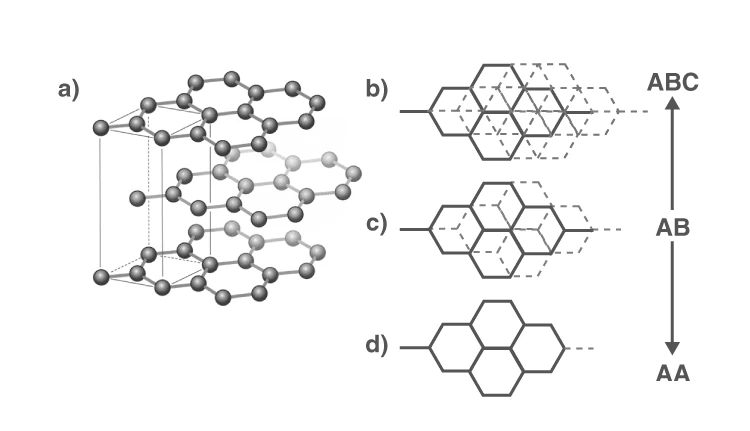
Hexagonal Layered Arrangement of Carbon Atoms in Graphite
Graphite is also a good conductor of heat and electricity due to the mobility of its delocalized electrons. It is widely used as a dry lubricant in high-temperature environments and in manufacturing crucibles resistant to acids and alkalis.
Example Problem
Describe why graphite can conduct electricity and explain the role of its atomic structure in this property.
Solution:
Each carbon atom in graphite is bonded to three others, leaving one electron free.
This free electron forms a delocalized pi bond across the layer.
Delocalized electrons can move freely within the layers, enabling electrical conduction.
Weak interlayer forces allow layers to slide but do not contribute to conduction.
Thus, graphite conducts electricity primarily within its layers.
Diamond: The Hardest Carbon Allotrope
Atomic Arrangement and Physical Traits of Diamond
Diamond represents the purest crystalline form of carbon, where each carbon atom is tetrahedrally bonded to four other carbon atoms through strong covalent bonds, resulting in a three-dimensional network. This sp3 hybridized structure imparts exceptional hardness and rigidity to diamond, making it the hardest known natural material.
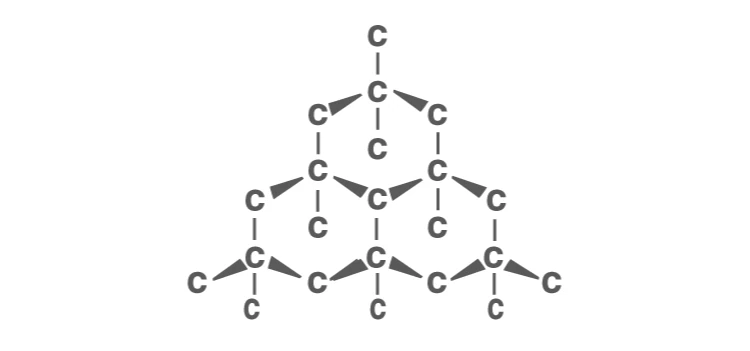
Tetrahedral Carbon Bonding in Diamond Crystal
Due to the extensive covalent bonding, breaking a diamond requires rupturing many strong bonds simultaneously, explaining its remarkable hardness. Diamond also exhibits a high melting point, high density, transparency to X-rays, and a high refractive index. However, it is a poor electrical conductor but an excellent conductor of heat.
Example Problem
Why is diamond an electrical insulator despite being composed of carbon atoms?
Solution:
In diamond, all four valence electrons of carbon form strong covalent bonds (sp3 hybridization).
There are no free or delocalized electrons available to carry charge.
The rigid 3D network restricts electron mobility.
Hence, diamond does not conduct electricity and acts as an insulator.
Additional Carbon Allotropes and Their Unique Features
Exploring Other Forms of Carbon
Beyond graphite and diamond, carbon exists in several other allotropes with fascinating structures and properties:
Lonsdaleite: Also known as hexagonal diamond, it has a hexagonal lattice and shares many properties with diamond.
Graphene: A single layer of carbon atoms arranged in a hexagonal lattice, serving as the fundamental building block for other allotropes like graphite and nanotubes.
Q-carbon: A recently discovered allotrope exhibiting ferromagnetism, exceptional hardness, and brightness surpassing diamond.
Carbyne: A linear chain of carbon atoms with alternating single and triple bonds.
Fullerenes: Spherical molecules composed of carbon atoms arranged in pentagons and hexagons, such as C60, resembling a soccer ball.
Carbon Nanotubes: Cylindrical nanostructures formed by rolling graphene sheets, notable for their strength and electrical properties.
Amorphous Carbon: Carbon without a crystalline structure, including charcoal and soot.
Illustration of Diverse Carbon Allotropes
Example Problem
List three carbon allotropes other than diamond and graphite and mention one unique property of each.
Solution:
Fullerenes: Spherical molecules with cage-like structures, soluble in some solvents.
Carbon Nanotubes: Cylindrical nanostructures with exceptional tensile strength.
Graphene: Single atomic layer with extraordinary electrical conductivity.
Silicates: Carbon-Related Tetrahedral Structures
Classification and Structural Variations of Silicates
Silicates are compounds formed by fusing alkali oxides with silicon dioxide (SiO2), featuring silicon atoms tetrahedrally coordinated to oxygen atoms. Silicon in silicates is sp3 hybridized, and these structures are categorized based on how the tetrahedral units connect:
Orthosilicates: Contain isolated SiO4 tetrahedra, e.g., Willemite (Zn2SiO4).
Pyrosilicates: Two tetrahedra linked by one oxygen atom, e.g., Thortveite (Sc2[Si2O7]).
Cyclic Silicates: Tetrahedra form ring structures sharing two oxygen atoms, e.g., Beryl (Be3Al2Si6O18).
Chain Silicates: Linear chains of tetrahedra sharing oxygen atoms, subdivided into:
Metasilicates: Single chains, e.g., Spodumene (NaAl(SiO3)2).
Amphiboles: Double chains linked by shared oxygen atoms, e.g., Asbestos (Ca2Mg5Si8O22(OH)2).
Two-Dimensional Silicates: Sheets formed by sharing three oxygen atoms, e.g., Mica.
Three-Dimensional Silicates: Networks where all oxygen atoms are shared, e.g., Zeolites.
Example Problem
Differentiate between orthosilicates and chain silicates with examples.
Solution:
Orthosilicates: Contain isolated SiO4 tetrahedra not linked to others; example: Willemite.
Chain Silicates: Tetrahedra linked in linear chains by sharing oxygen atoms; example: Spodumene.
Orthosilicates have discrete units, while chain silicates form extended structures.
Quick Reference: Summary of Carbon Allotropes
Allotrope | Structure | Hybridization | Key Properties | Uses |
|---|---|---|---|---|
Graphite | Layered hexagonal sheets | sp2 | Soft, conducts electricity, lubricant | Lubricants, electrodes, crucibles |
Diamond | 3D tetrahedral network | sp3 | Hardest, insulator, high melting point | Jewelry, cutting tools, heat sinks |
Fullerenes (C60) | Spherical cage-like molecules | sp2 | Soluble, unique electronic properties | Nanotechnology, drug delivery |
Carbon Nanotubes | Cylindrical tubes | sp2 | High strength, electrical conductivity | Electronics, materials science |
Graphene | Single atomic layer | sp2 | Excellent conductivity, strength | Electronics, sensors |
Glossary of Key Terms
Term | Definition |
|---|---|
Allotropy | The existence of an element in more than one physical form with different atomic arrangements. |
Catenation | The ability of an element to form bonds with itself, creating chains or rings. |
sp2 Hybridization | Mixing of one s and two p orbitals to form three equivalent orbitals in a plane. |
sp3 Hybridization | Mixing of one s and three p orbitals to form four equivalent orbitals in a tetrahedral geometry. |
Van der Waals Forces | Weak intermolecular forces between molecules or layers. |
Fullerenes | Spherical carbon molecules composed of pentagons and hexagons. |
Graphene | A single layer of carbon atoms arranged in a hexagonal lattice. |
Silicates | Compounds containing silicon and oxygen tetrahedra, often combined with metals. |
Orthosilicates | Silicates with isolated SiO4 tetrahedra. |
Pyrosilicates | Silicates with two tetrahedra linked by an oxygen atom. |
Frequently Asked Questions
What does allotropy mean in chemistry?
Allotropy is the phenomenon where an element exists in two or more different physical forms with distinct atomic arrangements.
Can you name some common allotropes of carbon?
Common carbon allotropes include diamond, graphite, fullerenes, graphene, and carbon nanotubes.
Which carbon allotropes are solid at room temperature?
Diamond and graphite are solid allotropes of carbon at room temperature.
Why is diamond considered the hardest natural material?
Diamond's hardness arises from its strong three-dimensional covalent bonding network where each carbon atom is tetrahedrally bonded to four others.
Does diamond conduct electricity?
No, diamond is an electrical insulator because it lacks free electrons for conduction.