Comprehensive Guide to Alkaline Earth Metals
Fundamental Characteristics of Group 2 Elements
Defining Alkaline Earth Metals and Their Electronic Structure
Alkaline earth metals belong to the second group of the periodic table and include beryllium, magnesium, calcium, strontium, barium, and radium. These elements share a common valence shell electronic configuration of \( ns^2 \), where \( n \) represents the principal quantum number corresponding to their period. This configuration results in their tendency to lose two electrons, forming divalent cations with a charge of +2, which is their most stable oxidation state.
Physically, these metals are silvery-white solids with a shiny luster and exhibit considerable reactivity, though less than alkali metals. Their chemical and physical properties show gradual changes down the group due to increasing atomic size and nuclear charge.
Example Problem
Explain why alkaline earth metals generally exhibit a +2 oxidation state and describe the electronic configuration that leads to this behavior.
Solution:
Alkaline earth metals have two electrons in their outermost s-orbital (\( ns^2 \)).
They tend to lose these two valence electrons to achieve a stable noble gas configuration.
Loss of two electrons results in a \( +2 \) charge on the ion, which is energetically favorable.
This explains why the common oxidation state for these metals is +2.
Physical Traits and Trends in Alkaline Earth Metals
Variation in Atomic and Ionic Sizes and Density
As we move down the group, the atomic and ionic radii of alkaline earth metals increase due to the addition of electron shells. Despite this increase, their radii remain smaller than those of alkali metals in the same period because of the higher nuclear charge. The ionic radius is always smaller than the atomic radius because of the loss of electrons and resulting stronger attraction between the nucleus and remaining electrons.
Alkaline earth metals are denser and harder than alkali metals. This is attributed to their smaller atomic size and the presence of two valence electrons, which contribute to stronger metallic bonding. Density generally rises from magnesium to radium, with calcium being an exception, having the lowest density among them.
Example Problem
Arrange the following alkaline earth metals in order of increasing atomic radius: Calcium (Ca), Magnesium (Mg), Barium (Ba), and Strontium (Sr).
Solution:
Atomic radius increases down the group due to added electron shells:
\[ \text{Mg} < \text{Ca} < \text{Sr} < \text{Ba} \]
Ionization Energies and Their Impact on Reactivity
Alkaline earth metals have two ionization energies corresponding to the removal of their two valence electrons. The first ionization energy is higher than that of alkali metals because of smaller atomic size and a fully filled s-subshell, which is relatively stable. The second ionization energy is even higher but still lower than the second ionization energy of alkali metals.
Despite these high ionization energies, the metals readily lose both electrons due to the energy gained from lattice formation and hydration in compounds. Ionization energy decreases down the group as atomic size increases and valence electrons are shielded more effectively.
Example Problem
Compare the first ionization energies of beryllium and calcium and explain the trend.
Solution:
Beryllium has a smaller atomic radius and higher nuclear charge per electron, resulting in a stronger attraction on valence electrons.
Calcium has a larger atomic radius and more electron shielding, making its valence electrons easier to remove.
Therefore, \( IE_{\text{Be}} > IE_{\text{Ca}} \).
Chemical Behavior and Reactions of Alkaline Earth Metals
Interaction with Hydrogen and Formation of Hydrides
Beryllium and magnesium form covalent hydrides characterized by three-center two-electron bonds, often called “banana bonds.” These hydrides are distinct from the metallic hydrides formed by calcium, strontium, and barium, which contain hydride ions (\( H^- \)).
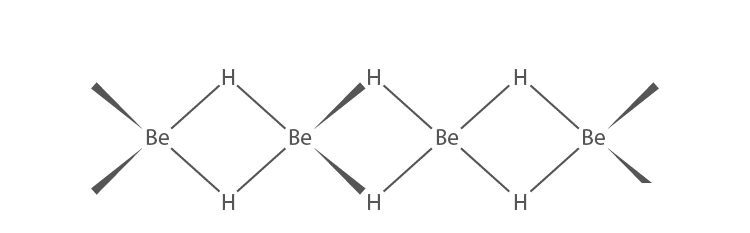
Covalent hydrides of beryllium and magnesium showing banana bonds
Metallic hydrides react vigorously with water to release hydrogen gas, for example:
\[ \text{CaH}_2 + 2 \text{H}_2\text{O} \rightarrow \text{Ca(OH)}_2 + \text{H}_2 \]
Calcium hydride reacting with water to produce hydrogen gas
Example Problem
Write the balanced chemical equation for the reaction of strontium hydride with water and describe the products formed.
Solution:
Strontium hydride reacts with water as follows:
\[ \text{SrH}_2 + 2 \text{H}_2\text{O} \rightarrow \text{Sr(OH)}_2 + 2 \text{H}_2 \]
Strontium hydroxide (\( \text{Sr(OH)}_2 \)) is formed as a strong base.
Hydrogen gas (\( \text{H}_2 \)) is released.
Reactions with Water and Ammonia
Beryllium is unique among alkaline earth metals as it does not react with water, even at elevated temperatures. Magnesium reacts only with hot water, forming magnesium hydroxide and hydrogen gas, but a protective oxide layer limits further reaction. Other members of the group react readily with cold water, liberating hydrogen.
When dissolved in liquid ammonia, alkaline earth metals form solvated electrons and cations, producing electrically conductive, paramagnetic solutions that appear blue or bronze depending on concentration. These solutions eventually decompose to amides, ammonia, and hydrogen gas.
Example Problem
Describe the color changes observed when calcium dissolves in liquid ammonia and explain the species responsible.
Solution:
Initially, the solution turns blue due to solvated electrons.
At higher concentrations, the color changes to bronze.
These colors arise from the presence of free electrons and metal-ammonia complexes.
Distinctive Properties of Beryllium
Beryllium exhibits anomalous behavior compared to other alkaline earth metals due to its small atomic size, high ionization energy, and strong polarizing power. It is the hardest metal in the group, resists reaction with water and acids, and forms amphoteric oxides and hydroxides. Unlike others, beryllium forms carbides that yield methane upon hydrolysis and does not react with atmospheric nitrogen or oxygen under normal conditions.
Sample of beryllium metal illustrating its unique properties
Example Problem
Explain why beryllium oxide is amphoteric while other alkaline earth metal oxides are predominantly basic.
Solution:
Beryllium oxide has significant covalent character due to the small size and high charge density of Be\(^{2+}\).
This covalency allows it to react with both acids and bases, showing amphoteric behavior.
Other oxides are more ionic and react mainly as bases.
Applications and Extraction of Alkaline Earth Metals
Calcium Compounds and Their Industrial Uses
Calcium carbonate is abundant in nature as limestone, marble, and chalk. It is purified by dissolving in hydrochloric acid, removing impurities with ammonia, and precipitating with ammonium carbonate. Heating calcium carbonate produces quick lime (calcium oxide), which reacts exothermically with water to form slaked lime (calcium hydroxide), widely used in construction and water treatment.
Plaster of Paris, derived from heating gypsum (calcium sulfate dihydrate), is used in medical casts and decorative work. It sets quickly upon mixing with water and hardens into a solid mass.
Example Problem
Write the chemical equation for the thermal decomposition of calcium carbonate and the subsequent reaction of calcium oxide with water.
Solution:
Thermal decomposition:
\[ \text{CaCO}_3 \xrightarrow{\Delta} \text{CaO} + \text{CO}_2 \]
Reaction with water:
\[ \text{CaO} + \text{H}_2\text{O} \rightarrow \text{Ca(OH)}_2 \]
Extraction Techniques for Magnesium
Magnesium is extracted primarily from ores such as magnesite (\( \text{MgCO}_3 \)), dolomite (\( \text{CaMg(CO}_3)_2 \)), and carnallite (\( \text{KCl} \cdot \text{MgCl}_2 \cdot 6\text{H}_2\text{O} \)). Due to their low electrode potentials, alkaline earth metals are obtained by electrolyzing fused chlorides. Additives like alkali metal chlorides and fluorides lower the melting point of the mixture, facilitating electrolysis. During extraction, a reducing atmosphere is maintained to prevent oxidation.
Example Problem
Explain why electrolysis of fused magnesium chloride is preferred over chemical reduction for magnesium extraction.
Solution:
Magnesium has a very low electrode potential, making chemical reduction difficult and inefficient.
Electrolysis allows direct extraction of magnesium metal from molten chloride.
It produces high purity magnesium and is economically viable on an industrial scale.
Summary Table: Key Properties of Alkaline Earth Metals
Property | Trend Down the Group | Notes |
|---|---|---|
Atomic Radius | Increases | Due to addition of electron shells |
Ionization Energy | Decreases | Valence electrons are more shielded |
Density | Generally increases | Calcium is an exception with lowest density |
Reactivity with Water | Increases | Beryllium unreactive; others react more readily |
Oxide Nature | Basicity increases | Beryllium oxide is amphoteric |
Flame Color | Varies | Ca: brick red, Sr: crimson, Ba: apple green |
Glossary of Important Terms
Term | Definition |
|---|---|
Alkaline Earth Metals | Elements in group 2 of the periodic table with valence configuration \( ns^2 \). |
Ionization Energy | Energy required to remove an electron from an atom or ion. |
Hydride | Compound formed between hydrogen and a metal. |
Amphoteric | Substance that can react both as an acid and a base. |
Lattice Energy | Energy released when ions form a crystalline lattice. |
Polarizing Power | Ability of a cation to distort the electron cloud of an anion. |
Banana Bond | A three-center two-electron bond found in some covalent hydrides. |
Electrolysis | Process of using electric current to drive a non-spontaneous chemical reaction. |
Flame Test | Analytical technique to identify elements based on flame color. |
Solvation | Interaction of solvent molecules with dissolved ions or molecules. |
Frequently Asked Questions
Which elements are classified as alkaline earth metals?
Group 2 elements including beryllium, magnesium, calcium, strontium, barium, and radium are known as alkaline earth metals.
What is the typical oxidation state of alkaline earth metals in compounds?
They commonly exhibit a +2 oxidation state by losing their two valence electrons.
Why are these metals called alkaline earth metals?
Because their oxides produce alkaline (basic) solutions when dissolved in water and they are found in the earth's crust.
What are the general physical properties of alkaline earth metals?
They are silvery-white, lustrous, relatively hard metals with higher densities and melting points than alkali metals.
Is copper an alkaline earth metal?
No, copper is a transition metal and does not belong to the alkaline earth metals group.