Understanding Adsorption Isotherms and Their Applications
Fundamentals of Adsorption Isotherms
Concept and Significance of Adsorption Isotherms
An adsorption isotherm illustrates how the quantity of a substance adsorbed onto a solid surface varies with pressure while maintaining a constant temperature. This graphical representation is crucial for analyzing adsorption processes, especially in environmental science and material engineering.
According to Le Chatelier’s principle, when pressure increases, the equilibrium shifts to reduce the number of gas molecules, favoring adsorption. The graph typically plateaus at a saturation pressure, beyond which no additional adsorption occurs due to limited surface sites.
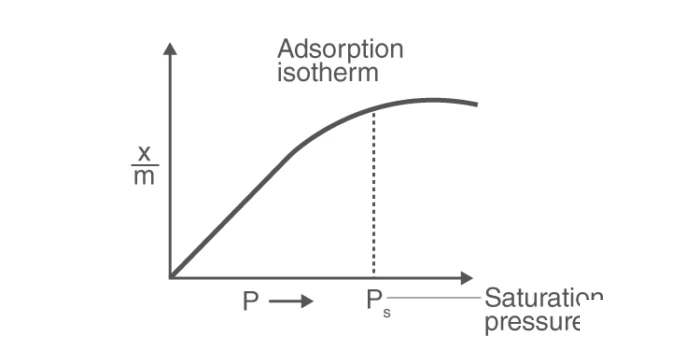
Graphical representation of an adsorption isotherm
Several models describe adsorption isotherms, including the Freundlich, Langmuir, and BET isotherms, each explaining different adsorption behaviors.
Example: Consider a gas adsorbing onto a solid surface at constant temperature. If the pressure is increased from 1 atm to 3 atm, explain qualitatively how the adsorption amount changes and why it eventually saturates.
Solution: Initially, as pressure rises, more gas molecules collide with and adhere to the surface, increasing adsorption. However, once all adsorption sites are occupied, further pressure increase does not enhance adsorption, leading to saturation.
Freundlich Adsorption Isotherm Explained
Understanding the Freundlich Model
The Freundlich isotherm describes how the amount of gas adsorbed per unit mass of adsorbent varies with pressure at a fixed temperature. It is an empirical relationship suitable for heterogeneous surfaces and multilayer adsorption.
The Freundlich equation is expressed as:
\[ \frac{x}{m} = k P^{1/n} \]
Here, \(x\) is the mass of gas adsorbed, \(m\) is the mass of adsorbent, \(P\) is the pressure, and \(k\) and \(n\) are constants dependent on the adsorbent-adsorbate system and temperature, with \(n > 1\).
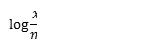
Mathematical form of Freundlich isotherm
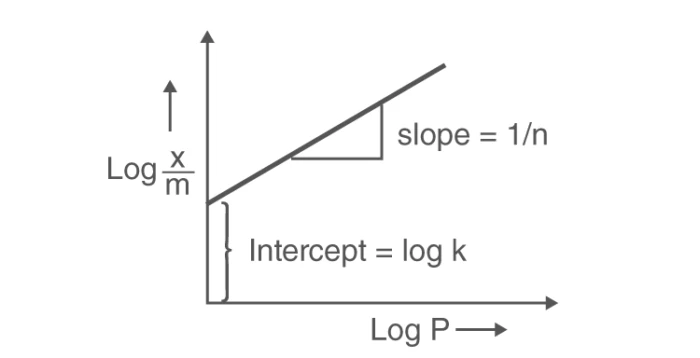
Taking logarithms on both sides yields a linear form:
\[ \log \frac{x}{m} = \log k + \frac{1}{n} \log P \]
Linear plot of Freundlich isotherm in log-log scale
Typical Freundlich adsorption isotherm curve
Example: For an adsorbent, the Freundlich constants are \(k = 0.5\) and \(n = 2\). Calculate the amount adsorbed per gram of adsorbent at a pressure of 4 atm.
Solution: Using the Freundlich equation,
\[ \frac{x}{m} = k P^{1/n} = 0.5 \times 4^{1/2} = 0.5 \times 2 = 1.0 \text{ units} \]
Thus, 1.0 unit of gas is adsorbed per gram of adsorbent at 4 atm.
Langmuir Adsorption Isotherm and Its Characteristics
Principles Behind the Langmuir Model
The Langmuir isotherm models adsorption assuming monolayer coverage on a uniform surface with no interaction between adsorbed molecules. It predicts a linear increase in adsorption at low pressures and saturation at high pressures.
The Langmuir equation is:
\[ \theta = \frac{K p}{1 + K p} \]
where \( \theta \) is the fraction of surface sites occupied, \(K\) is the adsorption equilibrium constant, and \(p\) is the pressure.
The constant \(K\) is the ratio of adsorption to desorption rate constants:
\[ K = \frac{k_a}{k_d} \]
Example: If the adsorption constant \(K = 0.8 \text{ atm}^{-1}\), calculate the surface coverage \( \theta \) at a pressure of 2 atm.
Solution: Substitute values into the Langmuir equation:
\[ \theta = \frac{0.8 \times 2}{1 + 0.8 \times 2} = \frac{1.6}{1 + 1.6} = \frac{1.6}{2.6} \approx 0.615 \]
So, approximately 61.5% of the surface is covered by adsorbed molecules at 2 atm.
BET Theory: Multilayer Adsorption Explained
Overview of the BET Adsorption Model
The BET (Brunauer, Emmett, and Teller) theory extends adsorption analysis to multilayer adsorption, assuming uniform adsorption sites and no interaction between layers. After the first monolayer forms, additional layers can adsorb on top, leading to multilayer coverage.
The BET equation is:
\[ \frac{P}{V (P_0 - P)} = \frac{1}{V_m C} + \frac{C - 1}{V_m C} \times \frac{P}{P_0} \]
where \(P\) is the equilibrium pressure, \(P_0\) is the saturation pressure, \(V\) is the volume adsorbed at pressure \(P\), \(V_m\) is the monolayer adsorbed gas volume, and \(C\) is a constant related to adsorption energy.
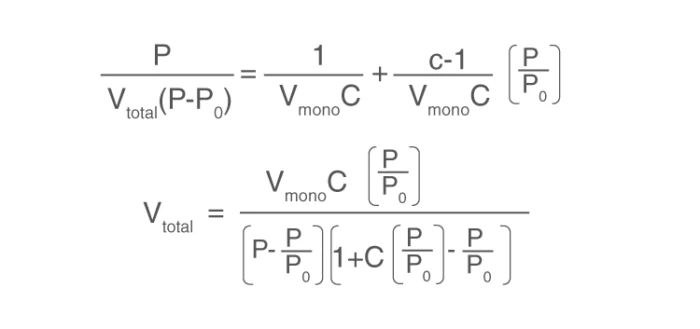
BET adsorption isotherm illustrating multilayer adsorption
Example: Given \(V = 10 \text{ cm}^3\), \(P = 0.4 \text{ atm}\), \(P_0 = 1 \text{ atm}\), \(V_m = 20 \text{ cm}^3\), and \(C = 50\), calculate the left side of the BET equation.
Solution: Compute numerator and denominator:
\[ \frac{P}{V (P_0 - P)} = \frac{0.4}{10 \times (1 - 0.4)} = \frac{0.4}{10 \times 0.6} = \frac{0.4}{6} \approx 0.0667 \]
This value can be used to plot the BET linear graph for further analysis.
Practical Uses of Adsorption in Daily Life and Industry
Key Applications of Adsorption Phenomena
Adsorption plays a vital role in various practical applications, including:
Gas Masks: Toxic gases are trapped on the mask’s surface, protecting users such as miners from harmful exposure.
Vacuum Production: Charcoal adsorbs residual air molecules, aiding in creating a vacuum in devices.
Moisture Control: Silica gel packets adsorb moisture in pharmaceuticals and packaging to maintain dryness.
Color Removal: Animal charcoal is used to remove color impurities from sugarcane juice, clarifying the liquid.
Catalysis: Adsorbents serve as catalysts by holding reactants on their surface, accelerating chemical reactions.
Illustration of adsorption applications in industry and health
Example: Explain how silica gel packets help in preserving medicines.
Solution:
Silica gel adsorbs moisture from the surrounding air.
This prevents humidity-induced degradation of medicines.
Maintains the efficacy and shelf life of pharmaceutical products.
Quick Reference: Summary of Adsorption Isotherms
Isotherm Type | Key Assumptions | Mathematical Form | Adsorption Type |
|---|---|---|---|
Freundlich | Heterogeneous surface, multilayer adsorption | \( \frac{x}{m} = k P^{1/n} \) | Multilayer, empirical |
Langmuir | Monolayer, uniform sites, no interaction | \( \theta = \frac{K p}{1 + K p} \) | Monolayer adsorption |
BET | Multilayer, uniform sites, no lateral interaction | \( \frac{P}{V (P_0 - P)} = \frac{1}{V_m C} + \frac{C - 1}{V_m C} \frac{P}{P_0} \) | Multilayer physisorption |
Glossary of Key Terms
Term | Definition |
|---|---|
Adsorption | The adhesion of molecules from a gas or liquid onto a solid surface. |
Adsorbate | The substance that is adsorbed onto the surface. |
Adsorbent | The solid material on which adsorption occurs. |
Isotherm | A curve representing adsorption at constant temperature. |
Monolayer | A single layer of adsorbed molecules on a surface. |
Multilayer Adsorption | Adsorption involving multiple layers of molecules on the surface. |
Equilibrium Constant (K) | Ratio of adsorption to desorption rate constants. |
Saturation Pressure (\(P_0\)) | The pressure at which the surface becomes fully covered with adsorbate. |
Physisorption | Adsorption due to weak van der Waals forces. |
Chemisorption | Adsorption involving chemical bond formation. |
Frequently Asked Questions
What is the main purpose of adsorption?
Adsorption helps in accumulating molecules from gases or liquids onto solid surfaces, forming a thin film that can be used for purification, catalysis, or moisture control.
Why are adsorption isotherms important?
They provide insight into how adsorption varies with pressure at constant temperature, helping to design and optimize adsorption-based processes.
Which factors influence the extent of adsorption?
Temperature, surface area of adsorbent, pressure, nature of adsorbate and adsorbent, and pore volume all affect adsorption capacity.
Does adsorption increase with temperature?
Generally, adsorption decreases with temperature for physical adsorption but may increase for chemisorption due to activation energy requirements.
What principle governs the adsorption process?
Adsorption is governed by the tendency of molecules to adhere to surfaces to minimize system energy, often explained by Le Chatelier’s principle in equilibrium contexts.