Fundamentals of Molecular Inheritance and Genetic Information
DNA Architecture and Its Role in Genetic Transmission
Understanding the Molecular Blueprint of Life
Deoxyribonucleic acid (DNA) serves as the hereditary material in all living beings, encoding the instructions necessary for life. It is a long chain polymer composed of repeating units called deoxyribonucleotides. The length of a DNA molecule varies depending on the number of nucleotide pairs it contains.
James Watson and Francis Crick introduced the iconic double helix model of DNA, inspired by X-ray crystallography data. Each DNA strand is a polymer made up of nucleotides, each consisting of a deoxyribose sugar, a nitrogenous base, and a phosphate group.
The central dogma of molecular biology explains the flow of genetic information: DNA is transcribed into RNA, which is then translated into proteins.
The DNA double helix resembles a twisted ladder, where two strands are connected by hydrogen bonds between nitrogenous bases. Purine bases always pair with pyrimidine bases: adenine (A) pairs with thymine (T), and guanine (G) pairs with cytosine (C).
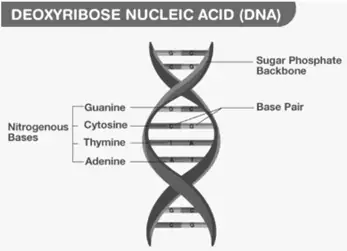
Illustration of DNA double helix structure
Example: Calculating the Number of Hydrogen Bonds in a DNA Segment
Consider a DNA fragment containing 150 base pairs, where 60% of the bases are adenine-thymine pairs and the rest are guanine-cytosine pairs. Calculate the total number of hydrogen bonds in this segment.
Solution:
Number of A-T pairs = \( 0.60 \times 150 = 90 \)
Number of G-C pairs = \( 150 - 90 = 60 \)
Each A-T pair forms 2 hydrogen bonds, and each G-C pair forms 3 hydrogen bonds.
Total hydrogen bonds = \( (90 \times 2) + (60 \times 3) = 180 + 180 = 360 \)
Therefore, the DNA segment has 360 hydrogen bonds holding the strands together.
Composition and Structure of Polynucleotides
A nucleotide, the building block of nucleic acids, comprises three components: a nitrogenous base, a sugar molecule, and a phosphate group. Nitrogenous bases are categorized into purines (adenine and guanine) and pyrimidines (cytosine and thymine).
The sugar in DNA is deoxyribose, a pentose sugar, while in RNA it is ribose. The phosphate group links nucleotides together, forming the backbone of the polynucleotide chain.
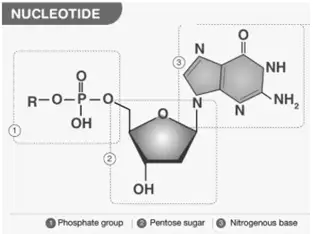
Together, these three parts make one nucleotide unit. Many nucleotides link together to form nucleic acids which store and transmit genetic information.
Detailed structure of a nucleotide
Example: Identifying Components of a Nucleotide
Given a nucleotide with the base guanine, identify its sugar and phosphate components and explain their roles.
Solution:
The sugar is deoxyribose, a five-carbon sugar that forms the backbone of DNA.
The phosphate group connects the 5' carbon of one sugar to the 3' carbon of the next, creating the sugar-phosphate backbone.
Guanine is the nitrogenous base that pairs with cytosine via hydrogen bonds.
Thus, the nucleotide consists of guanine, deoxyribose sugar, and a phosphate group, each essential for DNA structure and function.
Genes: The Functional Units of Heredity
A gene is a segment of DNA that acts as the fundamental unit of inheritance. In eukaryotic organisms, DNA contains both coding regions called exons and non-coding regions called introns. During RNA processing, introns are removed, and exons are joined to form mature RNA.
RNA, or ribonucleic acid, is a single-stranded nucleic acid that carries genetic instructions from DNA to the cellular machinery responsible for protein synthesis. The three main types of RNA are:
Messenger RNA (mRNA)
Transfer RNA (tRNA)
Ribosomal RNA (rRNA)
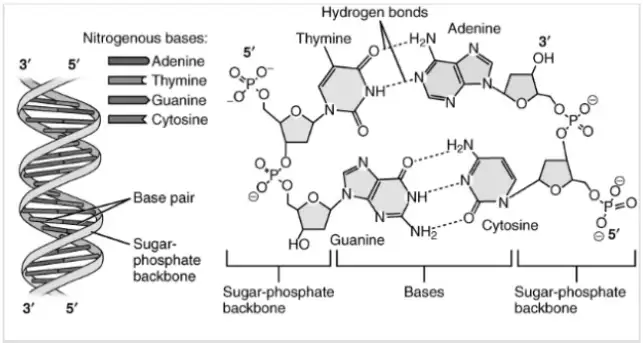
DNA structure highlighting gene components
Example: Differentiating Exons and Introns in a Gene
Explain the difference between exons and introns in a eukaryotic gene and their fate during RNA processing.
Solution:
Exons are coding sequences that remain in the mature mRNA and code for proteins.
Introns are non-coding sequences that are spliced out during RNA processing and do not appear in the final mRNA.
This selective removal ensures that only the necessary coding information is translated into proteins.
Organization and Packaging of DNA in Cells
DNA Arrangement in Prokaryotic and Eukaryotic Cells
In prokaryotes, DNA is organized as a large loop located in the nucleoid region. The negatively charged DNA is tightly bound by positively charged proteins, ensuring compactness.
In eukaryotic cells, DNA is intricately packaged into chromosomes. DNA wraps around histone proteins forming nucleosomes, which are the fundamental units of chromatin structure.
Histones are rich in basic amino acids such as lysine and arginine and exist in five types: H1, H2A, H2B, H3, and H4. The histone octamer, composed of two molecules each of H2A, H2B, H3, and H4, plays a crucial role in gene regulation.
A nucleosome contains approximately 200 base pairs of DNA and prevents DNA tangling. Further compaction is aided by non-histone chromosomal proteins (NHC).
Chromatin exists in two forms:
Euchromatin: Loosely packed, transcriptionally active regions that stain lightly.
Heterochromatin: Densely packed, transcriptionally inactive regions that stain darkly.
Example: Calculating DNA Length in a Nucleosome Array
If a chromatin fiber contains 50 nucleosomes, estimate the total length of DNA wrapped around these nucleosomes, assuming each nucleosome contains 200 base pairs.
Solution:
Total base pairs = \( 50 \times 200 = 10,000 \text{ bp} \)
Since 1 base pair corresponds to approximately 0.34 nm, total length = \( 10,000 \times 0.34 = 3400 \text{ nm} = 3.4 \text{ micrometers} \)
Thus, the DNA wrapped around 50 nucleosomes measures about 3.4 micrometers in length.
Mechanisms of Genetic Information Flow and Regulation
RNA: The First Genetic Material and Its Evolution
Scientific evidence suggests that RNA was the earliest genetic material, capable of both storing genetic information and catalyzing chemical reactions. However, RNA's high reactivity made it unstable, leading to the evolution of DNA, which is chemically more stable and better suited for long-term information storage.
DNA Replication: The Semiconservative Process
Watson and Crick proposed that DNA replication is semiconservative, meaning each new DNA molecule contains one original and one newly synthesized strand. This was experimentally confirmed by Meselson and Stahl in 1958 and further supported by Taylor and colleagues using radioactive thymidine in plant cells.
DNA polymerase is the enzyme responsible for synthesizing new DNA strands, but it can only add nucleotides in the 5’ to 3’ direction.
Replication proceeds continuously on the leading strand, which has a 3’ to 5’ template polarity, and discontinuously on the lagging strand, which has a 5’ to 3’ template polarity.
Example: Directionality in DNA Replication
Explain why DNA polymerase synthesizes the leading strand continuously but the lagging strand discontinuously.
Solution:
DNA polymerase can only add nucleotides in the 5’→3’ direction.
The leading strand template runs 3’→5’, allowing continuous synthesis in the 5’→3’ direction.
The lagging strand template runs 5’→3’, so synthesis occurs in short fragments (Okazaki fragments) in the opposite direction, requiring discontinuous replication.
Transcription: Copying DNA into RNA
Transcription is the process where a segment of DNA is copied into RNA. In RNA, adenine pairs with uracil instead of thymine. The process involves three key regions: the structural gene, promoter, and terminator.
RNA polymerase catalyzes transcription, synthesizing RNA in the 5’ to 3’ direction using the DNA template strand (antisense strand) which runs 3’ to 5’. The coding strand (sense strand) runs 5’ to 3’ and contains exons, introns, promoter, and terminator sequences.
Example: Identifying Template and Coding Strands
Given a DNA segment, determine which strand serves as the template for RNA synthesis and the direction of RNA polymerase movement.
Solution:
The template strand is the antisense strand with 3’→5’ polarity.
RNA polymerase moves along this strand in the 3’→5’ direction, synthesizing RNA in the 5’→3’ direction.
The coding strand has the same sequence as the RNA (except thymine is replaced by uracil).
Genetic Code and Protein Synthesis
The genetic code consists of nucleotide triplets (codons) in mRNA that specify amino acids during protein synthesis. There are 64 codons in total; 61 code for amino acids, and 3 are stop codons signaling termination of translation. The start codon AUG codes for methionine and initiates translation.
Mutations Affecting Genetic Information
Mutations are changes in the DNA sequence that can alter protein function. A point mutation involves a single base change, such as in sickle cell anemia where glutamate is replaced by valine in the beta-globin chain.
Frameshift mutations occur due to insertion or deletion of bases, shifting the reading frame and potentially altering the entire downstream amino acid sequence.
Translation: Building Proteins from Amino Acids
Translation is the assembly of amino acids into polypeptides. Amino acids are linked by peptide bonds. mRNA, tRNA, and rRNA each play distinct roles in this process.
The first step is aminoacylation of tRNA. Ribosomes facilitate peptide bond formation, with two tRNA binding sites in the large subunit allowing sequential addition of amino acids. Translation proceeds in the 5’→3’ direction.
Example: Role of Ribosomes in Protein Synthesis
Describe how ribosomes contribute to the formation of peptide bonds during translation.
Solution:
Ribosomes provide a platform where mRNA and tRNAs interact.
The large subunit has two sites that hold tRNAs carrying amino acids close together.
This proximity allows peptide bonds to form between amino acids, elongating the polypeptide chain.
Regulation of Gene Expression
Gene expression in eukaryotes is controlled at multiple stages:
During transcription initiation
During RNA processing or splicing
During mRNA transport from nucleus to cytoplasm
During translation
Environmental, physiological, and metabolic factors influence gene expression. Embryonic development depends on coordinated gene regulation.
In prokaryotes, gene expression is mainly regulated at transcription initiation. Regulatory proteins such as repressors or activators modulate RNA polymerase activity by binding to operator sequences near promoters.
Exam Tip: Remember that gene regulation in prokaryotes primarily occurs at the transcriptional level, while eukaryotes have multiple regulatory checkpoints.
Quick Reference: Key Concepts Summary
Concept | Details |
|---|---|
DNA Structure | Double helix with complementary base pairing (A-T, G-C) |
Nucleotide Components | Nitrogenous base, deoxyribose sugar, phosphate group |
Gene | Functional unit of inheritance; contains exons and introns |
RNA Types | mRNA, tRNA, rRNA |
DNA Packaging | DNA wrapped around histones forming nucleosomes |
Replication | Semiconservative; DNA polymerase synthesizes 5’→3’ |
Transcription | DNA to RNA; RNA polymerase synthesizes 5’→3’ |
Genetic Code | Triplet codons; 64 total, 61 code amino acids, 3 stop codons |
Mutation Types | Point mutation, frameshift mutation |
Gene Expression Regulation | Occurs at transcription, RNA processing, transport, translation |
Glossary of Important Terms
Term | Definition |
|---|---|
DNA | Deoxyribonucleic acid, the molecule carrying genetic information |
Nucleotide | Basic unit of nucleic acids, composed of base, sugar, phosphate |
Gene | Segment of DNA that codes for a functional product |
Exon | Coding sequence in a gene that remains in mature RNA |
Intron | Non-coding sequence removed during RNA processing |
Histone | Protein around which DNA is wrapped to form nucleosomes |
Replication | Process of copying DNA before cell division |
Transcription | Synthesis of RNA from a DNA template |
Translation | Process of assembling proteins from amino acids guided by mRNA |
Mutation | Change in DNA sequence that may affect gene function |
Frequently Asked Questions
What is the significance of the double helix structure of DNA?
The double helix allows DNA to store genetic information efficiently and enables complementary base pairing, which is essential for accurate replication and transcription.
How does semiconservative replication ensure genetic fidelity?
Each new DNA molecule contains one original strand and one newly synthesized strand, preserving the genetic information and reducing errors during replication.
What roles do mRNA, tRNA, and rRNA play in protein synthesis?
mRNA carries the genetic code from DNA, tRNA brings amino acids to the ribosome, and rRNA forms the core of ribosome structure and catalyzes peptide bond formation.
How do mutations affect protein function?
Mutations can alter amino acid sequences, potentially changing protein structure and function, which may lead to diseases or altered traits.
Why is gene expression regulation important?
Regulating gene expression allows cells to respond to environmental changes, differentiate during development, and maintain homeostasis by controlling protein production.