Comprehensive Overview of DNA Replication and Enzymatic Roles
Fundamentals of DNA Duplication
Mechanism and Stages of DNA Copying
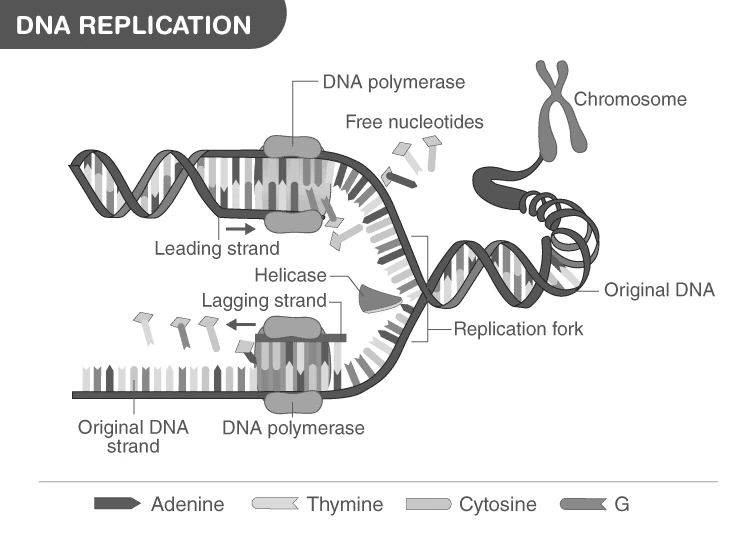
DNA duplication is a vital biological process where the molecule creates exact copies of itself. This process is enzymatically driven and unfolds in three main phases: initiation, elongation, and termination. The enzyme DNA polymerase plays a central role in catalyzing the synthesis of new DNA strands.
During initiation, replication begins at a specific site known as the origin of replication. The DNA strands are unwound locally to form a replication fork, a Y-shaped structure where the two strands separate. This unwinding is facilitated by helicase enzymes that break the hydrogen bonds between base pairs.
Example: Calculating the Number of Replication Forks
In a circular bacterial chromosome, replication starts at a single origin and proceeds bidirectionally. If replication forks move at a speed of 500 nucleotides per second and the chromosome length is 4,600,000 base pairs, how long will it take to complete replication?
Solution:
Since replication is bidirectional, there are two replication forks.
Total nucleotides to replicate = 4,600,000 base pairs
Each fork replicates half the chromosome: \( \frac{4,600,000}{2} = 2,300,000 \) nucleotides
Time taken by one fork = \(\frac{2,300,000 \text{ nucleotides}}{500 \text{ nucleotides/s}} = 4600 \text{ seconds}\)
Converting to minutes: \( \frac{4600}{60} \approx 76.7 \text{ minutes} \)
Therefore, the entire replication process completes in approximately 77 minutes.
Detailed Steps in DNA Duplication
Initiation: Starting the Replication Process
Replication initiation is highly regulated to ensure accuracy and prevent mutations. It begins at a defined sequence called the origin of replication. Helicase enzymes unwind the DNA strands locally, creating a replication fork. Complete unwinding of the entire DNA molecule at once is energetically unfavorable, so the process proceeds progressively from the origin.
At the replication fork, single-stranded binding proteins attach to the separated strands to prevent them from reannealing or forming secondary structures.
Example: Role of Helicase in Replication Initiation
Explain how helicase facilitates the start of DNA replication and why its function is critical.
Answer:
- Helicase breaks hydrogen bonds between complementary bases, separating the two DNA strands.
- This separation forms the replication fork, allowing other enzymes to access single strands.
- Without helicase, the DNA strands would remain tightly coiled, preventing replication.
Elongation: Synthesizing New DNA Strands
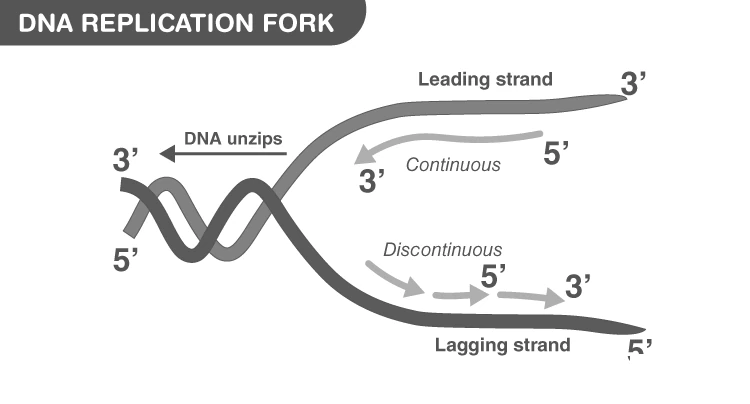
Once the strands are separated, DNA polymerase enzymes synthesize new complementary strands by adding nucleotides in the 5′ to 3′ direction. The original strands serve as templates. Because DNA strands are antiparallel, synthesis occurs continuously on the leading strand (template 3′→5′) and discontinuously on the lagging strand (template 5′→3′), producing Okazaki fragments.
DNA ligase later joins these fragments to form a continuous strand.
Example: Directionality of DNA Synthesis
Why does DNA polymerase synthesize DNA only in the 5′ to 3′ direction, and how does this affect replication on the lagging strand?
Answer:
- DNA polymerase can only add nucleotides to the 3′ end of a growing strand, so synthesis proceeds 5′ to 3′.
- On the lagging strand, this directionality causes synthesis to occur in short fragments (Okazaki fragments) moving away from the replication fork.
- These fragments are later connected by DNA ligase to form a continuous strand.
Termination: Concluding the Replication Process
The replication process concludes differently depending on the organism. In bacteria with circular chromosomes, termination occurs when two replication forks meet at the opposite side of the origin. In eukaryotes, multiple replication forks converge and replication ends when the entire DNA molecule is copied.
Example: Termination in Circular DNA
Describe how replication terminates in a circular bacterial chromosome.
Answer:
- Replication starts at a single origin and proceeds bidirectionally.
- Two replication forks move around the circle in opposite directions.
- Termination occurs when these forks meet, completing the duplication of the chromosome.
Enzymatic Functions in DNA Duplication
Key Enzymes and Their Roles
DNA replication relies on a suite of enzymes, each performing specific functions to ensure accurate and efficient copying of genetic material.
DNA-dependent DNA Polymerase: This enzyme catalyzes the addition of nucleotides to the growing DNA strand using the template strand. It requires deoxyribonucleoside triphosphates both as substrates and energy sources. There are three main types:
- DNA Polymerase I: Involved in DNA repair and removal of RNA primers; possesses 5′→3′ polymerase and exonuclease activities.
- DNA Polymerase II: Functions in primer extension and proofreading to maintain replication fidelity.
- DNA Polymerase III: The primary enzyme responsible for DNA synthesis during replication.
Helicase: Unwinds the DNA double helix by breaking hydrogen bonds, creating the replication fork.
Ligase: Joins Okazaki fragments on the lagging strand by forming phosphodiester bonds.
Primase: Synthesizes short RNA primers complementary to the DNA template to initiate DNA synthesis.
Endonucleases: Introduce cuts in DNA strands to facilitate repair and replication processes.
Single-Stranded Binding Proteins (SSB): Bind to single-stranded DNA to prevent secondary structure formation and protect the strands.
Example: Function of DNA Ligase in Replication
Explain the role of DNA ligase during DNA replication and why it is essential.
Answer:
- DNA ligase seals the nicks between Okazaki fragments on the lagging strand.
- It catalyzes the formation of phosphodiester bonds, creating a continuous DNA strand.
- Without ligase, the lagging strand would remain fragmented, compromising DNA integrity.
Replication in Prokaryotic Cells
In prokaryotes, DNA replication initiates at a single origin on the circular chromosome. Helicase unwinds the DNA, and single-stranded binding proteins stabilize the separated strands. Topoisomerase prevents supercoiling ahead of the replication fork. Primase synthesizes RNA primers, and DNA polymerase III extends these primers. DNA polymerase I removes primers and fills gaps, while ligase seals the fragments.
Example: Role of Topoisomerase in Prokaryotic Replication
What is the function of topoisomerase during DNA replication in prokaryotes?
Answer:
- Topoisomerase alleviates supercoiling tension generated ahead of the replication fork.
- It prevents DNA tangling and ensures smooth progression of the replication machinery.
Replication in Eukaryotic Cells
Eukaryotic DNA replication shares similarities with prokaryotic replication but is more complex. Multiple origins of replication exist on linear chromosomes. A pre-replication complex forms at each origin, involving initiator proteins. The polymerase enzyme Pol δ carries out DNA synthesis. The overall process includes initiation, elongation, and termination, coordinated by various enzymes specialized for eukaryotic cells.
Example: Multiple Origins in Eukaryotic Replication
Why do eukaryotic chromosomes have multiple origins of replication?
Answer:
- Eukaryotic chromosomes are much larger and linear, requiring multiple starting points to replicate efficiently.
- Multiple origins allow simultaneous replication at different sites, reducing total replication time.
Quick Reference: Summary of DNA Replication
| Stage | Description | Key Enzymes |
|---|---|---|
| Initiation | Unwinding of DNA at origin, formation of replication fork | Helicase, Single-Stranded Binding Proteins |
| Elongation | Synthesis of new DNA strands; continuous on leading, discontinuous on lagging | DNA Polymerase III (prokaryotes), Pol δ (eukaryotes), Primase, DNA Ligase |
| Termination | Completion of replication when forks meet or reach chromosome ends | Topoisomerase, DNA Ligase |
| Primer Removal & Repair | Removal of RNA primers and filling gaps with DNA | DNA Polymerase I (prokaryotes), DNA Ligase |
Glossary of Key Terms
| Term | Definition |
|---|---|
| DNA Polymerase | Enzyme that synthesizes new DNA strands by adding nucleotides. |
| Helicase | Enzyme that unwinds the DNA double helix by breaking hydrogen bonds. |
| Replication Fork | Y-shaped region where DNA strands separate for replication. |
| Okazaki Fragments | Short DNA segments synthesized discontinuously on the lagging strand. |
| DNA Ligase | Enzyme that joins Okazaki fragments to form a continuous strand. |
| Primase | Enzyme that synthesizes RNA primers to initiate DNA synthesis. |
| Single-Stranded Binding Proteins | Proteins that stabilize single-stranded DNA during replication. |
| Topoisomerase | Enzyme that prevents DNA supercoiling during replication. |
| Origin of Replication | Specific DNA sequence where replication begins. |
| Deoxyribonucleoside Triphosphates (dNTPs) | Building blocks and energy source for DNA synthesis. |
Frequently Asked Questions
What ensures the accuracy of DNA replication?
Proofreading activities of DNA polymerases and the regulated initiation at specific origins maintain high fidelity during replication.
Why is DNA replication semi-conservative?
Each new DNA molecule contains one original (parental) strand and one newly synthesized strand, preserving half of the original DNA.
How do Okazaki fragments form?
Because DNA polymerase synthesizes only in the 5′ to 3′ direction, the lagging strand is synthesized discontinuously in short fragments called Okazaki fragments.
What role does primase play in replication?
Primase synthesizes short RNA primers that provide starting points for DNA polymerase to begin DNA synthesis.
How is supercoiling prevented during DNA replication?
Topoisomerase enzymes relieve the torsional strain caused by unwinding DNA, preventing supercoiling and tangling.