Fundamental Categories of Chemical Reactions
Understanding Combination Reactions
Concept and Mechanism
A combination reaction occurs when two or more reactants unite to create a single, more complex product. This process is also referred to as a synthesis reaction. The general representation of this reaction type is:
\[ X + Y \rightarrow XY \]
Such reactions are fundamental in forming compounds from simpler substances, often releasing energy in the process.
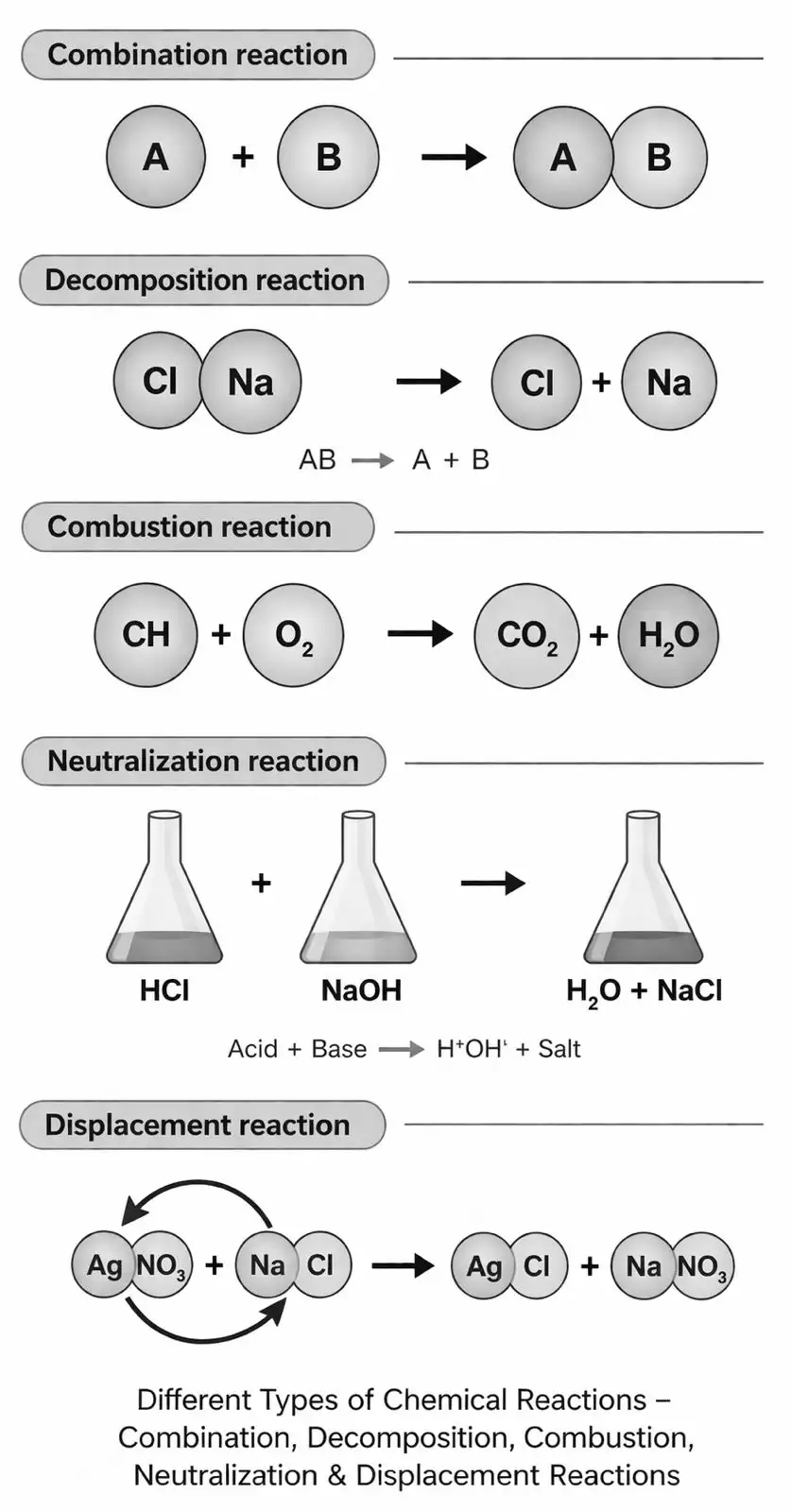
Visual representation of different chemical reaction types
Example Problem
Magnesium reacts with oxygen to form magnesium oxide. Write the balanced chemical equation for this reaction.
Solution:
Magnesium (Mg) combines with oxygen (O2) to produce magnesium oxide (MgO). The unbalanced equation is:
\[ \text{Mg} + \text{O}_2 \rightarrow \text{MgO} \]
Balancing oxygen atoms requires two MgO units:
\[ 2\text{Mg} + \text{O}_2 \rightarrow 2\text{MgO} \]
This balanced equation shows the combination of magnesium and oxygen to form magnesium oxide.
Breaking Down Decomposition Reactions
Explanation and Characteristics
Decomposition reactions involve a single compound splitting into two or more simpler substances. This process is essentially the reverse of combination reactions. The general formula is:
\[ XY \rightarrow X + Y \]
Often, heat or light is required to initiate these reactions, especially in thermal decomposition.
Example Problem
Calcium carbonate decomposes upon heating to form calcium oxide and carbon dioxide. Write the balanced chemical equation for this reaction.
Solution:
The decomposition reaction is:
\[ \text{CaCO}_3 \xrightarrow{\text{heat}} \text{CaO} + \text{CO}_2 \]
This equation is already balanced, showing the breakdown of calcium carbonate into calcium oxide and carbon dioxide gas.
Exploring Displacement Reactions
Definition and Process
Displacement reactions occur when a more reactive element replaces a less reactive element from its compound, typically in aqueous solution. This is also known as a substitution reaction. The general form is:
\[ X + YZ \rightarrow XZ + Y \]
This reaction type is important in understanding reactivity series and metal extraction.
Example Problem
Zinc metal is placed in a solution of copper(II) sulfate. Predict the products and write the balanced equation.
Solution:
Zinc, being more reactive, displaces copper from copper sulfate:
\[ \text{Zn} + \text{CuSO}_4 \rightarrow \text{ZnSO}_4 + \text{Cu} \]
This balanced equation shows zinc sulfate and copper metal as products.
Understanding Double Displacement Reactions
Mechanism and Features
Double displacement reactions involve the exchange of ions between two compounds, resulting in the formation of new products. This is also called a metathesis reaction. The general equation is:
\[ XY + ZA \rightarrow XZ + YA \]
These reactions often occur in aqueous solutions and can lead to the formation of precipitates, gases, or weak electrolytes.
Example Problem
Barium chloride reacts with sodium sulfate in aqueous solution. Write the balanced chemical equation and identify the precipitate.
Solution:
The reaction is:
\[ \text{BaCl}_2 + \text{Na}_2\text{SO}_4 \rightarrow \text{BaSO}_4 + 2\text{NaCl} \]
Barium sulfate (BaSO4) is the insoluble precipitate formed.
Precipitation Reactions and Their Significance
Overview and Ionic Perspective
Precipitation reactions are a subset of double displacement reactions where an insoluble solid (precipitate) forms from the reaction of two soluble ionic compounds in aqueous solution. The precipitate separates from the solution due to its low solubility.
For example, when solutions of sodium chloride and silver nitrate are mixed, silver chloride precipitates out:
\[ \text{NaCl}_{(aq)} \rightarrow \text{Na}^+_{(aq)} + \text{Cl}^-_{(aq)} \]
\[ \text{AgNO}_3_{(aq)} \rightarrow \text{Ag}^+_{(aq)} + \text{NO}_3^-_{(aq)} \]
Upon mixing:
\[ \text{NaCl}_{(aq)} + \text{AgNO}_3_{(aq)} \rightarrow \text{AgCl}_{(s)} + \text{NaNO}_3_{(aq)} \]
Here, AgCl is the white solid precipitate.
Example of precipitation reaction forming a solid
Example Problem
When aqueous solutions of lead(II) nitrate and potassium iodide are combined, does a precipitate form? Also, write the balanced equation for the reaction between copper(II) iodide and potassium hydroxide solutions.
Solution:
Mixing lead(II) nitrate and potassium iodide produces lead(II) iodide precipitate:
\[ \text{Pb(NO}_3)_2_{(aq)} + 2\text{KI}_{(aq)} \rightarrow \text{PbI}_2_{(s)} + 2\text{KNO}_3_{(aq)} \]
Copper(II) iodide reacts with potassium hydroxide to form copper(II) hydroxide precipitate:
\[ \text{CuI}_2_{(aq)} + 2\text{KOH}_{(aq)} \rightarrow \text{Cu(OH)}_2_{(s)} + 2\text{KI}_{(aq)} \]
Quick Reference: Summary of Reaction Types
Reaction Type | General Equation | Key Feature | Example |
|---|---|---|---|
Combination (Synthesis) | \( X + Y \rightarrow XY \) | Multiple reactants form one product | \( 2\text{Na} + \text{Cl}_2 \rightarrow 2\text{NaCl} \) |
Decomposition | \( XY \rightarrow X + Y \) | One compound breaks into simpler substances | \( \text{CaCO}_3 \xrightarrow{\text{heat}} \text{CaO} + \text{CO}_2 \) |
Displacement (Substitution) | \( X + YZ \rightarrow XZ + Y \) | More reactive element replaces less reactive one | \( \text{Zn} + \text{CuSO}_4 \rightarrow \text{ZnSO}_4 + \text{Cu} \) |
Double Displacement (Metathesis) | \( XY + ZA \rightarrow XZ + YA \) | Ions exchange between two compounds | \( \text{BaCl}_2 + \text{Na}_2\text{SO}_4 \rightarrow \text{BaSO}_4 + 2\text{NaCl} \) |
Precipitation | Soluble salts react to form insoluble solid | Formation of a solid precipitate | \( \text{AgNO}_3 + \text{NaCl} \rightarrow \text{AgCl}_{(s)} + \text{NaNO}_3 \) |
Glossary of Key Terms
Term | Definition |
|---|---|
Reactants | Substances that undergo change during a chemical reaction. |
Products | New substances formed as a result of a chemical reaction. |
Combination Reaction | A reaction where multiple reactants form a single product. |
Decomposition Reaction | A reaction where a compound breaks down into simpler substances. |
Displacement Reaction | A reaction where a more reactive element replaces a less reactive one. |
Double Displacement Reaction | A reaction involving exchange of ions between two compounds. |
Precipitation Reaction | A reaction that produces an insoluble solid from soluble reactants. |
Precipitate | An insoluble solid formed in a solution during a chemical reaction. |
Thermal Decomposition | Decomposition caused by heating a compound. |
Metathesis Reaction | Another term for double displacement reaction. |
Frequently Asked Questions
How can you recognize a chemical reaction?
Chemical reactions are identified by observable changes such as heat or light emission, gas production, formation of a precipitate, or a change in color or texture.
What distinguishes a physical change from a chemical change?
Physical changes alter the form or appearance without changing the substance's identity, while chemical changes produce new substances with different properties.
Why is it important to write balanced chemical equations?
Balanced equations show the correct proportions of reactants and products, ensuring the law of conservation of mass is obeyed and allowing calculation of quantities involved.
What does a chemical equation represent?
A chemical equation symbolically depicts the reactants and products in a reaction using chemical formulas and symbols.
What is a skeleton equation?
A skeleton equation lists the reactants and products with their chemical formulas but is not balanced for atom count or charge.