Comprehensive Insights into Sodium Hydroxide: Properties, Preparation, and Applications
Fundamental Characteristics and Molecular Arrangement of Sodium Hydroxide
Physical and Chemical Traits of Sodium Hydroxide
Sodium hydroxide, commonly known as caustic soda or lye, is an inorganic compound appearing as a white crystalline solid at ambient temperature. It is composed of sodium ions (Na+) and hydroxide ions (OH−), with the chemical formula NaOH. This compound is odorless and highly soluble in water, glycerol, and ethanol. When dissolved in water, it releases a significant amount of heat due to an exothermic reaction.
Its viscosity is notably higher than that of water, approximately 78 mPas. Sodium hydroxide can exist in various hydrated forms, including heptahydrate, pentahydrate, tetrahydrate, trihemihydrate, trihydrate, dihydrate, and monohydrate. The monohydrate and anhydrous forms crystallize in orthorhombic structures with space groups such as Cmcm (oS8) and Pbca (oP24). Additionally, NaOH readily absorbs moisture and carbon dioxide from the atmosphere and can also be found in liquid form under certain conditions.
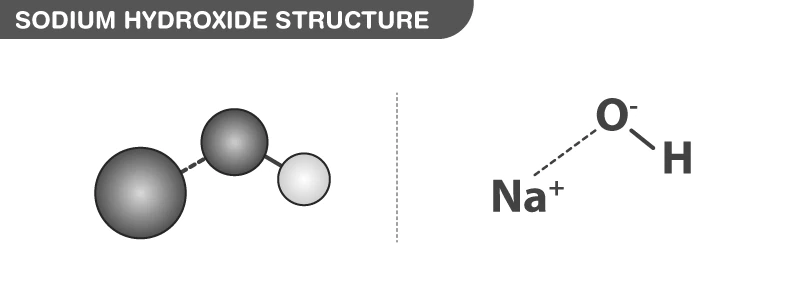
Chemically, sodium hydroxide features an ionic bond between Na+ and OH− ions, while the oxygen and hydrogen within the hydroxide ion share a covalent bond. It acts as a strong base with a pH around 13 and reacts with protic acids to yield water and corresponding salts. It is also effective in leaching amphoteric hydroxides and oxides.
Illustration of Sodium Hydroxide’s Molecular Structure
Example: Understanding Hydrate Formation
Calculate the number of water molecules in sodium hydroxide pentahydrate (NaOH·5H2O) and explain its significance.
Solution:
- The formula NaOH·5H2O indicates that each formula unit of sodium hydroxide is associated with 5 water molecules.
- These water molecules are integrated into the crystal lattice, affecting physical properties such as solubility and melting point.
- Hydrates are important in industrial applications where moisture content influences handling and reactivity.
Methods and Industrial Processes for Producing Sodium Hydroxide
Overview of Commercial Preparation Techniques
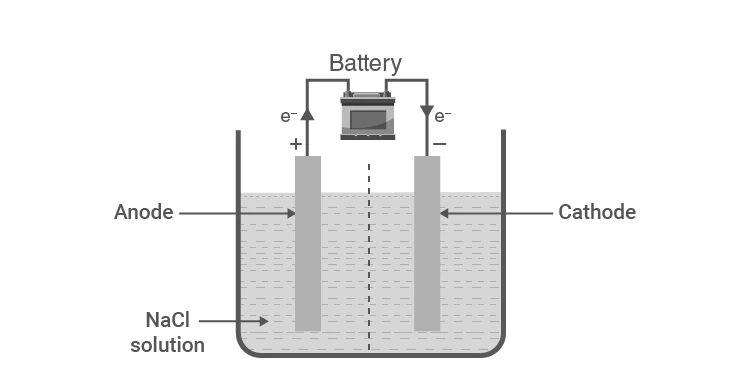
Sodium hydroxide is predominantly manufactured through the electrolysis of brine (aqueous sodium chloride solution). This process yields sodium hydroxide, chlorine gas, and hydrogen gas as primary products. Alternative historical methods include the Leblanc, Weldon, and Deacon processes, which involve chemical reactions producing NaOH alongside other compounds.
The electrolysis cell typically uses graphite electrodes and a diaphragm to separate the anode and cathode compartments, preventing unwanted side reactions. Modifications such as mercury cathodes can enhance efficiency by forming sodium amalgam, which is subsequently hydrolyzed to produce NaOH and hydrogen gas.
Example: Electrolysis Reaction Calculations
In an electrolytic cell, 96500 coulombs of charge are passed through brine solution. Calculate the amount of chlorine gas produced at the anode.
Solution:
- One mole of electrons corresponds to 96500 C (Faraday's constant).
- At the anode, the reaction is: \( 2Cl^- \to Cl_2 + 2e^- \).
- Thus, 2 moles of electrons produce 1 mole of Cl2.
- Charge passed corresponds to 1 mole of electrons, so chlorine produced is:
\[ \text{Moles of } Cl_2 = \frac{1}{2} \times 1 = 0.5 \text{ moles} \]
Therefore, 0.5 moles of chlorine gas are generated.
Reactivity and Practical Applications of Sodium Hydroxide
Interactions with Acids, Metals, and Oxides
Sodium hydroxide reacts vigorously with acids, metals, and acidic oxides. When combined with protic acids such as hydrochloric acid, it neutralizes to form water and salt:
\[ \mathrm{NaOH}_{(aq)} + \mathrm{HCl}_{(aq)} \to \mathrm{NaCl}_{(aq)} + \mathrm{H_2O}_{(l)} \]
At elevated temperatures (above 500 °C), sodium hydroxide reacts with metals like iron to produce metal oxides, sodium metal, and hydrogen gas:
\[ 4 \mathrm{Fe} + 6 \mathrm{NaOH} \to 2 \mathrm{Fe_2O_3} + 6 \mathrm{Na} + 3 \mathrm{H_2} \]
Transition metals such as aluminum react with NaOH to precipitate their hydroxides, useful in various chemical processes.
Additionally, sodium hydroxide neutralizes acidic oxides like sulfur dioxide, aiding in pollution control:
\[ 2 \mathrm{NaOH} + \mathrm{SO_2} \to \mathrm{Na_2SO_3} + \mathrm{H_2O} \]
Industrial and Laboratory Uses of Sodium Hydroxide
NaOH is indispensable in multiple industries. It is used in soap production through saponification, paper pulp processing, textile manufacturing, water softening, and glass making. In laboratories, it serves as a strong base for various chemical syntheses and precipitations.
It also facilitates the hydrolysis of esters, amides, and alkyl halides, making it vital in organic chemistry.
Example: Neutralization Reaction Calculation
Calculate the volume of 0.5 M HCl required to neutralize 50 mL of 0.4 M NaOH solution.
Solution:
- Neutralization reaction: \( \mathrm{NaOH} + \mathrm{HCl} \to \mathrm{NaCl} + \mathrm{H_2O} \)
- Moles of NaOH = \(0.4 \text{ M} \times 0.050 \text{ L} = 0.020 \text{ moles}\)
- Since the reaction is 1:1, moles of HCl needed = 0.020 moles
- Volume of HCl = \(\frac{0.020 \text{ moles}}{0.5 \text{ M}} = 0.040 \text{ L} = 40 \text{ mL}\)
Therefore, 40 mL of 0.5 M HCl is required for complete neutralization.
Safety Considerations and Handling Precautions for Sodium Hydroxide
Health Risks and Protective Measures
Sodium hydroxide is a highly corrosive substance that can cause severe damage to living tissues. Contact with eyes may result in permanent blindness, while skin exposure can lead to serious chemical burns. The dissolution of NaOH in water is highly exothermic, posing risks of splashing and burns.
Proper storage is critical, especially for large quantities. Small amounts are kept in sealed bottles, whereas industrial volumes require intermediate bulk containers or large stationary tanks made from materials resistant to corrosion, such as carbon steel, PVC, stainless steel, polyethylene, or fiberglass-reinforced plastic with protective liners.
Containers must be airtight to prevent moisture and carbon dioxide absorption, which can degrade the chemical and pose hazards.
Safety Tip
Always wear appropriate personal protective equipment (PPE) including gloves, goggles, and lab coats when handling sodium hydroxide. Ensure proper ventilation and have emergency washing stations accessible.
Example: Handling Precaution Scenario
Describe the immediate steps to take if sodium hydroxide solution splashes into the eyes during a laboratory experiment.
Answer:
- Immediately rinse the eyes with plenty of water for at least 15 minutes.
- Remove contact lenses if present and easy to do.
- Seek urgent medical attention without delay.
- Inform laboratory safety personnel and document the incident.
Quick Reference: Essential Sodium Hydroxide Facts
| Aspect | Details |
|---|---|
| Chemical Formula | NaOH |
| Physical State | White crystalline solid |
| Solubility | Highly soluble in water, glycerol, ethanol |
| pH Value | Approximately 13 (strong base) |
| Common Hydrates | Heptahydrate, Pentahydrate, Tetrahydrate, Trihydrate, Dihydrate, Monohydrate |
| Preparation Method | Electrolysis of brine solution |
| Major Uses | Soap making, paper pulp, textile, water treatment, glass production |
| Reactivity | Neutralizes acids, reacts with metals and acidic oxides |
| Health Hazards | Corrosive; causes burns and blindness |
| Storage | Airtight containers made of corrosion-resistant materials |
Glossary of Key Terms Related to Sodium Hydroxide
| Term | Definition |
|---|---|
| Caustic Soda | Common name for sodium hydroxide, a strong alkali. |
| Electrolysis | Process of using electric current to drive a chemical reaction. |
| Hydrate | A compound that includes water molecules within its crystal structure. |
| Protic Acid | An acid that donates a proton (H+) in reactions. |
| Saponification | Base-catalyzed hydrolysis of esters to produce soap. |
| Amphoteric | Substances that can react both as acids and bases. |
| Exothermic | A reaction that releases heat. |
| Diaphragm Cell | Electrolytic cell with a separator to prevent mixing of products. |
| Corrosive | Substance that can destroy or irreversibly damage materials or tissues. |
| Neutralization | Chemical reaction between an acid and a base producing salt and water. |
Frequently Asked Questions on Sodium Hydroxide
What is the primary industrial method for producing sodium hydroxide?
The main industrial technique is the electrolysis of brine solution, which simultaneously produces sodium hydroxide, chlorine gas, and hydrogen gas.
Why is sodium hydroxide considered a strong base?
Because it completely dissociates in water to release hydroxide ions (OH−), resulting in a high pH around 13.
What precautions should be taken when handling sodium hydroxide?
Wear protective gear such as gloves and goggles, avoid skin and eye contact, and ensure proper ventilation and storage in airtight, corrosion-resistant containers.
How does sodium hydroxide react with acids?
It neutralizes acids to form water and corresponding salts in a typical acid-base neutralization reaction.
Can sodium hydroxide be used to soften hard water?
Yes, it is used in water treatment to convert hard water into soft water by precipitating calcium and magnesium ions.