Understanding Light Refraction and Prism Effects
Fundamentals of Light Refraction and Its Everyday Impact
How Light Changes Direction When Passing Through Different Media
Refraction is the bending of light as it moves from one transparent medium to another with a different density. This change in direction occurs because light travels at varying speeds in different materials. For example, when light passes from air into water or glass, it slows down and bends towards the normal line, an imaginary line perpendicular to the surface. Conversely, when it moves from a denser to a rarer medium, it bends away from the normal.
This principle is the foundation for many optical phenomena and technologies, including the development of materials that can manipulate light paths, such as invisibility cloaks that aim to hide objects by guiding light around them.
Common Phenomena Explained by Refraction
Refraction is responsible for several natural and observable effects:
Distorted Appearance of Objects: A straw partially submerged in water appears bent or broken at the water's surface due to light bending.
Mirages: In deserts or hot roads, light refracts through layers of air at different temperatures, creating illusions of water or distant objects.
Twinkling of Stars: Variations in Earth's atmosphere cause starlight to refract differently, making stars appear to twinkle.
Rainbows: Sunlight disperses into its constituent colors when refracted through water droplets, forming a spectrum of colors.
Example Problem
A pencil is placed in a glass of water and viewed from the side. If the refractive index of water is 1.33 and air is 1.00, explain why the pencil appears bent at the water surface.
Solution:
When light rays travel from water (denser medium) to air (rarer medium), they bend away from the normal due to refraction. This bending causes the submerged part of the pencil to appear at a different position than it actually is, making the pencil look bent or broken at the water surface.
Light slows down entering water and bends towards the normal.
Light speeds up leaving water and bends away from the normal.
The apparent position of the pencil shifts due to this bending of light rays.
Refraction Through a Triangular Glass Prism
How Light Behaves Inside a Prism
A glass prism typically has two triangular bases and three rectangular sides inclined at an angle known as the prism angle. When a ray of light enters the prism, it passes from air (rarer medium) into glass (denser medium), causing it to bend towards the normal. Upon exiting, the light moves from glass back to air, bending away from the normal. This double refraction causes the light to deviate from its original path.
The angle between the incident ray and the emergent ray is called the angle of deviation. When the angle of incidence equals the angle of emergence, the deviation is at its minimum, and the refracted ray inside the prism runs parallel to one of its sides.
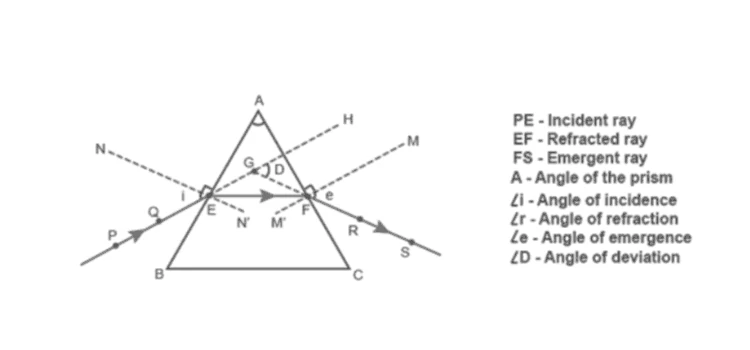
Refraction of Light Through a Glass Prism
Example Problem
A ray of light enters a glass prism with an angle of prism \( A = 60^\circ \). The angle of incidence is \( 40^\circ \) and the refractive index of glass is 1.5. Calculate the angle of minimum deviation if the angle of emergence equals the angle of incidence.
Solution:
Given:
Prism angle, \( A = 60^\circ \)
Angle of incidence, \( i = 40^\circ \)
Refractive index, \( n = 1.5 \)
Using Snell's law at the first surface:
\[ n_1 \sin i = n_2 \sin r \]
Where \( n_1 = 1.0 \) (air), \( n_2 = 1.5 \) (glass), and \( r \) is the angle of refraction inside the prism.
\[ \sin r = \frac{\sin 40^\circ}{1.5} = \frac{0.6428}{1.5} = 0.4285 \]
\[ r = \sin^{-1}(0.4285) \approx 25.4^\circ \]
Since the prism angle \( A = r + r' \), and for minimum deviation \( r = r' \),
\[ r' = A - r = 60^\circ - 25.4^\circ = 34.6^\circ \]
Using Snell's law at the second surface for angle of emergence \( e \):
\[ n_2 \sin r' = n_1 \sin e \]
\[ \sin e = 1.5 \times \sin 34.6^\circ = 1.5 \times 0.567 = 0.8505 \]
\[ e = \sin^{-1}(0.8505) \approx 58.1^\circ \]
Angle of minimum deviation \( \delta_m \) is:
\[ \delta_m = i + e - A = 40^\circ + 58.1^\circ - 60^\circ = 38.1^\circ \]
Therefore, the minimum deviation angle is approximately \( 38.1^\circ \).
Dispersion of White Light and Its Effects
Separation of Colors Through Refraction
White light is composed of multiple colors, each with a different wavelength. When white light passes through a prism, each color bends by a different amount due to varying refractive indices for different wavelengths. This process, called dispersion, causes the white light to split into its constituent colors, forming a spectrum ranging from red to violet.
This phenomenon explains natural occurrences such as rainbows, where sunlight disperses through water droplets in the atmosphere, creating a colorful arc in the sky.
Example Problem
Sunlight passes through a prism and splits into seven colors. If the refractive index for red light is 1.51 and for violet light is 1.53, explain why violet light bends more than red light.
Solution:
The refractive index indicates how much light slows down in a medium.
Violet light has a higher refractive index (1.53) than red light (1.51), so it slows down more.
According to Snell's law, a higher refractive index causes a greater bending towards the normal.
Therefore, violet light deviates more than red light, causing the separation of colors.
Spectrum of Colors Produced by Dispersion in a Prism
Quick Reference: Key Points on Light Refraction and Prism
Concept | Explanation |
|---|---|
Refraction | Bending of light when it passes between media of different densities. |
Snell's Law | \( n_1 \sin i = n_2 \sin r \), relates angles and refractive indices. |
Prism Angle | The angle between the two refracting surfaces of a prism. |
Angle of Deviation | The angle between the incident ray and the emergent ray after refraction. |
Minimum Deviation | Occurs when the angle of incidence equals the angle of emergence. |
Dispersion | Splitting of white light into its constituent colors due to different bending. |
Mirage | Optical illusion caused by refraction of light in layers of air at different temperatures. |
Twinkling of Stars | Apparent change in star brightness due to atmospheric refraction variations. |
Rainbow Formation | Result of sunlight dispersion through water droplets in the atmosphere. |
Refractive Index | Ratio of speed of light in vacuum to speed in a medium, determines bending. |
Glossary of Important Terms
Term | Definition |
|---|---|
Refraction | The change in direction of light when it passes from one medium to another. |
Normal | An imaginary line perpendicular to the surface at the point of incidence. |
Angle of Incidence | The angle between the incident ray and the normal. |
Angle of Refraction | The angle between the refracted ray and the normal. |
Prism | A transparent optical element with flat, polished surfaces that refract light. |
Angle of Prism | The angle between the two refracting surfaces of a prism. |
Angle of Deviation | The angle between the original path of the light and its path after refraction. |
Dispersion | The splitting of white light into its component colors due to different refraction. |
Refractive Index | A measure of how much a medium slows down light compared to vacuum. |
Mirage | An optical illusion caused by refraction of light in layers of air with different temperatures. |
Frequently Asked Questions
What causes the bending of light when it passes through different media?
Light changes speed when moving between media of different densities, causing it to bend at the interface. This bending is called refraction.
Why does a straw look bent when placed in water?
The light rays from the submerged part bend as they move from water to air, making the straw appear broken or bent at the water surface.
How does a prism separate white light into colors?
Different colors in white light refract by different amounts due to their wavelengths, causing the light to spread out into a spectrum when passing through a prism.
What is the angle of minimum deviation in a prism?
It is the smallest angle between the incident and emergent rays when the light passes symmetrically through the prism, with equal angles of incidence and emergence.
How does refraction explain the twinkling of stars?
Atmospheric layers with varying densities cause starlight to refract differently, making stars appear to twinkle as their apparent position and brightness change.