Understanding the Principles and Applications of Light Refraction
Fundamentals of Light Bending at Interfaces
Conceptualizing the Bending of Light Between Media
Light, a form of energy, exhibits various behaviors such as reflection, diffraction, and refraction. Refraction specifically refers to the change in direction of light as it passes obliquely from one transparent medium to another. This bending occurs because light travels at different speeds in different substances. For instance, when a pencil is partially submerged in water, it appears shifted from its actual position due to this bending of light rays reaching our eyes from the submerged part.
The degree of this apparent displacement varies with the medium; replacing water with kerosene or turpentine alters the extent of the pencil's apparent shift. This demonstrates that the path of light is medium-dependent, and the phenomenon of refraction explains such observations. Natural occurrences like rainbows and mirages are vivid examples of refraction in action, while atmospheric refraction causes the sun to appear slightly shifted during sunrise and sunset.
Illustrative Activity: Refraction Through a Rectangular Glass Slab
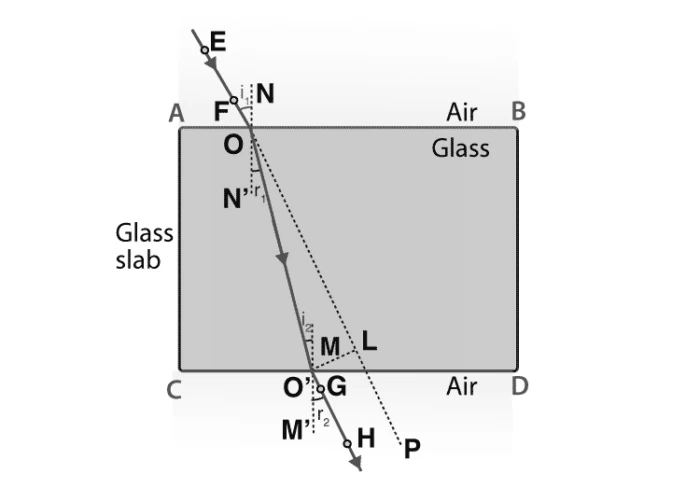
To visualize refraction, place a rectangular glass slab on a white sheet and outline its edges as ABCD. Insert two pins, E and F, at points A and B respectively. Viewing these pins through the opposite side of the slab, place two more pins, G and H, such that G, F, and the images of E and F align in a straight line. After removing the pins and slab, join points E and F, extending the line to meet AB at O. Similarly, join G and H, extending to meet CD at O'. Connecting O and O' and extending EF to P helps trace the path of light through the slab.
Example Problem: Determining the Path of Light Through a Glass Slab
Problem: A light ray strikes a rectangular glass slab at an angle of incidence of \(30^\circ\). The refractive index of glass with respect to air is 1.5. Calculate the angle of refraction inside the glass and the angle at which the ray emerges from the slab.
Solution:
Given:
- Angle of incidence, \(i = 30^\circ\)
- Refractive index of glass, \(n = 1.5\)
- Refractive index of air, \(n_0 = 1\)
Using Snell's Law at the air-glass interface:
\[ n_0 \sin i = n \sin r \]
Substituting values:
\[ 1 \times \sin 30^\circ = 1.5 \times \sin r \]
\[ \sin r = \frac{\sin 30^\circ}{1.5} = \frac{0.5}{1.5} = 0.3333 \]
Therefore,
\[ r = \sin^{-1}(0.3333) \approx 19.47^\circ \]
At the glass-air interface, the ray emerges back into air. The angle of incidence inside the glass at this interface is \(r = 19.47^\circ\). Applying Snell's Law again:
\[ n \sin r = n_0 \sin e \]
\[ 1.5 \times \sin 19.47^\circ = 1 \times \sin e \]
\[ \sin e = 1.5 \times 0.3333 = 0.5 \]
Thus,
\[ e = \sin^{-1}(0.5) = 30^\circ \]
The emergent ray makes an angle of \(30^\circ\) with the normal, parallel to the incident ray.
Fundamental Principles Governing Refraction
Understanding the Governing Laws of Light Refraction
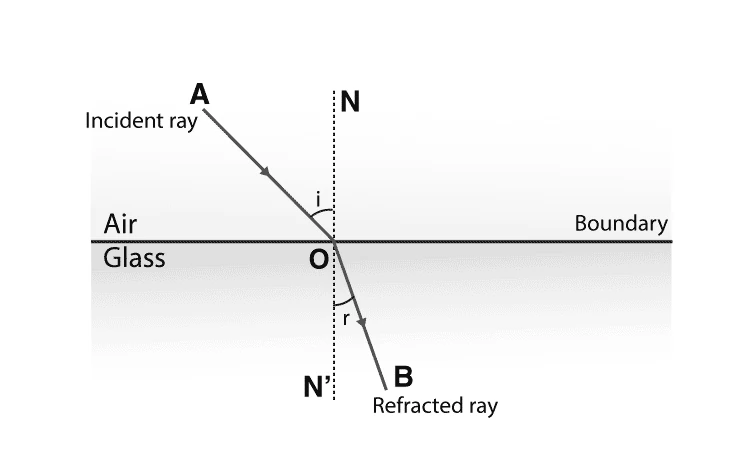
The behavior of light as it crosses the boundary between two transparent media is described by two fundamental laws, commonly known as Snell's Laws of Refraction. First, the incident ray, the refracted ray, and the normal to the interface all lie in the same plane. Second, for a given pair of media, the ratio of the sine of the angle of incidence to the sine of the angle of refraction remains constant.
This constant ratio is expressed mathematically as:
\[ \frac{\sin i}{\sin r} = \text{constant} \]
This constant is unique for each pair of media and is related to the refractive indices of the two substances.
Example Problem: Verifying Snell’s Law for Water and Air
Problem: A light ray passes from air into water. If the angle of incidence is \(45^\circ\) and the angle of refraction is \(32^\circ\), verify the ratio \(\frac{\sin i}{\sin r}\) and interpret its significance.
Solution:
Calculate the sine values:
\[ \sin 45^\circ = 0.7071, \quad \sin 32^\circ = 0.5299 \]
Compute the ratio:
\[ \frac{\sin i}{\sin r} = \frac{0.7071}{0.5299} \approx 1.334 \]
This ratio corresponds to the refractive index of water with respect to air, indicating that light slows down when entering water, causing it to bend towards the normal.
Quantifying Refraction: The Refractive Index
Defining and Calculating the Refractive Index
The refractive index quantifies how much light bends when transitioning between two media. It is defined as the ratio of the speed of light in the first medium to that in the second medium. If \(v_1\) is the speed of light in medium 1 and \(v_2\) in medium 2, then the refractive index of medium 2 relative to medium 1 is:
\[ n = \frac{v_1}{v_2} \]
A higher refractive index indicates that light travels slower in that medium, resulting in greater bending. For example, the refractive index of water with respect to air is approximately 1.33, meaning light travels 1.33 times faster in air than in water.
Example Problem: Calculating Refractive Index from Speed of Light
Problem: Light travels at \(3.0 \times 10^8 \text{ m/s}\) in air and at \(2.0 \times 10^8 \text{ m/s}\) in a certain liquid. Find the refractive index of the liquid with respect to air.
Solution:
Given:
- Speed of light in air, \(v_1 = 3.0 \times 10^8 \text{ m/s}\)
- Speed of light in liquid, \(v_2 = 2.0 \times 10^8 \text{ m/s}\)
Using the formula for refractive index:
\[ n = \frac{v_1}{v_2} = \frac{3.0 \times 10^8}{2.0 \times 10^8} = 1.5 \]
This means light slows down by a factor of 1.5 in the liquid compared to air, causing it to bend towards the normal when entering the liquid.
Quick Reference Summary
| Concept | Definition/Formula | Key Points |
|---|---|---|
| Refraction | Bending of light when passing between media | Occurs due to change in light speed |
| Snell's Law | \( \frac{\sin i}{\sin r} = \text{constant} \) | Incident ray, refracted ray, and normal lie in same plane |
| Refractive Index | \( n = \frac{v_1}{v_2} \) | Ratio of speeds of light in two media |
| Angle of Incidence (\(i\)) | Angle between incident ray and normal | Measured in degrees |
| Angle of Refraction (\(r\)) | Angle between refracted ray and normal | Depends on media properties |
| Emergent Ray | Ray leaving the second medium | Usually parallel to incident ray in slabs |
| Denser Medium | Medium where light travels slower | Light bends towards normal entering it |
| Rarer Medium | Medium where light travels faster | Light bends away from normal entering it |
| Speed of Light in Vacuum | \(3.0 \times 10^8 \text{ m/s}\) | Maximum speed of light |
| Applications | Rainbows, mirages, atmospheric refraction | Real-life phenomena explained by refraction |
Glossary of Key Terms
| Term | Meaning |
|---|---|
| Refraction | The bending of light as it passes from one medium to another |
| Incident Ray | The incoming light ray striking a surface |
| Refracted Ray | The light ray that bends and travels inside the second medium |
| Emergent Ray | The ray that exits the second medium back into the first |
| Normal | A line perpendicular to the surface at the point of incidence |
| Angle of Incidence | The angle between the incident ray and the normal |
| Angle of Refraction | The angle between the refracted ray and the normal |
| Refractive Index | The ratio of the speed of light in one medium to that in another |
| Denser Medium | A medium in which light travels slower |
| Rarer Medium | A medium in which light travels faster |
Frequently Asked Questions
What is the phenomenon of refraction?
Refraction is the bending of light as it passes from one transparent medium to another due to a change in its speed.
How does refraction differ from reflection?
Reflection involves light bouncing back into the same medium, while refraction involves light changing direction as it enters a different medium.
Why do stars appear to twinkle?
Stars twinkle because their light undergoes atmospheric refraction, bending as it passes through layers of air with varying densities.
What does the refractive index indicate?
The refractive index measures how much light slows down in a medium compared to its speed in another medium, usually air.
What is the refractive index of water?
The refractive index of water with respect to air is approximately 1.33, meaning light travels 1.33 times faster in air than in water.