Understanding the Reactivity Series of Metals
Overview of Metal Reactivity and Its Arrangement
Concept and Significance of the Reactivity Series
The reactivity series is a systematic ranking of metals based on their tendency to engage in chemical reactions, arranged from the most reactive to the least reactive. This sequence helps predict how metals behave in various chemical processes, such as displacement reactions, and their interaction with water and acids.
Metals generally lose electrons to form positive ions and often react with oxygen in the air to form oxides. However, the rate and ease of these reactions vary widely among different metals. For instance, noble metals like gold and platinum resist oxidation and corrosion under normal conditions.
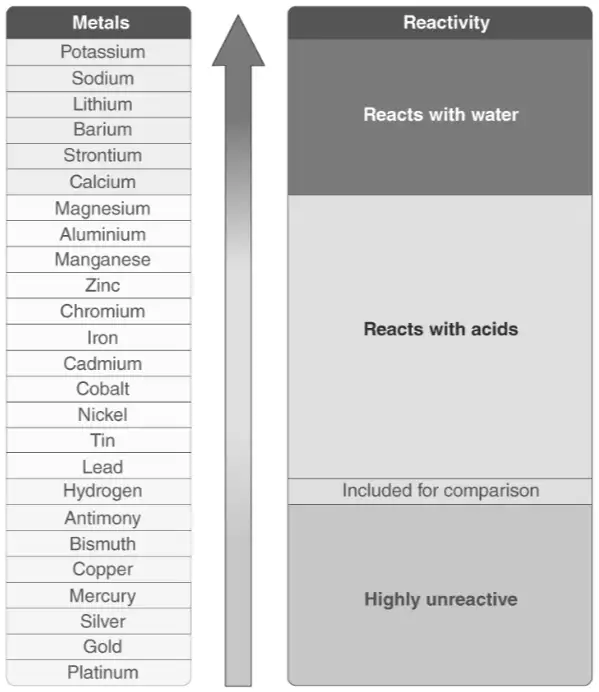
Chart illustrating the Activity Series of Metals
Example: Consider two metals, zinc and copper. Zinc is placed higher in the reactivity series than copper, indicating that zinc can displace copper from its compounds in solution. This property is essential in predicting the outcome of single displacement reactions.
Key Characteristics and Trends in Metal Reactivity
Features Defining the Reactivity Series
Metals positioned at the top of the reactivity series are strong reducing agents because they easily lose electrons and oxidize. These metals tend to corrode or tarnish quickly when exposed to air. As we move down the series, the metals become less reactive, and their ability to donate electrons diminishes.
Electropositivity, which is the tendency to lose electrons, also decreases down the series. Metals above hydrogen in the series can react with dilute acids like hydrochloric acid or sulfuric acid to release hydrogen gas. Additionally, metals higher in the series can displace metals lower in the series from their salt solutions.
Extracting metals higher in the series from their ores requires more energy due to their strong affinity for oxygen and other elements. This trend is crucial in metallurgy and industrial applications.
Example: Magnesium, which is above hydrogen in the reactivity series, reacts with dilute hydrochloric acid to produce magnesium chloride and hydrogen gas, as shown in the reaction:
\[ \text{Mg} + 2\text{HCl} \rightarrow \text{MgCl}_2 + \text{H}_2 \]
Applications of the Reactivity Series in Chemical Reactions
Predicting Metal Reactions with Water
Metals such as potassium, sodium, and calcium, which rank high in the reactivity series, react vigorously with cold water to form metal hydroxides and release hydrogen gas. This reaction is a clear indicator of their high reactivity.
Potassium reacting with water producing potassium hydroxide and hydrogen gas
Example: When potassium reacts with water, the products formed are potassium hydroxide and hydrogen gas. The balanced chemical equation is:
\[ 2\text{K} + 2\text{H}_2\text{O} \rightarrow 2\text{KOH} + \text{H}_2 \]
Metal Interaction with Acids
Metals above lead in the reactivity series react with dilute acids such as hydrochloric acid or sulfuric acid to form salts and liberate hydrogen gas. This property is useful in identifying reactive metals and understanding their chemical behavior.
Zinc reacting with sulfuric acid to form zinc sulfate and hydrogen gas
Example: Zinc reacts with sulfuric acid to produce zinc sulfate and hydrogen gas. The reaction is represented as:
\[ \text{Zn} + \text{H}_2\text{SO}_4 \rightarrow \text{ZnSO}_4 + \text{H}_2 \]
Single Displacement Reactions Among Metals
In single displacement reactions, a metal higher in the reactivity series can replace a metal lower in the series from its salt solution. This principle is widely applied in metal extraction and purification processes.
Zinc displacing copper from copper sulfate solution
Example: Zinc metal can displace copper from copper sulfate solution, forming zinc sulfate and copper metal. The chemical equation is:
\[ \text{Zn} (s) + \text{CuSO}_4 (aq) \rightarrow \text{ZnSO}_4 (aq) + \text{Cu} (s) \]
Summary Table: Reactivity Series Highlights
Metal | Reactivity Level | Reaction with Water | Reaction with Acids | Displacement Ability |
|---|---|---|---|---|
Potassium (K) | Very High | Reacts vigorously with cold water | Reacts with dilute acids | Displaces all metals below it |
Calcium (Ca) | High | Reacts with cold water | Reacts with dilute acids | Displaces metals below it |
Zinc (Zn) | Moderate | Does not react with cold water | Reacts with dilute acids | Displaces metals below it |
Lead (Pb) | Low | No reaction with cold water | Reacts slowly with acids | Displaces metals below it |
Copper (Cu) | Very Low | No reaction with water | No reaction with dilute acids | Cannot displace metals above it |
Gold (Au) | Least Reactive | No reaction | No reaction | Cannot displace any metal |
Glossary of Key Terms
Term | Definition |
|---|---|
Reactivity Series | A list of metals arranged in order of decreasing reactivity. |
Reducing Agent | A substance that donates electrons in a chemical reaction. |
Oxidation | The loss of electrons by a substance during a chemical reaction. |
Displacement Reaction | A reaction where a more reactive metal replaces a less reactive metal from its compound. |
Electropositivity | The tendency of an element to lose electrons and form positive ions. |
Corrosion | The gradual destruction of metals by chemical reactions with the environment. |
Hydrogen Gas | A colorless, flammable gas released during reactions of metals with acids or water. |
Metal Hydroxide | A compound formed when metals react with water. |
Noble Metals | Metals like gold and platinum that resist corrosion and oxidation. |
Salt Solution | An aqueous solution containing metal ions and their corresponding anions. |
Frequently Asked Questions
What information does the reactivity series provide?
The reactivity series ranks metals by their chemical activity, helping predict their reactions with water, acids, and other metals, including displacement capabilities.
Which metal is considered the least reactive?
Platinum is among the least reactive metals, known for its resistance to corrosion and oxidation, often found in its pure form in nature.
How does the reactivity series relate to metal extraction?
Metals higher in the series require more energy-intensive methods for extraction due to their strong chemical bonds, while less reactive metals are easier to isolate.
Why is hydrogen included in the reactivity series?
Hydrogen is included as a reference point to compare metal reactivities, especially to determine which metals can displace hydrogen from acids.
Can metals below hydrogen in the series react with acids?
Metals below hydrogen generally do not react with dilute acids to release hydrogen gas, indicating their lower reactivity.