Understanding pH: The Measure of Acidity and Alkalinity
Fundamentals of pH and Its Measurement
Concept and Calculation of pH
The pH value quantifies the acidity or basicity of a solution by measuring the concentration of hydrogen ions (\(H^+\)) present. It is defined mathematically as the negative logarithm (base 10) of the hydrogen ion concentration:
\[ \text{pH} = -\log [H^+] \]
This logarithmic scale inversely relates to the hydrogen ion concentration, meaning that a lower pH corresponds to a higher concentration of \(H^+\) ions, indicating acidity, while a higher pH indicates alkalinity.
To measure pH, instruments such as pH meters with glass electrodes or colorimetric indicators like litmus paper are commonly used. These tools help determine the pH by comparing the potential difference between a hydrogen electrode and a reference electrode.
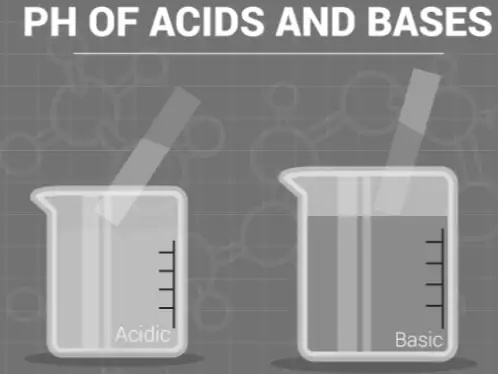
Visual representation of acids and bases on the pH scale
Example Problem
Calculate the pH of a solution with a hydrogen ion concentration of \(2.5 \times 10^{-4} \text{ mol/L}\).
Solution:
Using the formula:
\[ \text{pH} = -\log [H^+] = -\log (2.5 \times 10^{-4}) \]
Calculate the logarithm:
\[ \log (2.5 \times 10^{-4}) = \log 2.5 + \log 10^{-4} = 0.3979 - 4 = -3.6021 \]
Therefore,
\[ \text{pH} = -(-3.6021) = 3.60 \]
The solution is acidic with a pH of 3.60.
Classification and Behavior of Acids and Bases on the pH Scale
Understanding Acidic, Neutral, and Basic Solutions
The pH scale ranges from 0 to 14, where values below 7 indicate acidic solutions, 7 represents neutrality, and values above 7 correspond to basic (alkaline) solutions. The strength of acids and bases depends on the concentration of hydrogen ions (\(H^+\)) and hydroxide ions (\(OH^-\)) respectively.
Strong acids have a high concentration of \(H^+\) ions and thus a low pH, while strong bases have a high concentration of \(OH^-\) ions and a high pH. The relationship between hydronium ion concentration \([H_3O^+]\) and hydroxide ion concentration \([OH^-]\) in aqueous solutions is given by the ionic product of water:
\[ K_w = [H_3O^+][OH^-] = 1.0 \times 10^{-14} \text{ at } 25^\circ \text{C} \]
Taking negative logarithms, we get:
\[ pK_w = pH + pOH = 14 \]
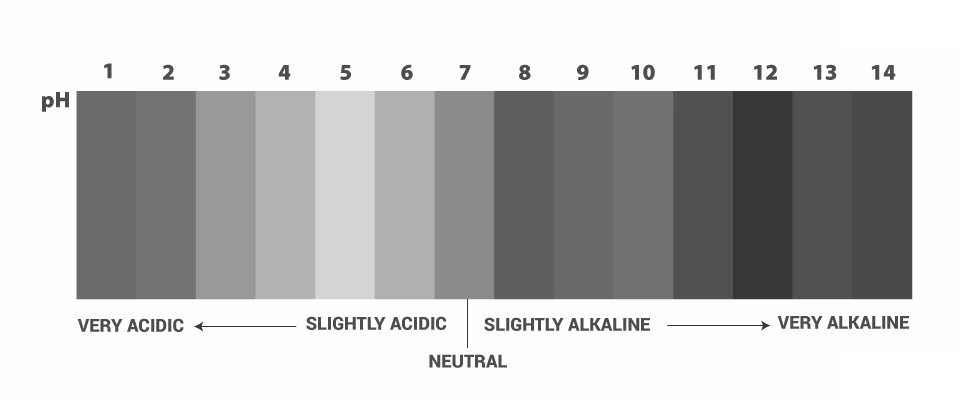
The pH scale illustrating acidic, neutral, and basic zones
Example Problem
Determine the pH of a potassium hydroxide (KOH) solution with hydroxide ion concentration \([OH^-] = 5.0 \times 10^{-3} \text{ mol/L}\).
Solution:
First, calculate \(pOH\):
\[ pOH = -\log [OH^-] = -\log (5.0 \times 10^{-3}) = -(\log 5.0 + \log 10^{-3}) = -(0.6990 - 3) = 2.301 \]
Then, find pH using the relation:
\[ pH = 14 - pOH = 14 - 2.301 = 11.699 \]
The solution is basic with a pH of approximately 11.70.
Factors Influencing pH and Its Practical Significance
Variations in pH of Natural Water and Temperature Effects
The pH of natural water bodies varies due to environmental factors such as the type of soil and rock in the area, biological activity, and temperature changes. For instance, limestone-rich regions tend to neutralize acidity more effectively than granite areas.
When aquatic plants die and decompose, they release carbon dioxide which forms weak carbonic acid in water, lowering the pH. Additionally, temperature influences the ionization of water; as temperature rises, water dissociates more, increasing \(H^+\) concentration and thus decreasing pH.
At 100°C, the neutral pH of pure water shifts to approximately 6.14 due to increased ionization, although the water remains neutral because the concentrations of \(H^+\) and \(OH^-\) remain equal.
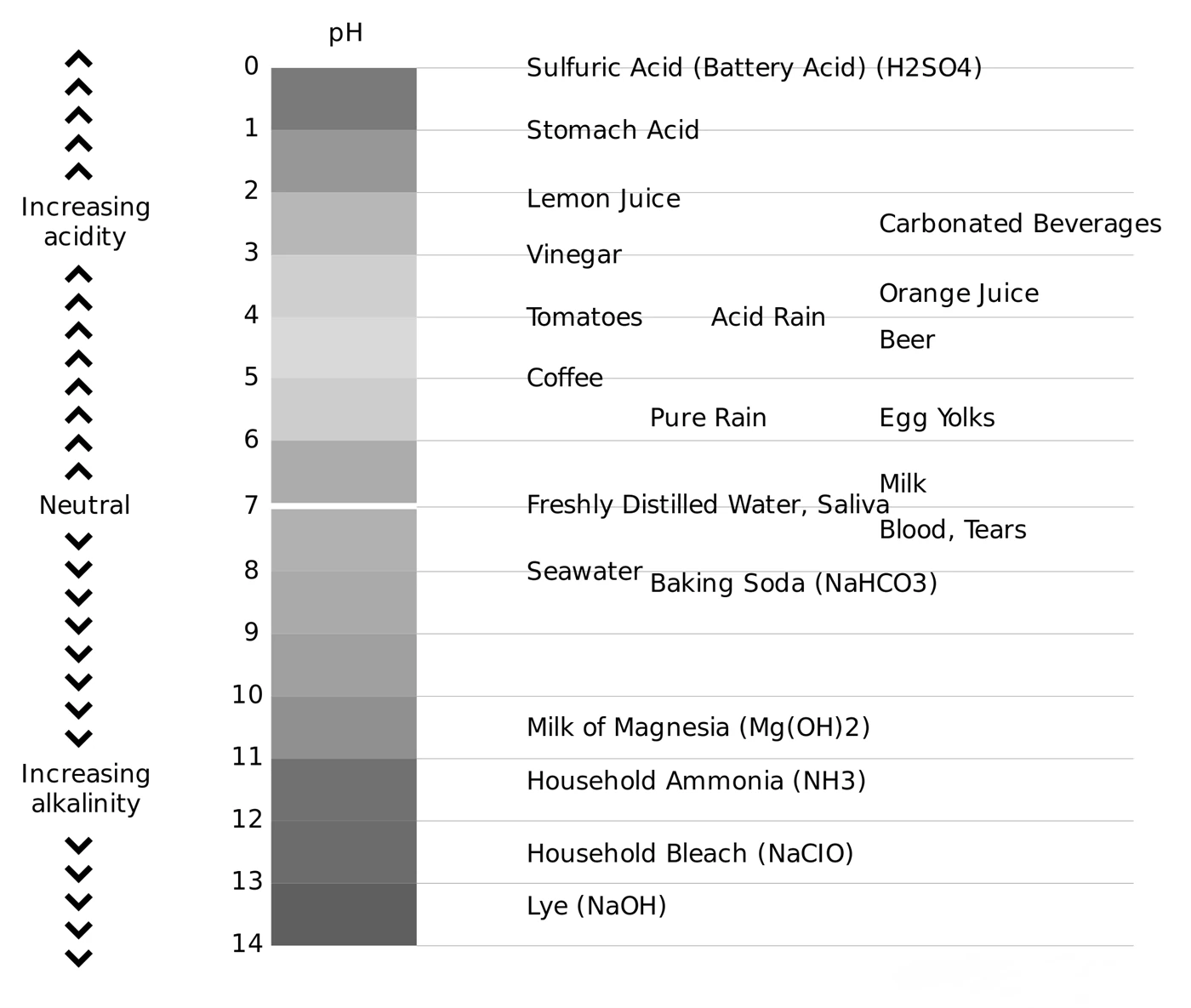
Chart correlating pH values with solution acidity or basicity
Example Problem
Explain why the pH of pure water decreases as temperature increases.
Answer:
Increasing temperature enhances molecular vibrations, promoting water ionization.
This results in a higher concentration of hydrogen ions (\(H^+\)) and hydroxide ions (\(OH^-\)).
Since both ion concentrations increase equally, water remains neutral, but the pH value decreases.
At elevated temperatures, the neutral pH shifts below 7, for example, to 6.14 at 100°C.
Summary Table: Key Points on pH
Aspect | Details |
|---|---|
Definition | Negative logarithm of hydrogen ion concentration: \( \text{pH} = -\log [H^+] \) |
pH Range | 0 (strongly acidic) to 14 (strongly basic), 7 is neutral |
Acidic Solution | pH < 7, \([H_3O^+] > [OH^-]\) |
Neutral Solution | pH = 7, \([H_3O^+] = [OH^-]\) |
Basic Solution | pH > 7, \([H_3O^+] < [OH^-]\) |
Effect of Temperature | pH decreases with temperature increase; neutral pH shifts below 7 |
Measurement Tools | pH meter, glass electrode, litmus paper |
Limitations | pH scale less accurate at very high acid concentrations; Hammett acidity function used instead |
Importance | Vital for biological systems, water quality, digestion, and chemical reactions |
Discovery | Introduced by Søren Sørensen in 1909 |
Glossary of Important Terms
Term | Definition |
|---|---|
pH | Measure of hydrogen ion concentration in a solution |
Acid | Substance that increases \(H^+\) ion concentration in solution |
Base | Substance that increases \(OH^-\) ion concentration in solution |
Neutral Solution | Solution where \(H^+\) and \(OH^-\) concentrations are equal |
Hydronium Ion (\(H_3O^+\)) | Water molecule bonded to an extra proton, representing \(H^+\) in aqueous solution |
pOH | Negative logarithm of hydroxide ion concentration |
Ionic Product of Water (\(K_w\)) | Product of concentrations of \(H_3O^+\) and \(OH^-\) ions in water |
Litmus Paper | Indicator paper used to test acidity or alkalinity |
Logarithmic Scale | Scale based on powers of ten, used for pH to handle wide concentration ranges |
Hammett Acidity Function | Measure of acidity used for very concentrated acid solutions where pH is insufficient |
Frequently Asked Questions
What does the pH scale represent in chemistry?
The pH scale indicates the acidity or alkalinity of a solution by measuring the concentration of hydrogen ions, ranging typically from 0 (strong acid) to 14 (strong base), with 7 being neutral.
What is the ideal pH range for the human body?
The optimal pH for human blood and tissues is approximately 7.2, slightly alkaline. Saliva and urine may show slightly lower pH values due to other components.
What is the full form of pH?
pH stands for "potential of Hydrogen," referring to the concentration of hydrogen ions in a solution.
Why is monitoring pH in water important?
pH indicates the chemical nature of water, affecting aquatic life and water quality. Changes in pH can signal pollution or chemical changes in the water.
What causes high pH levels in natural water sources?
High pH in water often results from the presence of alkaline minerals like carbonates and bicarbonates from surrounding rocks and soil, especially in calcareous regions.