Understanding the Periodic Arrangement of Elements
Origins and Necessity of Element Classification
Why Organizing Elements Became Essential
All substances around us are composed of fundamental units called elements. In the early 19th century, only 31 elements were identified, making it manageable to study each individually. However, by the mid-1800s, technological progress led to the discovery of over 90 elements, and today, 118 elements are known, including some artificially created ones.
This rapid increase made it impractical to analyze each element separately. Scientists sought a systematic approach to categorize elements based on their properties, leading to the development of the periodic classification system. This arrangement helps reveal recurring trends and simplifies the study of chemical behavior.
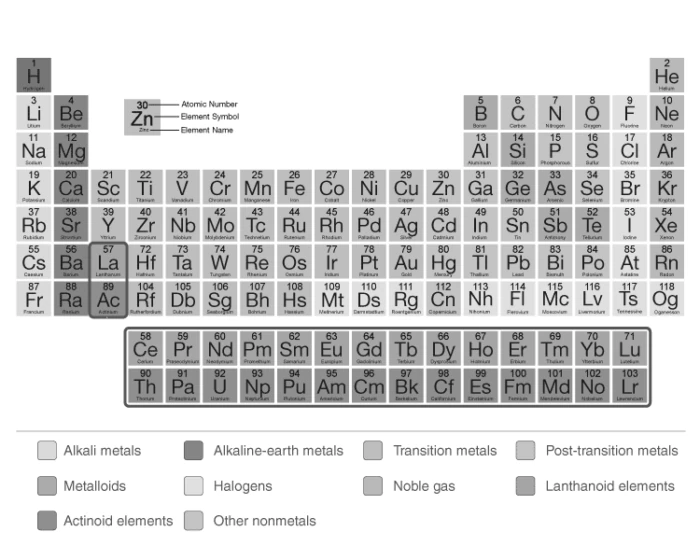
Illustration of the Periodic Classification of Elements
Example: Suppose in 1820, only 31 elements were known. By 1870, 94 elements were discovered. Calculate the percentage increase in the number of known elements over 50 years.
Solution:
Initial elements = 31
Final elements = 94
Percentage increase = \(\frac{94 - 31}{31} \times 100 = \frac{63}{31} \times 100 \approx 203.23\%\)
Thus, the number of known elements increased by approximately 203.23% in 50 years.
Features of the Modern Periodic Table
Structure and Grouping of Elements
The contemporary periodic table arranges elements in ascending order of their atomic numbers, which correspond to the number of protons in an atom's nucleus. It consists of 18 vertical columns called groups and 7 horizontal rows known as periods.
Groups 1, 2, and 13 to 17 are known as the main group or representative elements, exhibiting predictable chemical properties. Groups 3 to 12 contain transition metals, characterized by variable oxidation states and complex chemistry. Additionally, the f-block elements include lanthanides (atomic numbers 58 to 71) and actinides (atomic numbers 90 to 103), often displayed separately at the bottom of the table.
Layout of the Modern Periodic Table
Example: Identify the group and period of an element with atomic number 26 and describe its classification.
Solution:
Atomic number 26 corresponds to iron (Fe).
Iron is located in group 8 and period 4 of the periodic table.
It is classified as a transition element because it lies within groups 3 to 12.
Importance and Applications of Periodic Classification
Benefits of Grouping Elements Periodically
Periodic classification streamlines the study of elements by grouping those with similar properties together. This organization allows scientists and students to predict the behavior of unknown elements based on their group characteristics.
Moreover, the periodic table aids in the discovery of new elements by highlighting gaps where undiscovered elements might fit, maintaining the periodic trends without disruption.
Significance of Periodic Classification in Chemistry
Example: How does the periodic table help predict the properties of an element with atomic number 119?
Solution:
Since element 119 is not yet discovered, scientists use the periodic table to predict its properties by examining elements in group 1 and period 8.
It is expected to be an alkali metal with properties similar to other group 1 elements, such as high reactivity and a single valence electron.
Quick Reference: Key Points on Periodic Classification
Aspect | Details |
|---|---|
Number of Elements Known | 118 (including synthetic elements) |
Arrangement Basis | Increasing atomic number (number of protons) |
Groups | 18 vertical columns |
Periods | 7 horizontal rows |
Main Group Elements | Groups 1, 2, 13 to 17 (representative elements) |
Transition Elements | Groups 3 to 12 |
Lanthanides | Atomic numbers 58 to 71 (f-block) |
Actinides | Atomic numbers 90 to 103 (f-block) |
Periodic Law | Properties of elements are periodic functions of their atomic numbers |
Purpose | To group elements with similar properties and predict unknown elements |
Glossary of Important Terms
Term | Definition |
|---|---|
Atomic Number | The number of protons in the nucleus of an atom |
Element | A pure substance consisting of only one type of atom |
Group | Vertical column in the periodic table with elements having similar properties |
Period | Horizontal row in the periodic table indicating energy levels |
Main Group Elements | Elements in groups 1, 2, and 13 to 17 with typical chemical properties |
Transition Elements | Elements in groups 3 to 12 with variable oxidation states |
Lanthanides | Elements with atomic numbers 58 to 71, part of the f-block |
Actinides | Elements with atomic numbers 90 to 103, radioactive f-block elements |
Periodic Law | The principle that element properties repeat periodically when arranged by atomic number |
Synthetic Elements | Elements artificially created in laboratories, not found naturally |
Frequently Asked Questions
Why was it necessary to classify elements?
Classifying elements groups those with similar properties together, making it easier to study and predict their behavior rather than examining each element individually.
What were the drawbacks of Dobereiner's triads?
Dobereiner could only identify three triads, covering just 9 elements, leaving most known elements unclassified, limiting the usefulness of his system.
How does periodic classification benefit chemists?
It enables prediction of element and compound properties based on position in the table, facilitating comparison and understanding of chemical behavior.
Which elements are considered main group elements?
Main group elements include those in groups 1, 2, and 13 to 17, such as helium, lithium, carbon, nitrogen, oxygen, and fluorine, representing typical chemical properties.
What are the two primary types of alloys?
Alloys are mainly classified as substitutional alloys, where atoms of one metal replace another (e.g., brass), and interstitial alloys, where smaller atoms fit into spaces between metal atoms.