Comprehensive Guide to Oxidation and Reduction Reactions
Fundamentals of Oxidation and Reduction
Understanding Oxidation Processes
Oxidation traditionally refers to the chemical process where a substance gains oxygen or an electronegative element, or loses hydrogen or an electropositive element. From a modern electronic perspective, oxidation is defined as the loss of electrons by an atom or ion during a chemical reaction. This electron loss results in an increase in the oxidation state of the species involved.
For example, when carbon reacts with oxygen to form carbon dioxide, carbon undergoes oxidation by gaining oxygen:
Example Reaction: \( \mathrm{C} + \mathrm{O}_2 \rightarrow \mathrm{CO}_2 \)
Example Problem:
In the reaction of iron with sulfur to form iron sulfide, identify the species oxidized and the oxidizing agent.
Solution:
Reaction: \( \mathrm{Fe} + \mathrm{S} \rightarrow \mathrm{FeS} \)
Iron (Fe) loses electrons and combines with sulfur, so iron is oxidized.
Sulfur gains electrons and acts as the oxidizing agent.
Clarifying Reduction Concepts
Reduction is the reverse of oxidation. Classically, it involves the addition of hydrogen or an electropositive element, or the removal of oxygen or an electronegative element. Electronically, reduction is the gain of electrons by an atom or ion, leading to a decrease in its oxidation state.
For instance, nitrogen is reduced when it reacts with hydrogen to form ammonia:
Example Reaction: \( \mathrm{N}_2 + 3\mathrm{H}_2 \rightarrow 2\mathrm{NH}_3 \)
Example Problem:
In the reaction \( \mathrm{ZnO} + \mathrm{C} \rightarrow \mathrm{Zn} + \mathrm{CO} \), determine which species is reduced and which is oxidized.
Solution:
Zinc oxide (ZnO) loses oxygen and is reduced to zinc metal.
Carbon gains oxygen to form carbon monoxide and is oxidized.
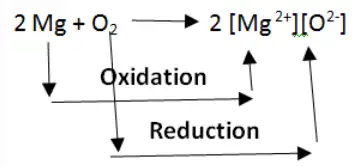
Visual representation of oxidation and reduction
Electron Transfer Perspective on Redox Reactions
Electron Movement in Oxidation and Reduction
In modern chemistry, oxidation and reduction are best understood as electron transfer processes. Oxidation involves the loss of electrons, while reduction involves the gain of electrons. This concept is often remembered by the mnemonic OIL RIG: Oxidation Is Loss, Reduction Is Gain.
Since electrons cannot be created or destroyed, oxidation and reduction always occur simultaneously in a reaction, collectively called redox reactions.
For example, magnesium metal reacts with oxygen by losing electrons (oxidation) while oxygen gains those electrons (reduction):
\[ \mathrm{Mg} \rightarrow \mathrm{Mg}^{2+} + 2e^{-} \quad \text{(oxidation)} \]
\[ \mathrm{O}_2 + 4e^{-} \rightarrow 2\mathrm{O}^{2-} \quad \text{(reduction)} \]
The substance that causes oxidation by accepting electrons is called the oxidizing agent, while the one that causes reduction by donating electrons is the reducing agent.
Example Problem:
In the reaction \( \mathrm{2KI} + \mathrm{H}_2\mathrm{O}_2 \rightarrow \mathrm{I}_2 + 2\mathrm{KOH} \), identify the oxidizing and reducing agents.
Solution:
Potassium iodide (KI) loses electrons and is oxidized, acting as the reducing agent.
Hydrogen peroxide (\( \mathrm{H}_2\mathrm{O}_2 \)) gains electrons and is reduced, acting as the oxidizing agent.
Common Types of Redox Reactions and Their Balancing
Varieties of Redox Reactions
Redox reactions manifest in several common forms:
Combustion: A reaction where a compound reacts with oxygen to produce oxides, releasing energy. Example:
\[ 2\mathrm{C}_4\mathrm{H}_{10} + 13\mathrm{O}_2 \rightarrow 8\mathrm{CO}_2 + 10\mathrm{H}_2\mathrm{O} \]
Disproportionation: A single substance undergoes simultaneous oxidation and reduction. Example:
\[ 3\mathrm{ClO}^- \rightarrow \mathrm{ClO}_3^- + 2\mathrm{Cl}^- \]
Single Displacement: An element replaces another in a compound. Example:
\[ \mathrm{Zn} + 2\mathrm{HCl} \rightarrow \mathrm{ZnCl}_2 + \mathrm{H}_2 \]
Example Problem:
Classify the reaction \( \mathrm{Fe} + \mathrm{CuSO}_4 \rightarrow \mathrm{FeSO}_4 + \mathrm{Cu} \) and identify the oxidizing and reducing agents.
Solution:
This is a single displacement redox reaction.
Iron (Fe) loses electrons and is oxidized (reducing agent).
Copper ion (\( \mathrm{Cu}^{2+} \)) gains electrons and is reduced (oxidizing agent).
Balancing Redox Equations
Balancing redox reactions is essential to satisfy the law of conservation of mass and charge. Two common methods are used:
Oxidation Number Method
This method involves assigning oxidation states to atoms, identifying changes, and balancing the increase and decrease in oxidation numbers.
Example Problem:
Balance the reaction \( \mathrm{PbO}_2 + \mathrm{HCl} \rightarrow \mathrm{PbCl}_2 + \mathrm{Cl}_2 + \mathrm{H}_2\mathrm{O} \) using the oxidation number method.
Solution:
Assign oxidation numbers: Pb in \( \mathrm{PbO}_2 \) is +4, Pb in \( \mathrm{PbCl}_2 \) is +2, Cl in HCl is -1, Cl in \( \mathrm{Cl}_2 \) is 0.
Pb is reduced from +4 to +2 (gain of 2 electrons), Cl is oxidized from -1 to 0 (loss of electrons).
Balance electrons lost and gained by multiplying accordingly.
Balance atoms and charges to get the final balanced equation:
\[ \mathrm{PbO}_2 + 4\mathrm{HCl} \rightarrow \mathrm{PbCl}_2 + \mathrm{Cl}_2 + 2\mathrm{H}_2\mathrm{O} \]
Ion-Electron (Half-Reaction) Method
This approach separates the oxidation and reduction processes into half-reactions, balances each for mass and charge, then combines them.
Example Problem:
Balance the redox reaction \( \mathrm{MnO}_4^- + \mathrm{Fe}^{2+} \rightarrow \mathrm{Mn}^{2+} + \mathrm{Fe}^{3+} \) in acidic medium.
Solution:
Oxidation half-reaction: \( \mathrm{Fe}^{2+} \rightarrow \mathrm{Fe}^{3+} + e^- \)
Reduction half-reaction: \( \mathrm{MnO}_4^- + 8\mathrm{H}^+ + 5e^- \rightarrow \mathrm{Mn}^{2+} + 4\mathrm{H}_2\mathrm{O} \)
Multiply oxidation half by 5 to balance electrons:
\[ 5\mathrm{Fe}^{2+} \rightarrow 5\mathrm{Fe}^{3+} + 5e^- \]
Add half-reactions:
\[ \mathrm{MnO}_4^- + 8\mathrm{H}^+ + 5\mathrm{Fe}^{2+} \rightarrow \mathrm{Mn}^{2+} + 4\mathrm{H}_2\mathrm{O} + 5\mathrm{Fe}^{3+} \]

Assigning oxidation numbers to atoms in a reaction

Atoms undergoing oxidation and reduction identified
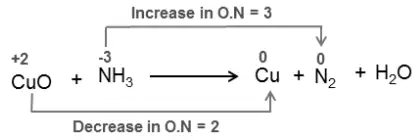
Calculating increase and decrease in oxidation numbers

Balancing oxidation and reduction changes in the equation

Balancing atoms after oxidation number adjustments

Final balancing of hydrogen and oxygen atoms by trial

Half reactions showing oxidation and reduction species
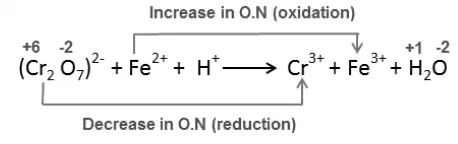
Oxidation half reaction balanced with electrons
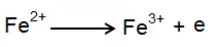
Adding electrons to balance oxidation half reaction

Balancing reduction half reaction with water and hydrogen ions
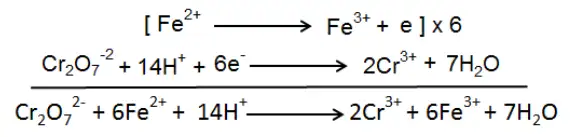
Final balanced redox reaction combining half reactions
Distinguishing Oxidation from Reduction
Key Differences and Interdependence
Oxidation is characterized by the loss of electrons, while reduction involves the gain of electrons. These processes are inseparable in redox reactions, as one species loses electrons and another gains them simultaneously. For example, when metals react with acids, the metal atoms lose electrons (oxidation) and hydrogen ions gain electrons (reduction), producing hydrogen gas.
It is important to note that oxidation does not necessarily require oxygen; it is defined by electron transfer rather than oxygen involvement.
Example Problem:
Explain the redox changes in the reaction \( \mathrm{Fe} + 2\mathrm{HCl} \rightarrow \mathrm{FeCl}_2 + \mathrm{H}_2 \).
Solution:
Iron (Fe) loses two electrons to form \( \mathrm{Fe}^{2+} \) ions (oxidation).
Hydrogen ions (\( \mathrm{H}^+ \)) gain electrons to form hydrogen gas (reduction).
This reaction is a classic example of a redox process involving electron transfer.
Summary and Key Takeaways
Initially, oxidation was understood as the addition of oxygen to a substance, such as magnesium reacting with oxygen to form magnesium oxide. Reduction was seen as the reverse process, where oxygen is removed, restoring the original element.
Modern chemistry defines oxidation as the loss of electrons and reduction as the gain of electrons. These processes always occur together in redox reactions, which are fundamental to many natural and industrial processes.
For example, during the combustion of wood, carbon atoms are oxidized as they lose electrons to oxygen atoms, which are reduced. This electron transfer drives the energy release in combustion.
Redox reaction during combustion of organic material
Quick Reference: Oxidation and Reduction Essentials
Concept | Oxidation | Reduction |
|---|---|---|
Definition (Classical) | Addition of oxygen or electronegative element; removal of hydrogen or electropositive element | Addition of hydrogen or electropositive element; removal of oxygen or electronegative element |
Definition (Electronic) | Loss of electrons | Gain of electrons |
Oxidation State | Increases | Decreases |
Agent | Reducing agent (donates electrons) | Oxidizing agent (accepts electrons) |
Example | \( \mathrm{Fe} \rightarrow \mathrm{Fe}^{3+} + 3e^- \) | \( \mathrm{Cl}_2 + 2e^- \rightarrow 2\mathrm{Cl}^- \) |
Mnemonic | OIL RIG: Oxidation Is Loss, Reduction Is Gain (of electrons) | |
Glossary of Key Terms
Term | Meaning |
|---|---|
Oxidation | Process involving loss of electrons or gain of oxygen |
Reduction | Process involving gain of electrons or loss of oxygen |
Redox Reaction | Chemical reaction involving simultaneous oxidation and reduction |
Oxidizing Agent | Substance that accepts electrons and causes oxidation |
Reducing Agent | Substance that donates electrons and causes reduction |
Oxidation Number | Charge assigned to an atom to indicate its degree of oxidation |
Half Reaction | Equation representing either oxidation or reduction separately |
Combustion | Redox reaction involving oxygen and a fuel producing oxides |
Disproportionation | Reaction where a single species is both oxidized and reduced |
Single Displacement | Reaction where one element replaces another in a compound |
Frequently Asked Questions (FAQs)
What distinguishes oxidation from reduction?
Oxidation involves losing electrons, while reduction involves gaining electrons. Both occur simultaneously in redox reactions.
Why are redox reactions important?
They are fundamental to energy production in biological systems and industrial processes, enabling electron transfer and energy release.
How is the oxidation state useful?
It helps track electron transfer and identify which atoms are oxidized or reduced in a reaction.
Can oxidation occur without oxygen?
Yes, oxidation is defined by electron loss and does not require oxygen presence.
What is an example of a slow oxidation process?
Rusting of iron and decay of wood are examples of gradual oxidation reactions.