Understanding Magnetic Fields and Their Properties
Fundamentals of Magnetic Fields
Defining the Magnetic Field Concept
A magnetic field is the spatial region surrounding a magnet or a moving electric charge where magnetic forces can be detected. It serves as a framework to visualize how magnetic forces are distributed around magnetic materials or currents. This field is a vector field, meaning it has both magnitude and direction, and is generated by moving charges or intrinsic magnetic moments of particles.
Magnetic fields are closely linked with electric fields, together forming the electromagnetic force, one of the fundamental forces in nature.
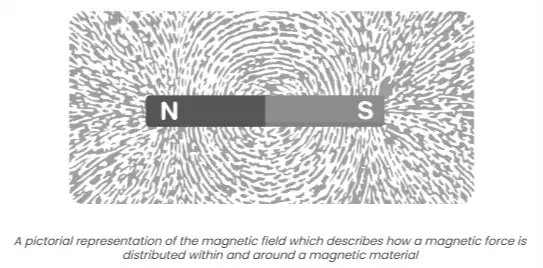
Visual depiction of magnetic field distribution around a magnet
Example Problem
Consider a magnet producing a magnetic field in the surrounding space. If the magnetic field at a point is represented by a vector pointing north with a magnitude of 0.5 T, describe the nature of this field at that point.
Solution:
The magnetic field vector indicates both the direction and strength of the magnetic force at that location.
A magnitude of 0.5 T (Tesla) means the field is moderately strong.
The direction pointing north shows the orientation a north magnetic pole would experience force.
Historical Development and Visualization of Magnetic Fields
Tracing the Evolution of Magnetic Field Understanding
The study of magnetic fields dates back to 1269 when Petrus Peregrinus de Maricourt mapped magnetic poles using iron needles, identifying the concept of north and south poles. Later, William Gilbert proposed that Earth itself behaves like a giant magnet. Subsequent scientists like John Mitchell and Charles-Augustin de Coulomb expanded on magnetic pole interactions and Earth's magnetic field.
In the 19th century, discoveries by Oersted, Ampère, Faraday, and Maxwell established the relationship between electricity and magnetism, culminating in Maxwell's equations that unify these forces.
Representing Magnetic Fields: Vectors and Lines
Magnetic fields can be depicted mathematically as vector fields, where each vector shows the direction and strength of the field at a point. Alternatively, magnetic field lines provide a visual representation, illustrating the path a north magnetic pole would follow.
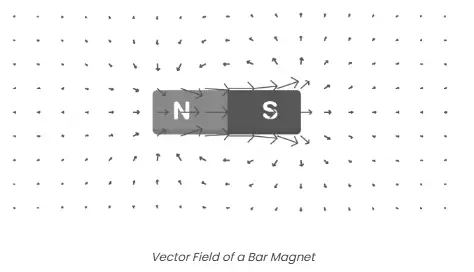
Vector field around a bar magnet showing direction and magnitude
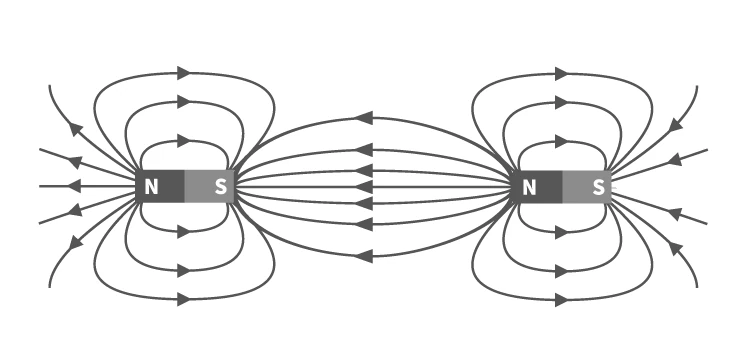
Magnetic field lines illustrating the field around a bar magnet
Example Problem
A bar magnet produces magnetic field lines that are denser near its poles and sparse farther away. Explain what this indicates about the magnetic field strength.
Solution:
The density of magnetic field lines correlates with the field's strength.
Near the poles, where lines are crowded, the magnetic field is stronger.
As the distance from the poles increases, the field weakens, shown by fewer lines.
Quantifying and Generating Magnetic Fields
Understanding Magnetic Field Intensity
Magnetic field intensity, denoted by the vector \( \mathbf{H} \), measures the magnetizing force within a material. It relates to the magnetic flux density \( \mathbf{B} \), magnetization \( \mathbf{M} \), and magnetic permeability \( \mu \) through the formula:
\[ \mathbf{H} = \frac{\mathbf{B}}{\mu} - \mathbf{M} \]
The SI unit for magnetic field intensity is amperes per meter (A/m), while magnetic flux density is measured in tesla (T). One tesla corresponds to the magnetic field that exerts a force of one newton on a one-meter length of wire carrying one ampere of current.
Magnetic Fields from Electric Currents
When electric charges move through a conductor, they generate a magnetic field around it. According to Ampère's law, the magnetic field \( B \) at a distance \( r \) from a long straight conductor carrying current \( I \) is given by:
\[ B = \frac{\mu_0 I}{2 \pi r} \]
Here, \( \mu_0 = 4\pi \times 10^{-7} \, \text{T}\cdot\text{m/A} \) is the permeability of free space. The magnetic field direction can be determined using the right-hand rule: if the thumb points in the current's direction, the curled fingers show the magnetic field's circular direction around the wire.
Example Problem
A wire carries a current of 3 A. Calculate the magnetic field at a point 0.05 m away from the wire.
Solution:
Using the formula:
\[ B = \frac{\mu_0 I}{2 \pi r} = \frac{4\pi \times 10^{-7} \times 3}{2 \pi \times 0.05} = \frac{12\pi \times 10^{-7}}{2 \pi \times 0.05} \]
Simplify numerator and denominator:
\[ B = \frac{12 \times 10^{-7}}{2 \times 0.05} = \frac{12 \times 10^{-7}}{0.1} = 1.2 \times 10^{-5} \text{ T} \]
Therefore, the magnetic field at 0.05 m from the wire is \(1.2 \times 10^{-5} \text{ T}\).
Electron Motion and Magnetism in Materials
Permanent magnets owe their properties to the motion and spin of electrons within atoms. Most electrons are paired with opposite spins, canceling magnetic effects. Materials with unpaired electrons having aligned spins, like iron with four unpaired electrons, exhibit magnetism.
For a material to be magnetic, the atomic magnetic moments must align in a stable manner, forming a ferromagnet. Some materials only show magnetism when exposed to an external magnetic field, known as paramagnetic materials, where alignment disappears once the field is removed.
Electron spin alignment contributing to magnetism in materials
Summary and Quick Reference
Term | Definition | Unit |
|---|---|---|
Magnetic Field | Region around a magnet or moving charge where magnetic force acts | Tesla (T) |
Magnetic Field Intensity (\( \mathbf{H} \)) | Magnetizing force per unit length in a material | Amperes per meter (A/m) |
Magnetic Flux Density (\( \mathbf{B} \)) | Magnetic field strength including material response | Tesla (T) |
Permeability (\( \mu \)) | Measure of material's ability to support magnetic field | Henries per meter (H/m) |
Permeability of Free Space (\( \mu_0 \)) | Constant for vacuum magnetic permeability | 4π × 10⁻⁷ T·m/A |
Right-Hand Rule | Method to determine magnetic field direction around current | — |
Ferromagnetism | Permanent magnetism due to aligned electron spins | — |
Paramagnetism | Temporary magnetism induced by external magnetic field | — |
Magnetic Poles | Points where magnetic field lines emerge or terminate | — |
Magnetic Field Lines | Imaginary lines representing magnetic field direction and strength | — |
Glossary of Key Terms
Term | Meaning |
|---|---|
Magnetic Field | Space around magnets or currents where magnetic forces act |
Magnetic Flux Density (\( \mathbf{B} \)) | Measure of magnetic field strength including material effects |
Magnetic Field Intensity (\( \mathbf{H} \)) | Magnetizing force per unit length in a material |
Permeability (\( \mu \)) | Property of material indicating how it supports magnetic fields |
Right-Hand Rule | Technique to find magnetic field direction around current |
Ferromagnetism | Permanent magnetism due to aligned electron spins |
Paramagnetism | Temporary magnetism induced by external magnetic fields |
Magnetic Poles | Locations where magnetic field lines start or end |
Electromagnetic Induction | Generation of electric field by changing magnetic field |
Magnetic Field Lines | Imaginary lines showing magnetic field direction and strength |
Frequently Asked Questions
Why are magnetic field lines important in understanding magnetism?
Magnetic field lines provide a visual representation of the magnetic field's direction and strength. The tangent to a line at any point shows the field direction, while the density of lines indicates the field's magnitude, helping to understand how magnetic forces vary in space.
What generates Earth's magnetic field?
Earth's magnetic field is produced by the movement of liquid iron in its outer core, which creates electric currents. These currents generate magnetic fields that combine to form a large-scale magnetic field enveloping the planet, maintained by the geodynamo process.
How is magnetic field intensity different from magnetic flux density?
Magnetic field intensity (\( \mathbf{H} \)) measures the magnetizing force applied to a material, while magnetic flux density (\( \mathbf{B} \)) represents the total magnetic field including the material's response. They are related but distinct quantities.
Can magnetic fields exist in outer space?
Yes, magnetic fields are present throughout space, generated by celestial bodies, plasma movements, and cosmic currents, influencing phenomena such as solar winds and cosmic radiation.
What is the significance of the right-hand rule in magnetism?
The right-hand rule helps determine the direction of the magnetic field around a current-carrying conductor, essential for understanding and predicting magnetic effects in circuits and devices.