Understanding Ionic Compounds: Structure, Properties, and Examples
Fundamentals of Ionic Compounds and Their Formation
Nature and Formation of Ionic Compounds
Ionic compounds are crystalline solids composed of ions arranged in a highly ordered lattice. These compounds typically arise when metals react with non-metals, resulting in the transfer of electrons. Metals tend to lose electrons, forming positively charged ions (cations), while non-metals gain electrons, forming negatively charged ions (anions). This electron exchange allows both elements to achieve a stable noble gas electron configuration, often referred to as the octet rule.
The electrostatic attraction between these oppositely charged ions forms strong ionic bonds, which hold the compound together in a rigid three-dimensional structure. This bonding mechanism is the defining characteristic of ionic compounds.
Illustration of Ionic Crystal Structure
The arrangement of ions in an ionic compound depends on the relative sizes of the cations and anions. The ions pack together in a repeating pattern to maximize attraction and minimize repulsion, creating a stable crystal lattice. For instance, in sodium chloride, each sodium ion is surrounded by six chloride ions and vice versa, forming a cubic lattice.
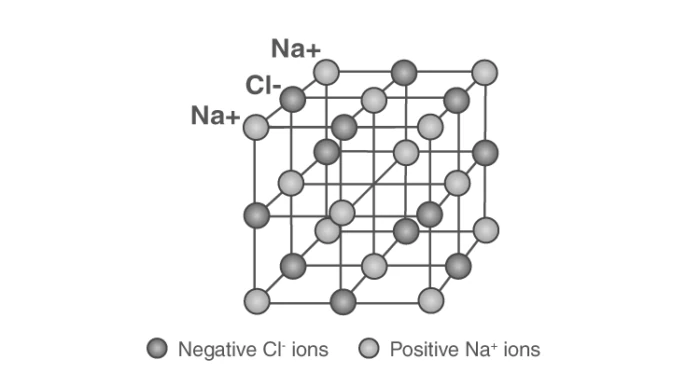
This strong ionic bonding results in a solid with high melting and boiling points due to the significant energy required to break the electrostatic forces holding the ions together.
Solution: Since the metal ion has a charge of \( +2 \) and the non-metal ion has a charge of \( -1 \), two non-metal ions are needed to balance the charge of one metal ion. Therefore, the formula of the compound is \( \text{MX}_2 \).
Characteristics and Properties of Ionic Compounds
Physical Traits and Mechanical Behavior
Ionic compounds are generally hard solids at room temperature due to the strong electrostatic forces between ions. However, they are brittle and tend to shatter when subjected to mechanical stress because shifting the layers of ions causes like charges to align and repel each other, breaking the crystal lattice.
Thermal Properties: Melting and Boiling Points
The strong ionic bonds require substantial energy to overcome, resulting in ionic compounds having high melting and boiling points. This is why salts and similar compounds remain solid at temperatures where many covalent compounds would melt or vaporize.
Solution: The high melting point indicates strong electrostatic attractions between the ions in the lattice. A large amount of thermal energy is needed to disrupt these ionic bonds and allow the ions to move freely, causing melting.
Solubility and Electrical Conductivity
Ionic compounds tend to dissolve well in polar solvents like water because the solvent molecules stabilize the separated ions. Conversely, they are generally insoluble in non-polar solvents such as gasoline. In solid form, ionic compounds do not conduct electricity since ions are fixed in place. However, when melted or dissolved in water, the ions become mobile and can conduct electric current.
Solution: In solid sodium chloride, ions are locked in place within the crystal lattice and cannot move, so no charge flows. When melted, the lattice breaks down, freeing the ions to move and carry electric current.
Illustrative Examples and Ionic Character Assessment
Formation of Magnesium Chloride: A Detailed Example
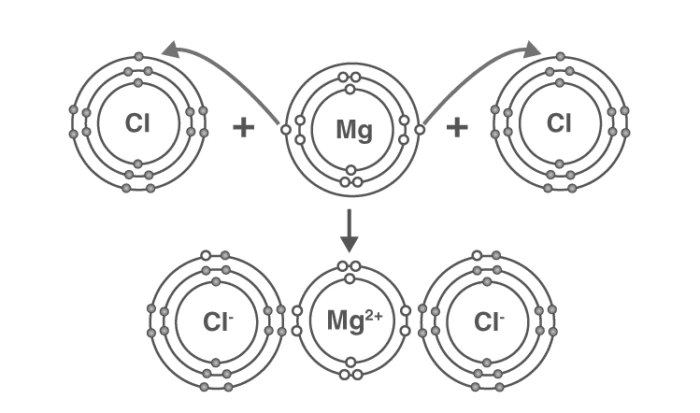
Magnesium has two electrons in its outermost shell and tends to lose both to achieve a stable electron configuration. Chlorine atoms each require one electron to complete their octet. When magnesium reacts with chlorine, it loses two electrons to form \( \text{Mg}^{2+} \), while two chlorine atoms each gain one electron to form two \( \text{Cl}^- \) ions. The resulting compound is magnesium chloride, \( \text{MgCl}_2 \), held together by ionic bonds.
Solution: To balance the charges, the total positive and negative charges must be equal. The least common multiple of 3 and 2 is 6. Therefore, two \( \text{A}^{3+} \) ions and three \( \text{B}^{2-} \) ions combine to form \( \text{A}_2\text{B}_3 \).
Quantifying Ionic Character Using Electronegativity
The ionic character of a bond can be estimated by the difference in electronegativity between the two atoms involved. The greater the difference, the more ionic the bond is. This difference is calculated as:
\[ \Delta \chi = \chi_{\text{non-metal}} - \chi_{\text{metal}} \]
where \( \chi \) represents the electronegativity values. A larger \( \Delta \chi \) indicates a bond with higher ionic character and polarity.
Solution: \[ \Delta \chi = 3.0 - 1.2 = 1.8 \]
This significant difference suggests a bond with strong ionic character.
Summary Table: Key Properties of Ionic Compounds
| Property | Description |
|---|---|
| Physical State | Hard, brittle crystalline solids |
| Melting & Boiling Points | High due to strong ionic bonds |
| Solubility | Soluble in polar solvents like water; insoluble in non-polar solvents |
| Electrical Conductivity | Non-conductive in solid state; conductive when molten or dissolved |
| Bond Type | Electrostatic attraction between cations and anions |
Glossary of Essential Terms
| Term | Definition |
|---|---|
| Cation | A positively charged ion formed by loss of electrons |
| Anion | A negatively charged ion formed by gain of electrons |
| Octet Rule | Atoms tend to gain, lose, or share electrons to have eight electrons in their valence shell |
| Electronegativity | The tendency of an atom to attract electrons in a chemical bond |
| Ionic Bond | Electrostatic force of attraction between oppositely charged ions |
| Crystal Lattice | Regular, repeating arrangement of ions in an ionic solid |
| Polar Solvent | A solvent with molecules that have a partial electric charge, e.g., water |
| Brittleness | The tendency of a material to break or shatter under stress |
| Melting Point | The temperature at which a solid becomes a liquid |
| Electrostatic Attraction | Force between charged particles of opposite sign |
Frequently Asked Questions (FAQs)
What defines an ionic compound?
An ionic compound consists of ions formed by the transfer of electrons between metals and non-metals, held together by strong electrostatic forces.
Can you name some common ionic compounds?
Common ionic compounds include sodium chloride (NaCl), magnesium oxide (MgO), and calcium carbonate (CaCO₃), all characterized by high melting points and brittleness.
How does an ionic bond form?
An ionic bond forms when a metal atom loses electrons to become a cation and a non-metal atom gains those electrons to become an anion, resulting in an electrostatic attraction between them.
Is magnesium oxide an ionic compound?
Yes, magnesium oxide is ionic because magnesium loses two electrons to form \( \text{Mg}^{2+} \) and oxygen gains two electrons to form \( \text{O}^{2-} \), creating a strong ionic bond.
What are the two main components of an ionic compound?
Ionic compounds are composed of cations (positively charged ions) and anions (negatively charged ions) that combine in ratios balancing their charges.