Comprehensive Overview of Ethanol: Properties, Reactions, and Applications
Fundamentals and Molecular Structure of Ethanol
Understanding Ethanol’s Chemical Composition
Ethanol is an organic compound naturally produced through the fermentation of plant materials and can also be synthesized industrially by hydrating ethylene. Its molecular formula is \( \mathrm{C_2H_6O} \), indicating two carbon atoms, six hydrogen atoms, and one oxygen atom. The structural formula, often written as \( \mathrm{C_2H_5OH} \), reveals a two-carbon chain with a hydroxyl group (-OH) attached, classifying it as an alcohol.
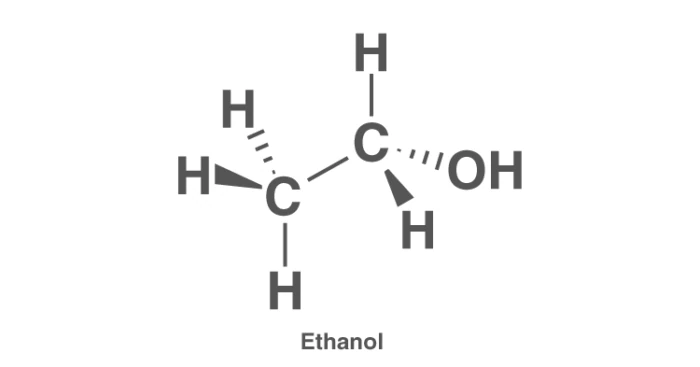
Illustration of Ethanol’s molecular structure
Example Problem
Calculate the molar mass of ethanol given the atomic masses: C = 12 g/mol, H = 1 g/mol, O = 16 g/mol.
Solution:
The molecular formula of ethanol is \( \mathrm{C_2H_6O} \).
Calculating molar mass:
\[ (2 \times 12) + (6 \times 1) + (1 \times 16) = 24 + 6 + 16 = 46 \text{ g/mol} \]
Therefore, the molar mass of ethanol is \( 46 \text{ g/mol} \).
Physical and Chemical Characteristics of Ethanol
Key Properties and Behavior
At ambient conditions, ethanol exists as a clear liquid. It has a melting point of 156 K and boils at 351 K. Ethanol is highly miscible with water in all proportions, making it an excellent solvent for various applications including pharmaceuticals and tinctures. Despite its widespread use, even small amounts of pure ethanol can be toxic, and prolonged consumption leads to serious health complications.
Example Problem
If ethanol boils at 351 K, what is this temperature in degrees Celsius?
Solution:
Using the conversion formula:
\[ T(^{\circ}C) = T(K) - 273 \]
Substituting the boiling point:
\[ 351 - 273 = 78^{\circ}C \]
Thus, ethanol boils at \( 78^{\circ}C \).
Chemical Reactions Involving Ethanol
Interaction with Sodium Metal
Ethanol reacts with sodium metal to produce sodium ethoxide and hydrogen gas. This reaction is a classic example of alcohols reacting with active metals, releasing hydrogen and forming alkoxides.
The balanced chemical equation is:
\[ 2 \mathrm{Na} + 2 \mathrm{C_2H_5OH} \rightarrow 2 \mathrm{C_2H_5ONa} + \mathrm{H_2} \]
Example Problem
Calculate the volume of hydrogen gas produced at STP when 46 g of ethanol reacts completely with sodium.
Solution:
Molar mass of ethanol = 46 g/mol (from previous example).
Moles of ethanol = \( \frac{46}{46} = 1 \) mole.
From the equation, 2 moles of ethanol produce 1 mole of \( \mathrm{H_2} \), so 1 mole ethanol produces \( \frac{1}{2} \) mole \( \mathrm{H_2} \).
At STP, 1 mole of gas occupies 22.4 L, so volume of hydrogen:
\[ \frac{1}{2} \times 22.4 = 11.2 \text{ L} \]
Therefore, 11.2 liters of hydrogen gas is generated.
Acid-Catalyzed Dehydration to Form Alkenes
When ethanol is heated to approximately 443 K in the presence of concentrated sulfuric acid, it undergoes dehydration to form ethene (an alkene) and water. Sulfuric acid acts as a dehydrating agent, removing water from ethanol.
The reaction can be represented as:
\[ \mathrm{C_2H_5OH} \xrightarrow[\text{443 K}]{\mathrm{conc. H_2SO_4}} \mathrm{C_2H_4} + \mathrm{H_2O} \]
Example Problem
Determine the mass of ethene produced when 46 g of ethanol is dehydrated completely.
Solution:
Molar mass of ethanol = 46 g/mol, molar mass of ethene \( \mathrm{C_2H_4} \) = \( (2 \times 12) + (4 \times 1) = 28 \text{ g/mol} \).
Moles of ethanol = \( \frac{46}{46} = 1 \) mole.
From the reaction, 1 mole ethanol produces 1 mole ethene.
Mass of ethene produced = \( 1 \times 28 = 28 \text{ g} \).
Practical Applications and Biological Impact of Ethanol
Industrial and Household Uses
Ethanol is widely used in cosmetics as a preservative and solvent in lotions and tonics. It also serves as a solvent in paints and cleaning agents, preventing microbial growth. Additionally, ethanol is added to gasoline to improve engine performance and reduce knocking.
Ethanol’s role in cosmetics, fuels, and cleaning products
Effects of Alcohol on Living Organisms
Excessive ethanol intake slows metabolic functions and depresses the central nervous system, leading to impaired coordination and drowsiness. Methanol, a toxic alcohol sometimes added to ethanol to prevent misuse (a process called denaturing), metabolizes into formaldehyde in the liver, causing severe cellular damage and potentially fatal outcomes.
Example Problem
Explain why methanol is added to industrial ethanol and describe its effect on the human body.
Answer:
Methanol is added to ethanol to make it unfit for consumption, preventing misuse.
When ingested, methanol is metabolized in the liver to formaldehyde (methanal).
Formaldehyde reacts with body cells causing coagulation of protoplasm, similar to egg coagulation.
This leads to severe poisoning and can result in death.
Quick Reference Summary
Aspect | Details |
|---|---|
Molecular Formula | \( \mathrm{C_2H_6O} \) |
Structural Formula | \( \mathrm{C_2H_5OH} \) |
Physical State at Room Temp | Liquid |
Melting Point | 156 K |
Boiling Point | 351 K (78°C) |
Solubility | Completely miscible with water |
Reaction with Sodium | Produces sodium ethoxide and hydrogen gas |
Dehydration Reaction | Forms ethene and water in presence of conc. H₂SO₄ at 443 K |
Common Uses | Solvent, fuel additive, cosmetics, cleaning agents |
Health Impact | Depresses CNS; methanol contamination is toxic |
Glossary of Key Terms
Term | Definition |
|---|---|
Ethanol | An alcohol with formula \( \mathrm{C_2H_5OH} \), used as solvent and fuel additive. |
Hydroxyl Group | A functional group (-OH) characteristic of alcohols. |
Fermentation | Biological process converting sugars into ethanol and carbon dioxide. |
Dehydration | Removal of water molecule from a compound, often catalyzed by acid. |
Sodium Ethoxide | Salt formed when ethanol reacts with sodium metal. |
Denaturing | Adding toxic substances to ethanol to prevent its consumption. |
Methanol | A toxic alcohol sometimes added to ethanol for denaturing. |
Central Nervous System (CNS) | Part of the nervous system consisting of brain and spinal cord. |
Miscible | Ability of two liquids to mix in all proportions. |
Alkene | Unsaturated hydrocarbon containing at least one carbon-carbon double bond. |
Frequently Asked Questions
What are the primary industrial uses of ethanol?
Ethanol is extensively used as a solvent in chemical synthesis, as a fuel additive in gasoline to improve combustion, and as the main ingredient in alcoholic beverages.
Is ethanol safe to handle and consume?
While ethanol is widely used, it is highly flammable and toxic in pure form. Consumption of pure ethanol can cause severe health issues including coma and death. It should be handled with care.
How does ethanol act as a solvent?
Ethanol dissolves both water and many organic compounds, making it a versatile solvent in pharmaceuticals, cosmetics, and cleaning products.
Why is methanol added to ethanol in industrial products?
Methanol is added to ethanol to denature it, making it poisonous and unsuitable for drinking, thereby preventing misuse.
What happens chemically when ethanol is dehydrated?
Under acidic conditions and heat, ethanol loses a water molecule to form ethene, an alkene, through an elimination reaction.