Fundamentals of Electromagnetic Induction
Understanding the Basics of Electromagnetic Induction
Concept and Discovery of Electromagnetic Induction
Electromagnetic induction refers to the generation of an electric current in a conductor when it is exposed to a changing magnetic field. This phenomenon was first identified by Michael Faraday in 1831, and later mathematically formulated by James Clerk Maxwell as Faraday’s law of induction. The principle explains how voltage, also known as electromotive force (emf), is produced without direct electrical contact, solely due to variations in magnetic flux.
Induction occurs either when a conductor moves through a stationary magnetic field or when the magnetic field around a stationary conductor changes. This interaction causes electrons in the conductor to move, creating an electric current.
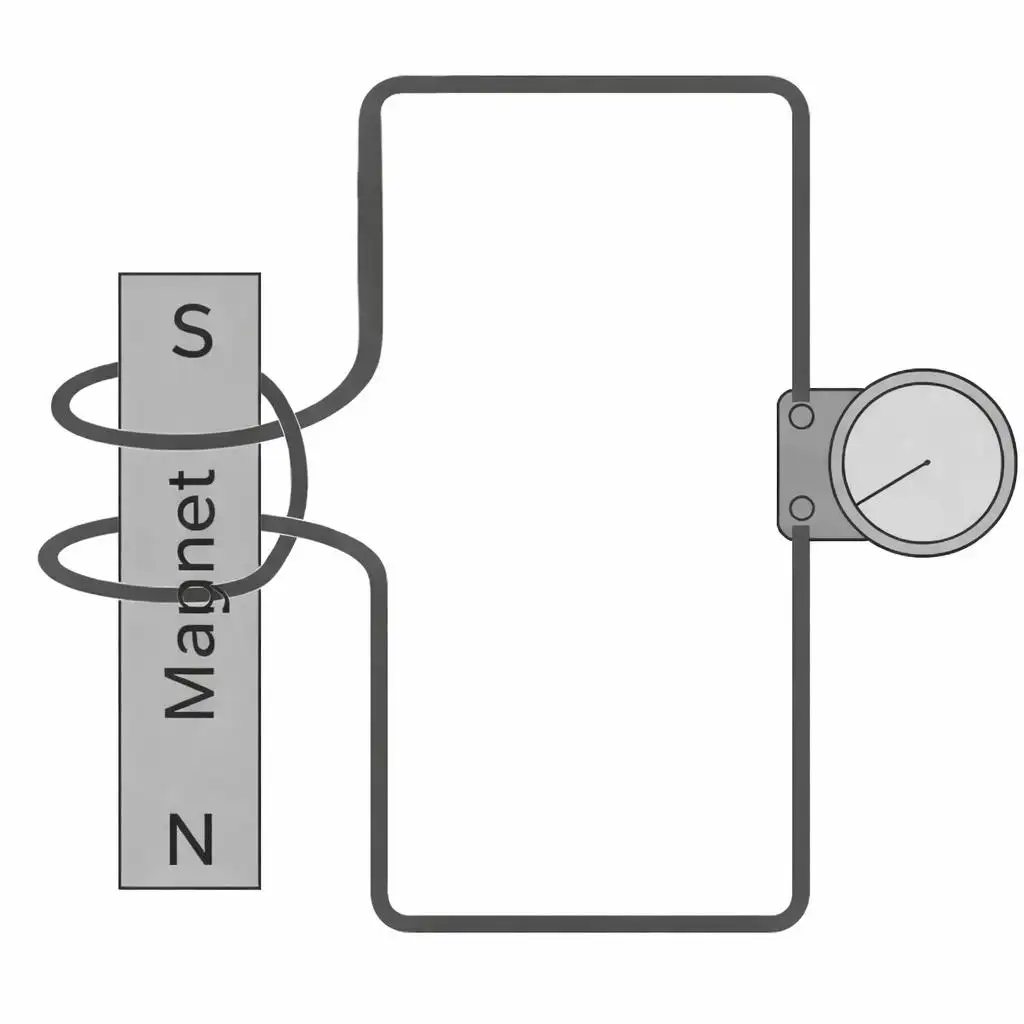
Experimental setup demonstrating electromagnetic induction by moving a magnet through a coil
Example Problem
A coil with 120 turns is placed in a magnetic field. If the magnetic flux through the coil changes uniformly from 0.06 Wb to 0.01 Wb in 0.02 seconds, calculate the induced emf in the coil.
Solution:
Given:
Number of turns, \( N = 120 \)
Initial magnetic flux, \( \Phi_i = 0.06 \text{ Wb} \)
Final magnetic flux, \( \Phi_f = 0.01 \text{ Wb} \)
Time interval, \( t = 0.02 \text{ s} \)
The induced emf is given by Faraday’s law:
\[ e = -N \frac{\Delta \Phi}{\Delta t} = -120 \times \frac{0.01 - 0.06}{0.02} = -120 \times \frac{-0.05}{0.02} \]
\[ e = 120 \times 2.5 = 300 \text{ volts} \]
The negative sign indicates the direction of induced emf (Lenz’s law). The magnitude of the induced emf is \(300 \text{ volts}\).
Factors Influencing the Induced Voltage
Role of Coil Turns and Magnetic Field Variation
The magnitude of the voltage induced in a coil depends primarily on two factors: the number of turns in the coil and the rate at which the magnetic flux changes. Increasing the number of loops in the wire amplifies the total induced emf because each loop contributes to the total voltage.
Additionally, the magnetic flux must vary either by moving the magnet relative to the coil or by changing the magnetic field strength. A stationary conductor in a steady magnetic field will not have any induced voltage.
Example Problem
A coil with 200 turns experiences a magnetic flux change from 0.12 Wb to 0.02 Wb in 0.05 seconds. Calculate the induced emf.
Solution:
Given:
Number of turns, \( N = 200 \)
Initial flux, \( \Phi_i = 0.12 \text{ Wb} \)
Final flux, \( \Phi_f = 0.02 \text{ Wb} \)
Time, \( t = 0.05 \text{ s} \)
Using Faraday’s law:
\[ e = -N \frac{\Delta \Phi}{\Delta t} = -200 \times \frac{0.02 - 0.12}{0.05} = -200 \times \frac{-0.10}{0.05} \]
\[ e = 200 \times 2 = 400 \text{ volts} \]
The induced emf magnitude is \(400 \text{ volts}\).
Applications and Mathematical Representation of Electromagnetic Induction
Practical Uses and Formula Derivation
Electromagnetic induction forms the foundation for many electrical devices. Alternating current (AC) generators convert mechanical energy into electrical energy by rotating coils in magnetic fields. Transformers use induction to change voltage levels in power distribution. Magnetic flow meters measure fluid velocity by detecting induced voltage in conductive liquids.
The induced voltage \( e \) in a coil with \( N \) turns is mathematically expressed as:
\[ e = -N \frac{d\Phi}{dt} \]
where \( \Phi \) is the magnetic flux in Webers and \( t \) is time in seconds. The negative sign indicates the direction of induced emf opposes the change in flux (Lenz’s law).
Exam Tip: Remember that the induced emf depends on both the number of coil turns and how quickly the magnetic flux changes. The negative sign in the formula represents the opposition to flux change.
Example Problem
A coil with 150 turns is exposed to a magnetic flux that decreases uniformly from 0.09 Wb to zero in 0.03 seconds. Calculate the induced emf.
Solution:
Given:
Number of turns, \( N = 150 \)
Initial flux, \( \Phi_i = 0.09 \text{ Wb} \)
Final flux, \( \Phi_f = 0 \text{ Wb} \)
Time, \( t = 0.03 \text{ s} \)
Applying Faraday’s law:
\[ e = -150 \times \frac{0 - 0.09}{0.03} = -150 \times \frac{-0.09}{0.03} \]
\[ e = 150 \times 3 = 450 \text{ volts} \]
The induced emf magnitude is \(450 \text{ volts}\).
Quick Reference Summary
Parameter | Description | Unit |
|---|---|---|
Electromotive Force (emf) | Voltage induced in a coil due to changing magnetic flux | Volts (V) |
Number of Turns (N) | Total loops in the coil | Unitless |
Magnetic Flux (\( \Phi \)) | Magnetic field passing through a surface | Webers (Wb) |
Time Interval (t) | Duration of flux change | Seconds (s) |
Faraday’s Law Formula | Induced emf calculation | \( e = -N \frac{d\Phi}{dt} \) |
Key Principle | Induced emf opposes change in magnetic flux (Lenz’s Law) | Conceptual |
Applications | AC generators, transformers, magnetic flow meters | Devices |
Glossary of Important Terms
Term | Definition |
|---|---|
Electromagnetic Induction | Generation of voltage due to changing magnetic flux |
Magnetic Flux (\( \Phi \)) | Measure of magnetic field passing through an area |
Electromotive Force (emf) | Voltage produced by changing magnetic flux |
Faraday’s Law | Induced emf is proportional to rate of change of magnetic flux and coil turns |
Lenz’s Law | Direction of induced emf opposes the change causing it |
Coil Turns (N) | Number of loops in a wire coil |
Transformer | Device that changes voltage levels using electromagnetic induction |
AC Generator | Machine converting mechanical energy to electrical energy via induction |
Magnetic Flow Meter | Instrument measuring fluid velocity using induced voltage |
Magnetic Field | Region around a magnet where magnetic forces act |
Frequently Asked Questions
What is electromagnetic induction?
It is the process of generating an electric voltage in a conductor due to a changing magnetic field around it.
Who first discovered electromagnetic induction?
Michael Faraday discovered electromagnetic induction in 1831 through his experiments with coils and magnets.
Why is electromagnetic induction important?
It enables the generation of electrical energy without batteries, forming the basis for generators, transformers, and many electrical devices.
Which devices operate based on electromagnetic induction?
AC generators, electrical transformers, and magnetic flow meters are common devices that utilize this principle.
How does the number of coil turns affect induced voltage?
The induced voltage is directly proportional to the number of turns; more loops result in higher voltage.