Evolution and Trends in Element Classification
Early Attempts at Grouping Elements
Dobereiner’s Triads: Grouping by Atomic Mass Averages
In the early 19th century, Johann Wolfgang Dobereiner, a German chemist, proposed grouping elements into sets of three called triads based on their similar chemical properties. He observed that the atomic mass of the middle element in each triad was approximately the average of the other two. This insight hinted at an underlying order among elements.
For instance, consider the triad of lithium, sodium, and potassium. Lithium has an atomic mass of 7.0, potassium about 39.2, and sodium, the middle element, has an atomic mass close to 23.1, which is nearly the mean of lithium and potassium.
Example: Verify the average atomic mass for the triad of lithium (7.0), sodium (23.1), and potassium (39.2).
\[ \text{Average} = \frac{7.0 + 39.2}{2} = 23.1 \text{ u} \]
This matches the atomic mass of sodium, confirming Dobereiner’s observation.
However, Dobereiner’s triads had limitations. Only a few elements could be grouped this way, and many known elements did not fit into any triad, restricting the method’s applicability.
Newland’s Octaves: Periodicity Every Eight Elements
John Newlands, an English scientist, arranged 56 known elements in order of increasing atomic mass in 1866. He noticed a repeating pattern where every eighth element shared similar properties, analogous to musical octaves. This became known as Newland’s Law of Octaves.
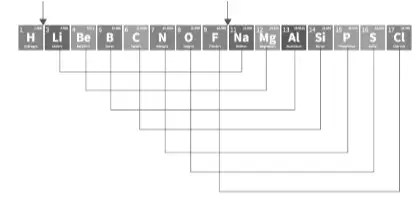
Classification of Elements and Periodicity in Properties
Newland’s insight was a significant step toward recognizing periodicity, but his classification was limited to lighter elements up to calcium. The discovery of noble gases, which did not fit into this pattern, further challenged the octave concept.
Example: If lithium is the 3rd element, which element would Newlands predict to have similar properties based on the octave rule?
Since properties repeat every 8 elements, the element at position \(3 + 8 = 11\) should be similar. The 11th element is sodium, which indeed shares properties with lithium.
Development of the Periodic Table Concept
Mendeleev’s Periodic Table: Organizing by Atomic Mass
Dmitri Mendeleev, a Russian chemist, revolutionized element classification in 1869 by arranging elements in order of increasing atomic mass and grouping those with similar properties into columns. He formulated the Periodic Law, stating that chemical properties are periodic functions of atomic weights.
Mendeleev’s table allowed for the prediction of undiscovered elements and correction of atomic masses. For example, he left gaps for elements like gallium and germanium, which were later discovered with properties matching his predictions.
Despite its success, Mendeleev’s table had some inconsistencies. Hydrogen’s placement was ambiguous, isotopes posed classification challenges, and some elements like cobalt and nickel appeared out of atomic mass order.
Example: Mendeleev predicted an element with atomic mass around 68 to fit between zinc (65) and arsenic (75). If the actual atomic mass is 69.7, identify the element and explain its significance.
The element is gallium, discovered later, confirming Mendeleev’s prediction and validating the periodic table’s predictive power.
Modern Periodic Law: Atomic Number as the Basis
In 1913, Henry Moseley used X-ray spectra to demonstrate that the atomic number, not atomic mass, determines an element’s properties. He established the Modern Periodic Law: the physical and chemical properties of elements are periodic functions of their atomic numbers.
This corrected anomalies in Mendeleev’s table and provided a more accurate framework for element classification, emphasizing the role of protons and electronic configuration in chemical behavior.
Example: Explain why cobalt (atomic number 27) precedes nickel (atomic number 28) in the modern periodic table despite their atomic masses.
Since classification is based on atomic number, cobalt (27) comes before nickel (28), resolving the mass-based anomaly in Mendeleev’s table.
Structure and Properties of the Modern Periodic Table
Organization of the Modern Periodic Table
The contemporary periodic table consists of 18 vertical columns called groups and 7 horizontal rows called periods. Elements are arranged by increasing atomic number, reflecting recurring chemical properties.
The first period contains only two elements: hydrogen and helium. Periods 2 and 3 have eight elements each, periods 4 and 5 contain eighteen elements, period 6 has thirty-two elements, and period 7 is incomplete.
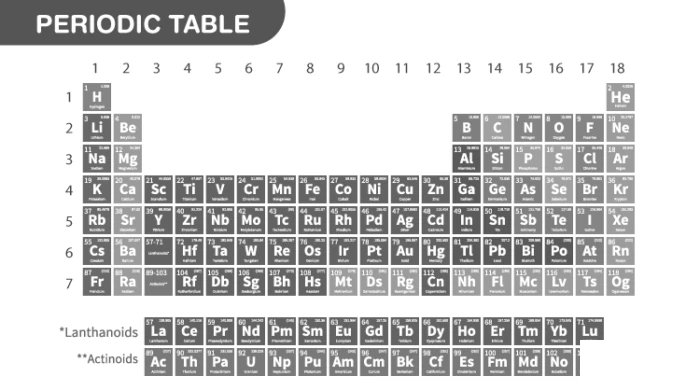
Modern Periodic Table Layout
Elements are further classified into blocks based on their valence electron configurations:
s-block: Groups 1 and 2, with general configuration \(ns^1 - ns^2\)
p-block: Groups 13 to 18, with configuration \(ns^2 np^{1-6}\)
d-block: Transition metals in groups 3 to 12, with configuration \((n-1)d^{1-10} ns^{1-2}\)
f-block: Lanthanides and actinides, with configuration \((n-2)f^{1-14} (n-1)d^{0-1} ns^2\)
Example: Identify the block and group of an element with electronic configuration \( [Ar] 3d^5 4s^1 \).
This corresponds to manganese, a d-block element in group 7.
Periodic Trends in Element Properties
Periodic properties arise from the electronic structure of atoms and show predictable variations across periods and groups. Key properties include atomic and ionic radii, ionization energy, electron gain enthalpy, and electronegativity.
Atomic and Ionic Radii
Atomic radius is the distance from the nucleus to the outermost electron shell. It decreases across a period due to increasing effective nuclear charge and increases down a group as new electron shells are added.
Ionic radius follows a similar trend. Cations are smaller than their neutral atoms due to electron loss, while anions are larger due to electron gain.
Example: Compare the atomic radius trend from sodium to chlorine in period 3.
Atomic radius decreases from sodium to chlorine because the nuclear charge increases, pulling electrons closer.
Ionization Energy
Ionization energy is the energy required to remove an electron from a gaseous atom. It generally increases across a period and decreases down a group. Exceptions occur due to stable electron configurations like half-filled or fully filled orbitals.
Example: Explain why the ionization energy of nitrogen is higher than that of oxygen.
Nitrogen has a half-filled \(2p^3\) configuration, which is more stable, so removing an electron requires more energy than from oxygen’s \(2p^4\) configuration.
Electron Gain Enthalpy
This is the energy change when an atom gains an electron. It generally becomes more negative across a period and less negative down a group. Chlorine has a higher electron affinity than fluorine due to less electron-electron repulsion.
Electronegativity
Electronegativity measures an atom’s ability to attract electrons in a bond. It increases across a period and decreases down a group. Fluorine is the most electronegative element, while cesium is among the least.
Summary of Key Periodic Concepts
Property | Trend Across Period | Trend Down Group | Reason |
|---|---|---|---|
Atomic Radius | Decreases | Increases | Effective nuclear charge and shell addition |
Ionic Radius | Decreases | Increases | Similar to atomic radius with charge effects |
Ionization Energy | Increases | Decreases | Electron removal difficulty due to nuclear attraction |
Electron Gain Enthalpy | More negative | Less negative | Electron affinity influenced by atomic size |
Electronegativity | Increases | Decreases | Ability to attract bonding electrons |
Glossary of Important Terms
Term | Definition |
|---|---|
Atomic Number | Number of protons in an atom’s nucleus |
Atomic Mass | Weighted average mass of an atom’s isotopes |
Effective Nuclear Charge | Net positive charge experienced by electrons |
Ionization Energy | Energy required to remove an electron from a gaseous atom |
Electron Gain Enthalpy | Energy change when an atom gains an electron |
Electronegativity | Ability of an atom to attract electrons in a bond |
Periodicity | Recurring trends in element properties across periods |
Triads | Groups of three elements with related properties |
Octaves | Pattern where every eighth element has similar properties |
Valence Electrons | Electrons in the outermost shell involved in bonding |
Frequently Asked Questions
Why was classifying elements necessary?
With over 100 elements known today, grouping them simplifies studying their properties and predicting chemical behavior.
What does periodicity mean in the periodic table?
Periodicity refers to the repeating patterns of element properties at regular intervals when arranged by atomic number.
Which properties show periodic trends?
Atomic radius, ionization energy, electron gain enthalpy, and electronegativity are key properties exhibiting periodic trends.
How is the modern periodic table organized?
Elements are arranged in order of increasing atomic number into groups and periods, reflecting recurring chemical properties.
What is the significance of electronic configuration in classification?
Electronic configuration determines an element’s chemical properties and its position in the periodic table blocks.