Understanding Covalent Bonding and Its Characteristics
Fundamentals of Covalent Bond Formation
Concept and Mechanism of Electron Sharing
Atoms with high ionization energies cannot easily lose electrons, and those with low electron affinity are unlikely to gain electrons. To achieve stable electronic configurations resembling noble gases, such atoms share electrons rather than transfer them. This mutual sharing of electron pairs between atoms, either identical or different, leads to the formation of covalent bonds. The shared electrons, known as bonding pairs, help each atom complete its valence shell, resulting in a stable molecule.
Covalent bonds are also referred to as molecular bonds due to their role in forming molecules through electron sharing.
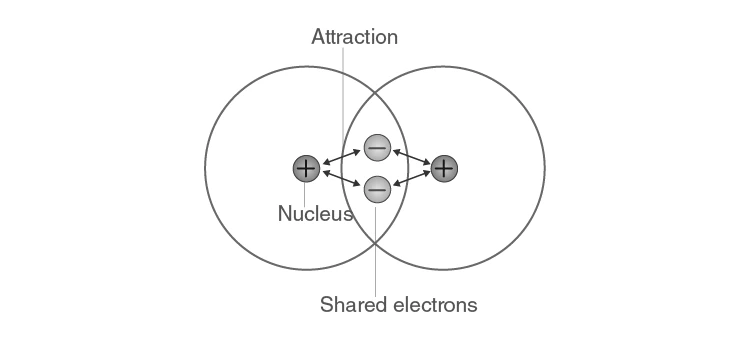
Illustration of Covalent Bonding in Carbon
Carbon's electronic configuration makes it challenging to gain or lose four electrons to achieve stability. Gaining four electrons would create an unstable C4- ion due to excessive electron repulsion, while losing four electrons to form C4+ requires too much energy and results in instability. Instead, carbon attains stability by sharing electrons with other atoms, forming covalent bonds that complete its octet.
Carbon cannot form C4- because the nucleus cannot hold 10 electrons stably, and forming C4+ requires removing four electrons, which is energetically unfavorable. Therefore, carbon shares electrons with other atoms to complete its octet, resulting in covalent bonding.
Key Properties and the Octet Rule in Covalent Compounds
Characteristics of Covalent Bonds
Covalent bonds involve pairing existing electrons without creating new ones. These bonds are strong and directional, meaning the bonded atoms have specific spatial orientations. Typically, covalent compounds have lower melting and boiling points compared to ionic compounds, and they do not conduct electricity due to the absence of free ions or electrons. Additionally, covalent substances are generally insoluble in water.
When a single pair of electrons is insufficient to satisfy the valence requirements, atoms may share multiple pairs, forming double or triple bonds.
Understanding the Octet Rule and Lewis Structures
Atoms tend to combine in ways that allow them to have eight electrons in their outermost shell, achieving a noble gas configuration. This tendency is known as the octet rule. Hydrogen is an exception, as it attains stability with two electrons, resembling helium.
Lewis dot symbols represent valence electrons as dots around the element's symbol, and Lewis structures depict how atoms share electrons in molecules.

Oxygen has six valence electrons and needs two more to complete its octet. Each hydrogen atom shares one electron with oxygen, forming two single covalent bonds. This sharing allows oxygen to have eight electrons in its valence shell, while each hydrogen attains two electrons.
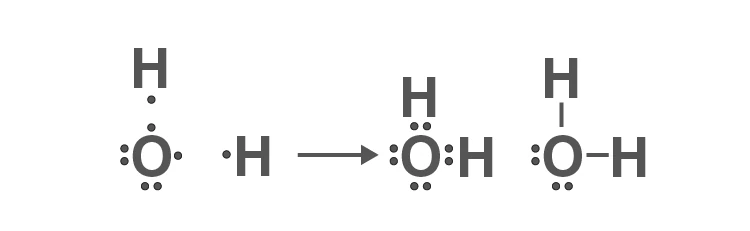
Classification and Examples of Covalent Bonds
Single, Double, and Triple Covalent Bonds
Covalent bonds are categorized based on the number of shared electron pairs:
- Single bond: One pair of electrons shared, represented by a single dash (-). It is the most common and relatively stable.
- Double bond: Two pairs of electrons shared, shown as two dashes (=). These bonds are stronger but less stable than single bonds.
- Triple bond: Three pairs of electrons shared, denoted by three dashes (≡). These are the strongest but least stable covalent bonds.
Examples include:
- HCl molecule with a single bond between hydrogen and chlorine.
- CO2 molecule with two double bonds between carbon and oxygen atoms.
- N2 molecule with a triple bond between two nitrogen atoms.



Polar and Nonpolar Covalent Bonds
When atoms share electrons unequally due to differences in electronegativity, the bond formed is polar covalent. The shared electrons are drawn closer to the more electronegative atom, creating partial charges. If the electronegativity difference is zero, the bond is nonpolar, with electrons shared equally.

In H2O2, the O–H bond has an electronegativity difference of approximately 1.4, making it polar covalent. The O–O bond has zero electronegativity difference, so it is nonpolar covalent.
Comparing Covalent and Ionic Bonds
Fundamental Differences in Bonding Types
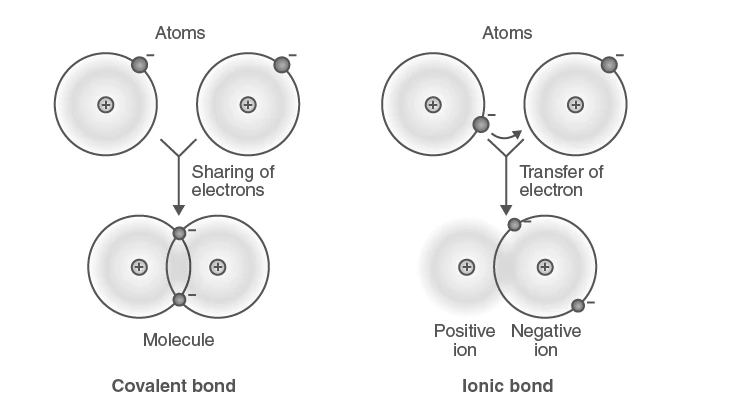
Covalent bonds form by sharing electron pairs between nonmetal atoms, resulting in molecules with specific orientations. Ionic bonds arise from electrostatic attraction between oppositely charged ions, typically formed between metals and nonmetals.
The electronegativity difference helps distinguish these bonds: covalent bonds usually have differences less than 2.0, while ionic bonds have greater differences.
The correct answer is NaNC. It contains an ionic bond between Na+ and the –NC ion, and a covalent bond between nitrogen and carbon atoms within the –NC group.
Practical Applications: Lewis Structures of Common Molecules
Carbon Tetrachloride (CCl4)
Carbon has four valence electrons and forms four single covalent bonds with four chlorine atoms, each contributing one electron. This sharing completes the octet for carbon and chlorine atoms, resulting in a stable molecule.

Ammonia (NH3)
Nitrogen has five valence electrons and shares three electrons with three hydrogen atoms, forming three single covalent bonds. This sharing allows nitrogen to complete its octet, while each hydrogen attains a stable duet.
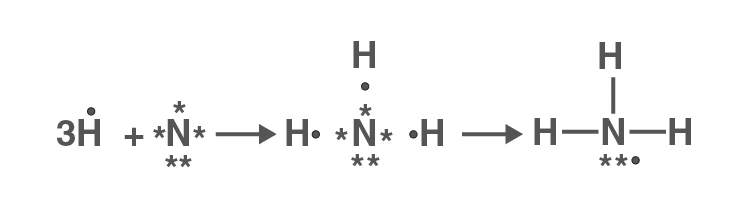
Ammonia consists of a nitrogen atom sharing electrons with three hydrogen atoms. Each N–H bond is a single covalent bond formed by sharing one electron pair, completing nitrogen's octet and hydrogen's duet.
Quick Reference: Covalent Bonding Summary
| Aspect | Description |
|---|---|
| Definition | Sharing of electron pairs between atoms to achieve stable valence shells |
| Bond Types | Single, double, and triple covalent bonds based on shared electron pairs |
| Polarity | Polar (unequal sharing) and nonpolar (equal sharing) covalent bonds |
| Directionality | Directional bonds with specific spatial orientations |
| Electrical Conductivity | Generally non-conductive due to lack of free ions or electrons |
| Melting/Boiling Points | Usually lower than ionic compounds |
| Solubility | Typically insoluble in water |
| Octet Rule | Atoms share electrons to complete eight electrons in valence shell (except hydrogen) |
| Examples | H2, O2, CO2, NH3, CH4 |
| Difference from Ionic Bond | Covalent bonds share electrons; ionic bonds transfer electrons forming ions |
Glossary of Key Terms
| Term | Definition |
|---|---|
| Covalent Bond | A chemical bond formed by sharing electron pairs between atoms |
| Bonding Pair | Shared pair of electrons that holds two atoms together |
| Octet Rule | Atoms tend to have eight electrons in their valence shell for stability |
| Electronegativity | Ability of an atom to attract shared electrons in a bond |
| Polar Covalent Bond | Covalent bond with unequal sharing of electrons due to electronegativity difference |
| Nonpolar Covalent Bond | Covalent bond with equal sharing of electrons |
| Lewis Dot Structure | Diagram showing valence electrons as dots around atomic symbols |
| Single Bond | Bond formed by sharing one pair of electrons |
| Double Bond | Bond formed by sharing two pairs of electrons |
| Triple Bond | Bond formed by sharing three pairs of electrons |
Frequently Asked Questions
What distinguishes a covalent bond from an ionic bond?
Covalent bonds involve sharing electron pairs between atoms, usually nonmetals, while ionic bonds form through the transfer of electrons creating charged ions, typically between metals and nonmetals.
Why do atoms share electrons instead of transferring them in covalent bonding?
Atoms with similar electronegativities find it energetically unfavorable to transfer electrons, so they share electrons to achieve stable valence shells.
How does the octet rule apply to hydrogen?
Hydrogen is stable with two electrons in its valence shell, following the duet rule, as its first shell can hold only two electrons.
What causes a covalent bond to be polar?
A covalent bond becomes polar when the atoms involved have different electronegativities, causing unequal sharing of electrons and partial charges.
Can covalent compounds conduct electricity?
Generally, covalent compounds do not conduct electricity because they lack free ions or electrons to carry charge.