Understanding Chemical Reactions and Their Types
Fundamentals of Chemical Transformations
Defining Chemical Reactions and Their Significance
Chemical reactions involve the breaking of bonds in the starting substances, known as reactants, and the formation of new bonds to create different substances called products. This process results in the creation of new materials with distinct properties. These reactions are ubiquitous, occurring in natural processes such as digestion and photosynthesis, as well as in industrial applications.
Before delving deeper, it is essential to distinguish between physical and chemical changes. Physical changes affect the form or state of a substance without altering its chemical identity, whereas chemical changes result in the formation of new substances, often accompanied by energy changes.
For example, when a candle burns, the wax melting is a physical change, but the burning itself is a chemical change where new substances like carbon dioxide and water vapor are produced. Covering a burning candle with a jar causes it to extinguish due to lack of oxygen, highlighting the role of reactants in sustaining chemical reactions.
Solution:
- The wax melting is a physical change as it changes from solid to liquid without altering its chemical composition.
- The flame results from a chemical reaction where wax reacts with oxygen producing new substances and releasing heat and light.
- Extinguishing the flame by covering it shows the necessity of oxygen for the chemical reaction to continue.
Representing Chemical Reactions Through Equations
Understanding Chemical Equations and Their Components
To communicate chemical reactions efficiently, scientists use chemical equations. These equations symbolically represent reactants on the left and products on the right, connected by arrows indicating the direction of the reaction. Each substance is represented by its chemical formula, and the equation must be balanced to obey the law of conservation of mass, ensuring equal numbers of each atom on both sides.
For instance, consider the combustion of methane gas:
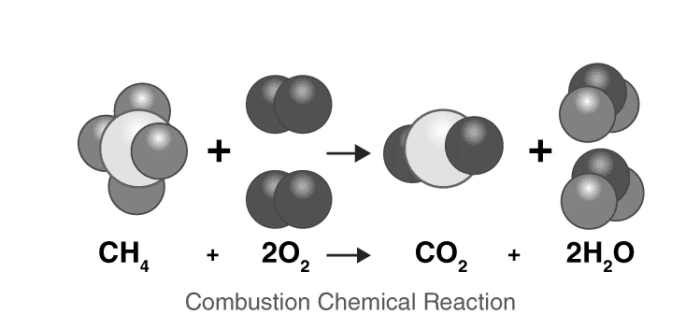
The balanced chemical equation is:
\[ CH_4 + 2 O_2 \rightarrow CO_2 + 2 H_2O \]
This shows one molecule of methane reacting with two molecules of oxygen to produce carbon dioxide and water, with all atoms accounted for on both sides.
Given: \( C_2H_6 + O_2 \rightarrow CO_2 + H_2O \)
Solution:
Step 1: Balance carbon atoms:
\[ C_2H_6 + O_2 \rightarrow 2 CO_2 + H_2O \]
Step 2: Balance hydrogen atoms:
\[ C_2H_6 + O_2 \rightarrow 2 CO_2 + 3 H_2O \]
Step 3: Balance oxygen atoms:
Right side oxygen atoms = \(2 \times 2 + 3 \times 1 = 7\)
Left side oxygen atoms come from \(O_2\), so:
\[ C_2H_6 + \frac{7}{2} O_2 \rightarrow 2 CO_2 + 3 H_2O \]
Multiply entire equation by 2 to remove fraction:
\[ 2 C_2H_6 + 7 O_2 \rightarrow 4 CO_2 + 6 H_2O \]
Classification of Chemical Reactions
Exploring Various Reaction Types and Their Characteristics
Chemical reactions can be categorized based on the nature of reactants, products, and the changes occurring during the process. The main types include combustion, decomposition, neutralization, redox, precipitation (double displacement), and synthesis reactions.
1. Combustion Reactions
These reactions involve a substance reacting with oxygen, releasing energy as heat and light. For example, magnesium burning in oxygen:
\[ 2 Mg + O_2 \rightarrow 2 MgO + \text{Heat} \]
Solution:
Unbalanced reaction:
\[ C_2H_4 + O_2 \rightarrow CO_2 + H_2O \]
Balance carbon:
\[ C_2H_4 + O_2 \rightarrow 2 CO_2 + H_2O \]
Balance hydrogen:
\[ C_2H_4 + O_2 \rightarrow 2 CO_2 + 2 H_2O \]
Balance oxygen:
Right side oxygen atoms = \(2 \times 2 + 2 \times 1 = 6\)
Left side oxygen atoms from \(O_2\):
\[ C_2H_4 + 3 O_2 \rightarrow 2 CO_2 + 2 H_2O \]
2. Decomposition Reactions
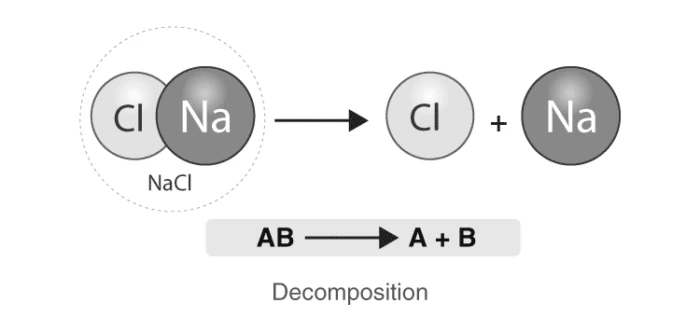
In these reactions, a single compound breaks down into two or more simpler substances, often requiring energy input such as heat or electricity. For example, heating calcium carbonate produces calcium oxide and carbon dioxide:
\[ CaCO_3 (s) \xrightarrow{\text{Heat}} CaO (s) + CO_2 (g) \]
Solution:
Potassium chlorate decomposes on heating to form potassium chloride and oxygen gas:
\[ 2 KClO_3 \xrightarrow{\text{Heat}} 2 KCl + 3 O_2 \]
3. Neutralization Reactions
These occur when an acid reacts with a base to produce salt and water. The reaction involves the combination of hydrogen ions (\(H^+\)) from the acid and hydroxide ions (\(OH^-\)) from the base. For example, hydrochloric acid reacting with sodium hydroxide:
\[ HCl + NaOH \rightarrow NaCl + H_2O \]
Solution:
Sulfuric acid reacts with potassium hydroxide to form potassium sulfate and water:
\[ H_2SO_4 + 2 KOH \rightarrow K_2SO_4 + 2 H_2O \]
4. Redox Reactions
Redox (reduction-oxidation) reactions involve the transfer of electrons between species. One substance loses electrons (oxidation) while another gains electrons (reduction). For example, zinc reacting with hydrogen ions:
\[ Zn + 2 H^+ \rightarrow Zn^{2+} + H_2 \]
Solution:
Reaction:
\[ Fe + CuSO_4 \rightarrow FeSO_4 + Cu \]
- Iron (Fe) loses electrons and is oxidized, so it is the reducing agent.
- Copper ions (Cu\(^{2+}\)) gain electrons and are reduced, so copper sulfate is the oxidizing agent.
5. Double Displacement (Precipitation) Reactions
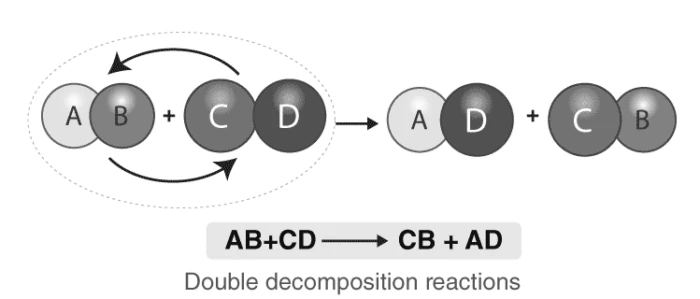
These reactions involve the exchange of ions between two compounds, resulting in the formation of two new compounds, often producing a precipitate. For example, silver nitrate reacting with sodium chloride:
\[ AgNO_3 + NaCl \rightarrow AgCl + NaNO_3 \]
Solution:
Barium chloride reacts with sodium sulfate to form barium sulfate (precipitate) and sodium chloride:
\[ BaCl_2 + Na_2SO_4 \rightarrow BaSO_4 + 2 NaCl \]
6. Synthesis Reactions
Synthesis reactions involve the combination of two or more simple substances to form a more complex compound. For example, sodium reacting with chlorine gas to form sodium chloride:
\[ 2 Na (s) + Cl_2 (g) \rightarrow 2 NaCl (s) \]
Solution:
Hydrogen and oxygen combine to form water:
\[ 2 H_2 + O_2 \rightarrow 2 H_2O \]
Summary Table of Key Chemical Reaction Types
| Reaction Type | Description | General Equation | Example |
|---|---|---|---|
| Combustion | Reaction with oxygen releasing heat and light | \( \text{Fuel} + O_2 \rightarrow \text{Oxides} + \text{Energy} \) | \( 2 Mg + O_2 \rightarrow 2 MgO + \text{Heat} \) |
| Decomposition | Single compound breaks into simpler substances | \( AB \xrightarrow{\text{Energy}} A + B \) | \( CaCO_3 \xrightarrow{\text{Heat}} CaO + CO_2 \) |
| Neutralization | Acid reacts with base to form salt and water | \( Acid + Base \rightarrow Salt + H_2O \) | \( HCl + NaOH \rightarrow NaCl + H_2O \) |
| Redox | Electron transfer between species | \( Oxidation + Reduction \rightarrow Products \) | \( Zn + 2 H^+ \rightarrow Zn^{2+} + H_2 \) |
| Double Displacement | Exchange of ions forming new compounds | \( AB + CD \rightarrow AD + CB \) | \( AgNO_3 + NaCl \rightarrow AgCl + NaNO_3 \) |
| Synthesis | Simple substances combine to form complex compound | \( A + B \rightarrow AB \) | \( 2 Na + Cl_2 \rightarrow 2 NaCl \) |
Glossary of Essential Terms
| Term | Definition |
|---|---|
| Reactants | Starting substances that undergo change in a chemical reaction. |
| Products | New substances formed as a result of a chemical reaction. |
| Chemical Equation | Symbolic representation of a chemical reaction showing reactants and products. |
| Combustion | Reaction of a substance with oxygen producing heat and light. |
| Decomposition | Breaking down of a compound into simpler substances. |
| Neutralization | Reaction between an acid and a base producing salt and water. |
| Redox Reaction | Reaction involving transfer of electrons between species. |
| Precipitation Reaction | Formation of an insoluble solid when two solutions react. |
| Synthesis Reaction | Combination of simple substances to form a complex compound. |
| Law of Conservation of Mass | Mass of reactants equals mass of products in a chemical reaction. |
Frequently Asked Questions
What defines a chemical reaction?
A chemical reaction is a process where reactants transform into products by breaking and forming chemical bonds, resulting in new substances.
How is a chemical equation different from a reaction?
A chemical equation is a symbolic representation of a chemical reaction, showing the reactants and products with their formulas and quantities.
What are the main types of chemical reactions?
Common types include combustion, decomposition, neutralization, redox, double displacement, and synthesis reactions.
What occurs during a combustion reaction?
In combustion, a substance reacts with oxygen releasing energy as heat and light, often producing oxides.
Why must chemical equations be balanced?
Balancing ensures the law of conservation of mass is obeyed, meaning the number of atoms of each element is the same on both sides.