Understanding Atomic and Mass Numbers
Fundamentals of Atomic Number and Mass Number
Defining Atomic Number and Its Significance
The atomic number, symbolized as Z, represents the total count of protons within an atom's nucleus. This number uniquely identifies each chemical element, as all atoms of a given element share the same proton count. For instance, every oxygen atom contains 8 protons, giving it an atomic number of 8, while carbon atoms have 6 protons, resulting in an atomic number of 6.
Since protons carry a positive charge, the atomic number also equals the number of electrons in a neutral atom, balancing the electrical charge.
Illustrative Example: Determining Atomic Number
Problem: An atom has 15 electrons orbiting its nucleus. What is its atomic number?
Solution: In a neutral atom, the number of electrons equals the number of protons. Therefore, the atomic number \( Z = 15 \).
This corresponds to the element phosphorus.
Understanding Mass Number and Its Role
The mass number, denoted as A, is the sum of protons and neutrons in the nucleus of an atom. Since neutrons and protons have nearly equal mass, the mass number approximates the total mass of the nucleus in atomic mass units (amu). Electrons contribute negligibly to the mass.
For example, a carbon atom with 6 protons and 7 neutrons has a mass number of 13.
Example: Calculating Mass Number
Problem: An atom contains 20 protons and 22 neutrons. Find its mass number.
Solution: Mass number \( A = \text{protons} + \text{neutrons} = 20 + 22 = 42 \).
Exploring Isotopes and Atomic Structure
Isotopes: Variations in Neutron Count
Atoms of the same element can have different numbers of neutrons, resulting in isotopes. These isotopes share the same atomic number but differ in mass number. For example, carbon-12 and carbon-14 are isotopes of carbon with 6 protons each but 6 and 8 neutrons respectively.
Isotopes influence the atomic weight of elements, which is the weighted average of all isotopic masses found naturally.
Example: Identifying Isotopes
Problem: An element has isotopes with mass numbers 35 and 37, both having 17 protons. Identify the element and explain the difference between the isotopes.
Solution: The atomic number \( Z = 17 \) corresponds to chlorine. The isotopes differ by the number of neutrons: 18 neutrons in chlorine-35 and 20 neutrons in chlorine-37.
Electron Arrangement and Energy Levels
Electrons orbit the nucleus in defined energy levels or shells. Each shell contains sublevels made up of orbitals, where electrons reside. The atomic number determines the total number of electrons, which fill these shells in a specific order.
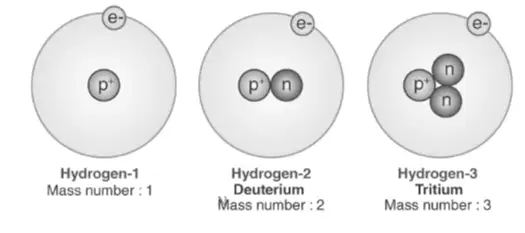
Diagram illustrating atomic number and electron orbital energy levels
For example, an atom with atomic number 12 has electrons arranged as 2 in the first shell, 8 in the second, and 2 in the third shell.
Example: Electron Configuration from Atomic Number
Problem: Determine the electron configuration of an atom with atomic number 10.
Solution: Atomic number 10 means 10 electrons. The distribution is:
\[ 2, 8 \]
Two electrons fill the first shell, and eight fill the second shell, completing the configuration.
Atomic Notation and Calculations
Writing Atomic Symbols
Atomic notation expresses an element's symbol with its mass number as a superscript and atomic number as a subscript. This notation helps quickly identify the composition of the atom.
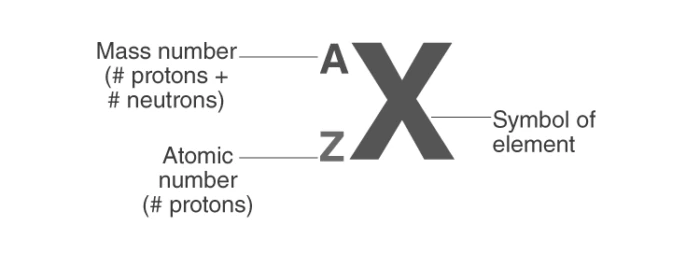
General format for atomic notation
For example, carbon with 6 protons and 12 as mass number is written as:
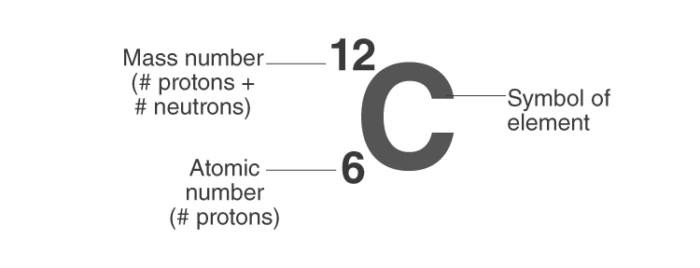
Atomic notation of a carbon atom
Calculating Neutron Number
The number of neutrons in an atom can be found by subtracting the atomic number from the mass number:
\[ \text{Number of neutrons} = A - Z \]

Formula to calculate neutrons in an atom
Example: Finding Neutrons in an Atom
Problem: An atom has a mass number of 23 and an atomic number of 11. Calculate the number of neutrons.
Solution: Using the formula:
\[ \text{Neutrons} = 23 - 11 = 12 \]
Therefore, the atom contains 12 neutrons.
Summary Table for Quick Review
Term | Symbol | Definition | Example |
|---|---|---|---|
Atomic Number | Z | Number of protons in the nucleus | Oxygen: 8 |
Mass Number | A | Sum of protons and neutrons | Carbon-12: 12 |
Isotopes | – | Atoms with same Z but different neutrons | Carbon-12 and Carbon-14 |
Neutrons | – | Neutral particles in nucleus | Carbon-12 has 6 neutrons |
Electron Configuration | – | Arrangement of electrons in shells | Neon: 2,8 |
Glossary of Key Terms
Term | Meaning |
|---|---|
Atomic Number (Z) | Number of protons in an atom's nucleus |
Mass Number (A) | Total number of protons and neutrons |
Isotope | Atoms of the same element with different neutron counts |
Proton | Positively charged particle in the nucleus |
Neutron | Neutral particle in the nucleus |
Electron | Negatively charged particle orbiting the nucleus |
Electron Shell | Energy level where electrons orbit the nucleus |
Orbital | Region within a shell where electrons are likely found |
Valency | Number of electrons in the outermost shell |
Atomic Mass Unit (amu) | Unit to express atomic and molecular masses |
Frequently Asked Questions
What is the element with the highest atomic number?
Oganesson (Og) has the highest known atomic number of 118, completing the seventh period of the periodic table.
Who introduced the concept of atomic number?
Henry Gwyn-Jefferies Moseley first defined the atomic number as the number of protons in an atom's nucleus.
How can atomic mass be calculated from atomic number and neutrons?
Atomic mass is approximately the sum of protons and neutrons: \( \text{Atomic mass} \approx Z + \text{neutrons} \).
Why is the atomic number symbolized by Z?
The letter Z comes from the German word "Zahl," meaning number, and was adopted to represent atomic number.
What does the mass number represent?
Mass number indicates the total count of protons and neutrons in an atom's nucleus, reflecting its nuclear mass.