Fundamentals of Trigonometric Ratios and Their Values
Introduction to Trigonometric Ratios and Their Standard Angles
Understanding the Six Primary Trigonometric Functions
Trigonometric ratios are fundamental functions that relate the angles of a right-angled triangle to the ratios of its sides. The six essential ratios are sine, cosine, tangent, cotangent, secant, and cosecant. These ratios are typically evaluated at specific standard angles: 0°, 30°, 45°, 60°, and 90°, which can also be expressed in radians as \(0, \frac{\pi}{6}, \frac{\pi}{4}, \frac{\pi}{3},\) and \(\frac{\pi}{2}\) respectively. Mastery of these values is crucial for solving a wide range of trigonometric problems.
Each trigonometric ratio is defined based on a right-angled triangle, where the sides are named relative to the angle of interest. The relationships are as follows:
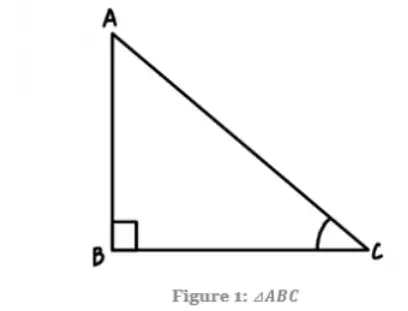
This image shows a right triangle labeled \( \triangle ABC \) with a right angle at vertex B. Step-by-step explanation: 1. Identify the right angle, which is at point B. 2. Recognize that side AB is vertical and side BC is horizontal. 3. Note that the triangle has three angles: one right angle at B, and two other angles at A and C. 4. Understand that side AC is the hypotenuse, the longest side opposite the right angle. 5. This setup is often used to study properties of right triangles, like the Pythagorean theorem.
Consider triangle \( \triangle ABC \) right-angled at \( B \). The trigonometric ratios for angle \( C \) are defined as:
\[ \sin \angle C = \frac{AB}{AC}, \quad \csc \angle C = \frac{1}{\sin \angle C} \]
\[ \cos \angle C = \frac{BC}{AC}, \quad \sec \angle C = \frac{1}{\cos \angle C} \]
\[ \tan \angle C = \frac{\sin \angle C}{\cos \angle C}, \quad \cot \angle C = \frac{1}{\tan \angle C} \]
These ratios are most commonly evaluated at the standard angles mentioned earlier, which are complementary in a right-angled triangle.
Example: Calculate the value of \(\sin 0^\circ\) and \(\cos 90^\circ\) using the definitions above.
Solution: For \(\sin 0^\circ\), since the opposite side length approaches zero, \(\sin 0^\circ = 0\). For \(\cos 90^\circ\), the adjacent side length approaches zero, so \(\cos 90^\circ = 0\).
Deriving Trigonometric Values for 45° Angles
Properties of a Right Isosceles Triangle and Ratio Calculations
When both acute angles in a right triangle are equal, each measures 45°, forming a right isosceles triangle. In such a triangle, the two legs are congruent. Let each leg be of length \(a\). Applying the Pythagorean theorem, the hypotenuse length is:
\[ AC = \sqrt{a^2 + a^2} = a\sqrt{2} \]
Using these lengths, the trigonometric ratios for the 45° angle are:
\[ \sin 45^\circ = \frac{a}{a\sqrt{2}} = \frac{1}{\sqrt{2}}, \quad \csc 45^\circ = \sqrt{2} \]
\[ \cos 45^\circ = \frac{a}{a\sqrt{2}} = \frac{1}{\sqrt{2}}, \quad \sec 45^\circ = \sqrt{2} \]
\[ \tan 45^\circ = \frac{\sin 45^\circ}{\cos 45^\circ} = 1, \quad \cot 45^\circ = 1 \]
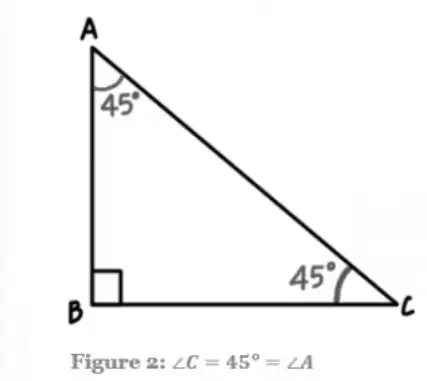
This image shows a right triangle ABC with a right angle at B. Angles A and C are both 45 degrees, making this a special triangle. Step-by-step explanation: 1. Identify the right angle at point B (90 degrees). 2. Notice angles A and C are each 45 degrees. 3. Since the total angles in a triangle add up to 180 degrees, 45° + 45° + 90° = 180°. 4. This makes triangle ABC an isosceles right triangle, meaning the two legs AB and BC are equal in length. 5. This type of triangle is useful in geometry because of its symmetry and equal legs.
Example: Find \(\tan 45^\circ + \cot 45^\circ\).
Solution: Since \(\tan 45^\circ = 1\) and \(\cot 45^\circ = 1\), their sum is:
\[ 1 + 1 = 2 \]
Evaluating Trigonometric Ratios for 30° and 60° Angles
Using an Equilateral Triangle to Derive Values
Consider an equilateral triangle \( \triangle PQR \) with each side length \(2a\). Dropping a perpendicular from vertex \(P\) to side \(QR\) bisects \(QR\) into two equal segments of length \(a\) and creates two 30° and 60° angles. The perpendicular length \(PS\) is calculated using the Pythagorean theorem:
\[ PS = \sqrt{(2a)^2 - a^2} = \sqrt{3}a \]
For angle \(30^\circ\), the trigonometric ratios are:
\[ \sin 30^\circ = \frac{a}{2a} = \frac{1}{2}, \quad \csc 30^\circ = 2 \]
\[ \cos 30^\circ = \frac{\sqrt{3}a}{2a} = \frac{\sqrt{3}}{2}, \quad \sec 30^\circ = \frac{2}{\sqrt{3}} \]
\[ \tan 30^\circ = \frac{\sin 30^\circ}{\cos 30^\circ} = \frac{1}{\sqrt{3}}, \quad \cot 30^\circ = \sqrt{3} \]
Similarly, for angle \(60^\circ\), the ratios are:
\[ \sin 60^\circ = \frac{\sqrt{3}}{2}, \quad \csc 60^\circ = \frac{2}{\sqrt{3}} \]
\[ \cos 60^\circ = \frac{1}{2}, \quad \sec 60^\circ = 2 \]
\[ \tan 60^\circ = \sqrt{3}, \quad \cot 60^\circ = \frac{1}{\sqrt{3}} \]
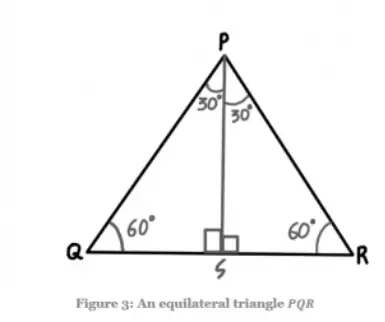
The image shows an equilateral triangle PQR with all sides equal and each angle measuring 60°. A perpendicular line is drawn from vertex P to the base QR, meeting QR at point S. This creates two right triangles, PQS and PRS. Step-by-step explanation: 1. Identify that triangle PQR is equilateral, so each angle is 60°. 2. A line is drawn from P to the base QR perpendicularly, creating a right angle at point S. 3. This splits the 60° angle at P into two 30° angles. 4. The triangle is now divided into two right triangles, each with angles 30°, 60°, and 90°. 5. This setup is useful for studying properties of 30-60-90 triangles and finding heights or side lengths.
Example: Calculate the value of \(\tan 30^\circ + \sin 60^\circ\).
Solution: Using the known values:
\[ \tan 30^\circ = \frac{1}{\sqrt{3}}, \quad \sin 60^\circ = \frac{\sqrt{3}}{2} \]
Adding these:
\[ \frac{1}{\sqrt{3}} + \frac{\sqrt{3}}{2} = \frac{2}{2\sqrt{3}} + \frac{3}{2\sqrt{3}} = \frac{5}{2\sqrt{3}} \]
Rationalizing the denominator:
\[ \frac{5}{2\sqrt{3}} \times \frac{\sqrt{3}}{\sqrt{3}} = \frac{5\sqrt{3}}{6} \]
Trigonometric Ratios at 0° and 90° Angles
Behavior of Ratios as Angles Approach Extremes
In a right-angled triangle \( \triangle ABC \), as the side \( BC \) shrinks towards zero, angle \( A \) approaches 0°, and angle \( C \) approaches 90°. At these limits, the trigonometric ratios take specific values:
For \( \angle A = 0^\circ \):
\[ \sin 0^\circ = 0, \quad \csc 0^\circ = \text{undefined} \]
\[ \cos 0^\circ = 1, \quad \sec 0^\circ = 1 \]
\[ \tan 0^\circ = 0, \quad \cot 0^\circ = \text{undefined} \]
For \( \angle C = 90^\circ \):
\[ \sin 90^\circ = 1, \quad \csc 90^\circ = 1 \]
\[ \cos 90^\circ = 0, \quad \sec 90^\circ = \text{undefined} \]
\[ \tan 90^\circ = \text{undefined}, \quad \cot 90^\circ = 0 \]
Exam Tip: Remember that ratios involving division by zero are undefined. For example, \(\csc 0^\circ\) and \(\tan 90^\circ\) do not exist.
Example: Evaluate \(\sin 45^\circ - \cos 45^\circ\).
Solution: Since \(\sin 45^\circ = \cos 45^\circ = \frac{1}{\sqrt{2}}\), their difference is:
\[ \frac{1}{\sqrt{2}} - \frac{1}{\sqrt{2}} = 0 \]
Summary of Trigonometric Ratios for Key Angles
Angle (°) | \(\sin\) | \(\cos\) | \(\tan\) | \(\cot\) | \(\sec\) | \(\csc\) |
|---|---|---|---|---|---|---|
0 | 0 | 1 | 0 | Undefined | 1 | Undefined |
30 | \(\frac{1}{2}\) | \(\frac{\sqrt{3}}{2}\) | \(\frac{1}{\sqrt{3}}\) | \(\sqrt{3}\) | \(\frac{2}{\sqrt{3}}\) | 2 |
45 | \(\frac{1}{\sqrt{2}}\) | \(\frac{1}{\sqrt{2}}\) | 1 | 1 | \(\sqrt{2}\) | \(\sqrt{2}\) |
60 | \(\frac{\sqrt{3}}{2}\) | \(\frac{1}{2}\) | \(\sqrt{3}\) | \(\frac{1}{\sqrt{3}}\) | 2 | \(\frac{2}{\sqrt{3}}\) |
90 | 1 | 0 | Undefined | 0 | Undefined | 1 |
Glossary of Key Trigonometric Terms
Term | Definition |
|---|---|
Sine (\(\sin\)) | Ratio of the length of the side opposite the angle to the hypotenuse. |
Cosine (\(\cos\)) | Ratio of the length of the adjacent side to the hypotenuse. |
Tangent (\(\tan\)) | Ratio of sine to cosine; opposite side over adjacent side. |
Cotangent (\(\cot\)) | Reciprocal of tangent; adjacent side over opposite side. |
Secant (\(\sec\)) | Reciprocal of cosine; hypotenuse over adjacent side. |
Cosecant (\(\csc\)) | Reciprocal of sine; hypotenuse over opposite side. |
Right-Angled Triangle | A triangle with one angle measuring 90°. |
Hypotenuse | The side opposite the right angle; the longest side in a right triangle. |
Complementary Angles | Two angles whose sum is 90°. |
Radian | A unit of angular measure where \(2\pi\) radians equal 360°. |
Frequently Asked Questions on Trigonometric Ratios
What are the six fundamental trigonometric ratios?
The six primary trigonometric ratios are sine, cosine, tangent, cotangent, secant, and cosecant, each relating sides of a right triangle to its angles.
Why are the angles 0°, 30°, 45°, 60°, and 90° important in trigonometry?
These angles are standard because their trigonometric ratios can be derived exactly using geometric properties, making them essential for problem-solving.
How do you find the sine of 45°?
In a right isosceles triangle with legs of equal length \(a\), \(\sin 45^\circ = \frac{a}{a\sqrt{2}} = \frac{1}{\sqrt{2}}\).
What happens to \(\tan \theta\) as \(\theta\) approaches 90°?
\(\tan \theta\) becomes undefined at 90° because the cosine of 90° is zero, and division by zero is undefined.
Can trigonometric ratios be used for angles greater than 90°?
Yes, but the definitions extend beyond right triangles using the unit circle concept, which is beyond the scope of basic right triangle trigonometry.