Comprehensive Guide to Trigonometric Identities
Fundamentals of Trigonometric Identities
Understanding the Core Trigonometric Functions and Their Relationships
Trigonometric identities are equations involving trigonometric functions that hold true for all permissible values of the variables involved. These identities are essential tools for simplifying expressions and solving equations involving angles and side lengths in triangles.
The six fundamental trigonometric functions are sine (\(\sin\)), cosine (\(\cos\)), tangent (\(\tan\)), cotangent (\(\cot\)), secant (\(\sec\)), and cosecant (\(\csc\)). The first three are primary, while the latter three are their reciprocals. Each function relates an angle of a right triangle to ratios of its sides.
Mastering these identities enables efficient problem-solving in trigonometry and related fields.
Example 1: Calculating Secant Using Tangent
In a right-angled triangle \(PQR\) with right angle at \(Q\), the side \(PQ = 5 \text{ cm}\) and \(QR = 12 \text{ cm}\). Find the value of \(\sec P\).
Solution:
First, calculate \(\tan P\):
\[ \tan P = \frac{QR}{PQ} = \frac{12}{5} = 2.4 \]
Using the identity \(1 + \tan^2 \theta = \sec^2 \theta\), we get:
\[ \sec^2 P = 1 + (2.4)^2 = 1 + 5.76 = 6.76 \]
Therefore,
\[ \sec P = \pm \sqrt{6.76} = \pm 2.6 \]
Since secant is positive in this context, \(\sec P = 2.6\).
Key Trigonometric Identities and Their Applications
Reciprocal and Pythagorean Identities
Reciprocal identities express each trigonometric function as the reciprocal of another:
\(\sin \theta = \frac{1}{\csc \theta}\), \(\csc \theta = \frac{1}{\sin \theta}\)
\(\cos \theta = \frac{1}{\sec \theta}\), \(\sec \theta = \frac{1}{\cos \theta}\)
\(\tan \theta = \frac{1}{\cot \theta}\), \(\cot \theta = \frac{1}{\tan \theta}\)
Pythagorean identities are derived from the Pythagoras theorem and relate squares of trigonometric functions:
\[ \sin^2 \alpha + \cos^2 \alpha = 1 \]
\[ 1 + \tan^2 \alpha = \sec^2 \alpha \]
\[ \csc^2 \alpha = 1 + \cot^2 \alpha \]
Example 2: Verifying a Pythagorean Identity
Prove that \(1 + \tan^2 \theta = \sec^2 \theta\) using a right triangle where the side adjacent to \(\theta\) is 7 units and the opposite side is 24 units.
Solution:
Calculate the hypotenuse using Pythagoras theorem:
\[ \text{Hypotenuse} = \sqrt{7^2 + 24^2} = \sqrt{49 + 576} = \sqrt{625} = 25 \]
Calculate \(\tan \theta\) and \(\sec \theta\):
\[ \tan \theta = \frac{24}{7}, \quad \sec \theta = \frac{25}{7} \]
Compute both sides:
\[ 1 + \tan^2 \theta = 1 + \left(\frac{24}{7}\right)^2 = 1 + \frac{576}{49} = \frac{49}{49} + \frac{576}{49} = \frac{625}{49} \]
\[ \sec^2 \theta = \left(\frac{25}{7}\right)^2 = \frac{625}{49} \]
Both sides are equal, hence the identity is verified.
Advanced Angle Identities and Their Proofs
Sum, Difference, Double, and Half Angle Formulas
These identities allow the expression of trigonometric functions of combined or scaled angles in terms of simpler angles.
Sum and difference formulas:
\[ \sin(\alpha \pm \beta) = \sin \alpha \cos \beta \pm \cos \alpha \sin \beta \]
\[ \cos(\alpha \pm \beta) = \cos \alpha \cos \beta \mp \sin \alpha \sin \beta \]
\[ \tan(\alpha \pm \beta) = \frac{\tan \alpha \pm \tan \beta}{1 \mp \tan \alpha \tan \beta} \]
Double angle formulas:
\[ \sin 2\theta = 2 \sin \theta \cos \theta \]
\[ \cos 2\theta = \cos^2 \theta - \sin^2 \theta = 2 \cos^2 \theta - 1 = 1 - 2 \sin^2 \theta \]
\[ \tan 2\theta = \frac{2 \tan \theta}{1 - \tan^2 \theta} \]
Half angle formulas:
\[ \sin \frac{\theta}{2} = \pm \sqrt{\frac{1 - \cos \theta}{2}} \]
\[ \cos \frac{\theta}{2} = \pm \sqrt{\frac{1 + \cos \theta}{2}} \]
\[ \tan \frac{\theta}{2} = \pm \sqrt{\frac{1 - \cos \theta}{1 + \cos \theta}} \]
Example 3: Proving a Half-Angle Identity
Show that \(\sin^2 \frac{\theta}{2} = \frac{1 - \cos \theta}{2}\).
Solution:
Starting from the double angle formula for cosine:
\[ \cos 2\alpha = 1 - 2 \sin^2 \alpha \]
Let \(\alpha = \frac{\theta}{2}\), then:
\[ \cos \theta = 1 - 2 \sin^2 \frac{\theta}{2} \]
Rearranging gives:
\[ 2 \sin^2 \frac{\theta}{2} = 1 - \cos \theta \]
\[ \sin^2 \frac{\theta}{2} = \frac{1 - \cos \theta}{2} \]
Thus, the identity is proven.
Fundamental Triangle Laws and Their Trigonometric Expressions
Extending Identities Beyond Right Triangles
Triangle identities apply to all triangles, not just right-angled ones. These include the Sine Rule, Cosine Rule, and Tangent Rule, which relate sides and angles in any triangle.
Sine Rule:
\[ \frac{a}{\sin A} = \frac{b}{\sin B} = \frac{c}{\sin C} \]
or equivalently,
\[ \frac{\sin A}{a} = \frac{\sin B}{b} = \frac{\sin C}{c} \]
Cosine Rule:
\[ c^2 = a^2 + b^2 - 2ab \cos C \]
or
\[ \cos C = \frac{a^2 + b^2 - c^2}{2ab} \]
Tangent Rule:
\[ \frac{a - b}{a + b} = \frac{\tan \frac{A - B}{2}}{\tan \frac{A + B}{2}} \]
Example 4: Applying the Cosine Rule
In triangle \(XYZ\), sides \(XY = 8 \text{ cm}\), \(YZ = 6 \text{ cm}\), and angle \(X = 60^\circ\). Find the length of side \(XZ\).
Solution:
Using the cosine rule:
\[ XZ^2 = XY^2 + YZ^2 - 2 \times XY \times YZ \times \cos X \]
\[ XZ^2 = 8^2 + 6^2 - 2 \times 8 \times 6 \times \cos 60^\circ = 64 + 36 - 96 \times 0.5 = 100 - 48 = 52 \]
\[ XZ = \sqrt{52} = 2 \sqrt{13} \approx 7.21 \text{ cm} \]
Summary of Essential Trigonometric Identities
Identity Type | Formula | Remarks |
|---|---|---|
Reciprocal | \(\sin \theta = \frac{1}{\csc \theta}\), \(\cos \theta = \frac{1}{\sec \theta}\), \(\tan \theta = \frac{1}{\cot \theta}\) | Defines reciprocal relationships |
Pythagorean | \(\sin^2 \theta + \cos^2 \theta = 1\) | Fundamental identity |
Ratio | \(\tan \theta = \frac{\sin \theta}{\cos \theta}\), \(\cot \theta = \frac{\cos \theta}{\sin \theta}\) | Expresses tangent and cotangent |
Sum and Difference | \(\sin(\alpha \pm \beta) = \sin \alpha \cos \beta \pm \cos \alpha \sin \beta\) | Combines angles |
Double Angle | \(\sin 2\theta = 2 \sin \theta \cos \theta\) | For doubled angles |
Half Angle | \(\sin \frac{\theta}{2} = \pm \sqrt{\frac{1 - \cos \theta}{2}}\) | For halved angles |
Triangle Laws | \(\frac{a}{\sin A} = \frac{b}{\sin B} = \frac{c}{\sin C}\) | Applies to all triangles |
Glossary of Key Terms in Trigonometry
Term | Definition |
|---|---|
Sine (\(\sin\)) | Ratio of opposite side to hypotenuse in a right triangle |
Cosine (\(\cos\)) | Ratio of adjacent side to hypotenuse |
Tangent (\(\tan\)) | Ratio of opposite side to adjacent side |
Cosecant (\(\csc\)) | Reciprocal of sine |
Secant (\(\sec\)) | Reciprocal of cosine |
Cotangent (\(\cot\)) | Reciprocal of tangent |
Pythagorean Identity | Relationship between squares of sine and cosine |
Sum and Difference Formulas | Express trigonometric functions of sums or differences of angles |
Double Angle Formula | Expresses functions of twice an angle |
Half Angle Formula | Expresses functions of half an angle |
Frequently Asked Questions on Trigonometric Identities
What are the primary trigonometric functions?
The main trigonometric functions are sine, cosine, and tangent, which relate angles to side ratios in right triangles.
Can you list the fundamental trigonometric identities?
Key identities include reciprocal identities, Pythagorean identities, ratio identities, and angle sum/difference formulas.
What is the significance of the Pythagorean identities?
They connect the squares of sine, cosine, tangent, secant, cosecant, and cotangent, forming the basis for many trigonometric proofs.
How is the reciprocal of sine defined?
The reciprocal of sine is cosecant, defined as \(\csc \theta = \frac{1}{\sin \theta}\).
What is the formula for \(\sin 2A\)?
The double angle formula for sine is \(\sin 2A = 2 \sin A \cos A\).
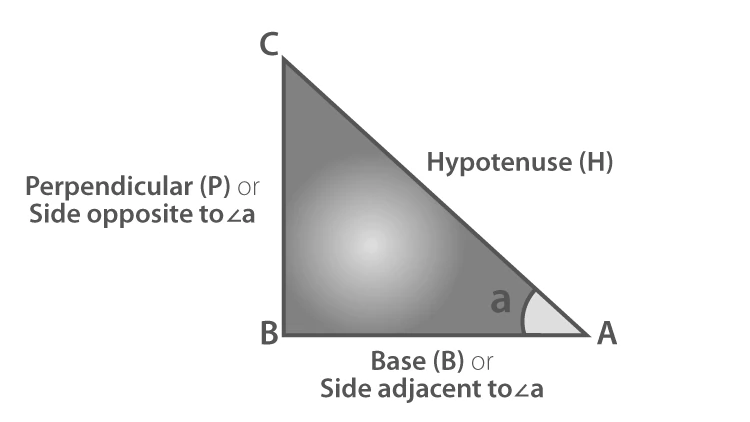
Right-angled triangle demonstrating Pythagoras theorem
Student practicing trigonometric identities
Instructor teaching trigonometric identities
Positive feedback from a student on learning platform
Register with BYJU'S to access free PDFs and live videos