Comprehensive Guide to Triangles: Properties, Types, and Calculations
Fundamentals of Triangles and Their Angle Relationships
Understanding the Basic Structure and Angle Sum Principle
A triangle is a polygon characterized by three straight sides and three vertices where these sides meet. Each vertex forms an angle between two adjacent sides. A key geometric fact is that the sum of the interior angles of any triangle is always \(180^\circ\). This fundamental property is essential in various geometric proofs and applications.
In notation, a triangle with vertices A, B, and C is represented as \(\triangle ABC\). The triangle lies in a single plane and is defined by three non-collinear points.
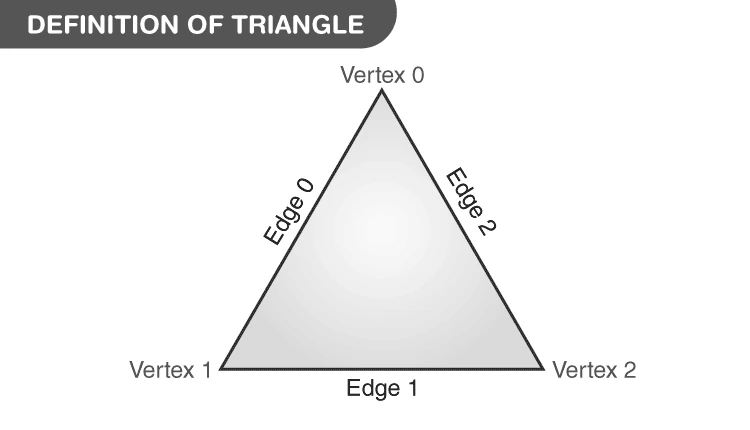
Diagram of a triangle with vertices and sides
Exterior Angles and Their Supplementary Nature
Extending a side of a triangle beyond a vertex creates an exterior angle. Each exterior angle forms a linear pair with its adjacent interior angle, meaning their sum is \(180^\circ\). If the interior angles are \(\angle 1, \angle 2, \angle 3\) and the corresponding exterior angles are \(\angle 4, \angle 5, \angle 6\), then:
\[ \angle 1 + \angle 4 = 180^\circ, \quad \angle 2 + \angle 5 = 180^\circ, \quad \angle 3 + \angle 6 = 180^\circ \]
Adding these equations yields the sum of all exterior angles as \(360^\circ\), a property true for every triangle.
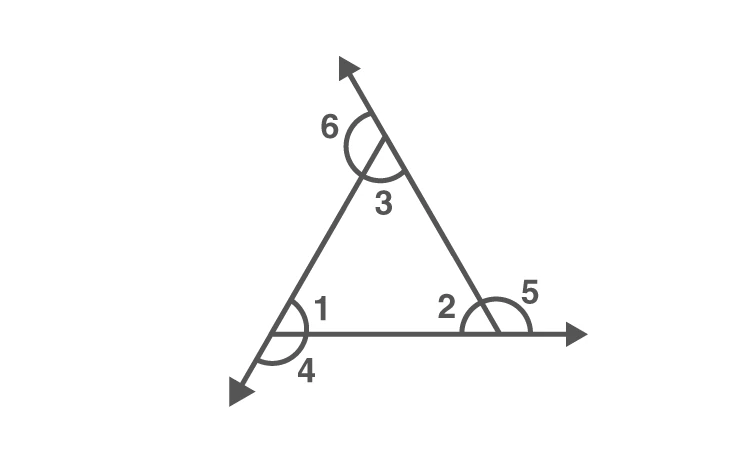
Triangle illustrating interior and exterior angles
Example Problem
Question: In a triangle, if two interior angles measure \(50^\circ\) and \(60^\circ\), find the third interior angle and the exterior angle adjacent to it.
Solution:
Sum of interior angles of a triangle is \(180^\circ\). Let the third angle be \(x\).
\[ 50^\circ + 60^\circ + x = 180^\circ \]
\[ x = 180^\circ - 110^\circ = 70^\circ \]
The exterior angle adjacent to this third angle is supplementary to it:
\[ \text{Exterior angle} = 180^\circ - 70^\circ = 110^\circ \]
Key Characteristics and Classification of Triangles
Essential Properties That Define Triangles
Triangles possess distinct properties that differentiate them from other polygons:
They have exactly three sides and three interior angles.
The sum of interior angles is always \(180^\circ\).
The sum of exterior angles totals \(360^\circ\).
The sum of an interior angle and its adjacent exterior angle is \(180^\circ\).
The length of any side is less than the sum and greater than the difference of the other two sides.
The smallest side lies opposite the smallest interior angle, and the largest side lies opposite the largest interior angle.
Classification Based on Side Lengths
Triangles are categorized by their side lengths into three types:
Scalene Triangle
All three sides have different lengths, resulting in three unequal angles.
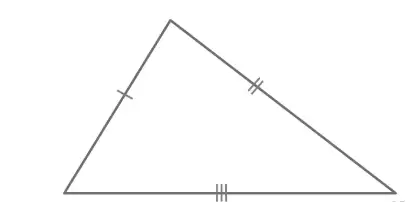
The image shows a triangle with three sides, each marked with different numbers of lines indicating that all three sides are of different lengths. Step-by-step explanation for high school students: 1. Look at the marks on each side of the triangle. 2. Each side has a different number of short lines (one, two, or three). 3. These marks show that no two sides are equal in length. 4. Since all sides have different lengths, this triangle is called a scalene triangle. 5. Understanding side lengths helps classify triangles and solve related problems.
Isosceles Triangle
This triangle has two sides of equal length, and the angles opposite these sides are also equal.
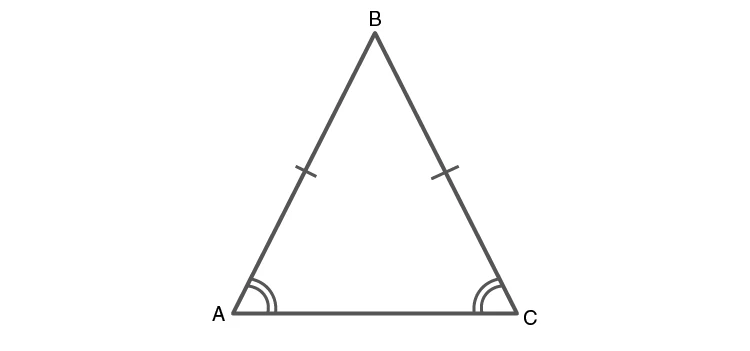
Isosceles triangle showing equal sides and angles
Equilateral Triangle
All three sides are equal in length, and each interior angle measures exactly \(60^\circ\).
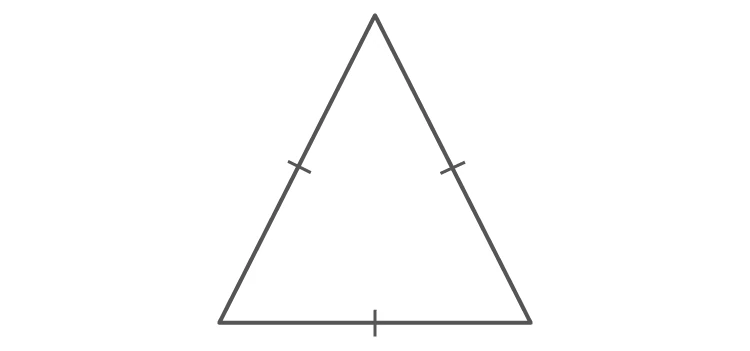
Equilateral triangle with equal sides and angles
Classification Based on Angle Measures
Triangles can also be classified by their interior angles:
Acute Triangle
All interior angles are less than \(90^\circ\).
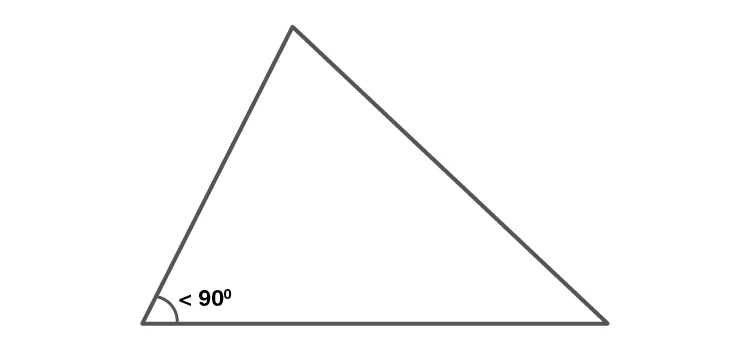
Acute triangle with all angles acute
Right Triangle
One interior angle is exactly \(90^\circ\), known as the right angle.
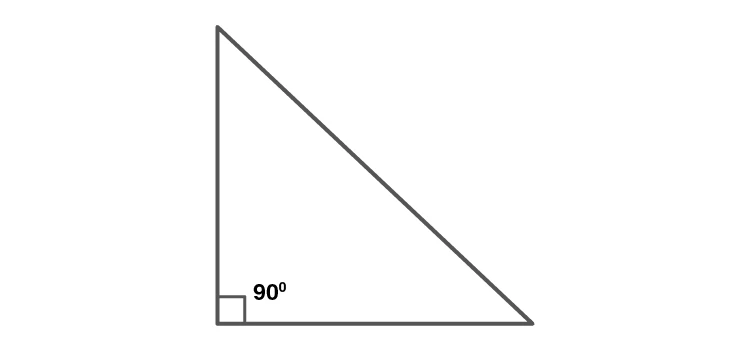
Right triangle with a right angle
Obtuse Triangle
One interior angle is greater than \(90^\circ\).
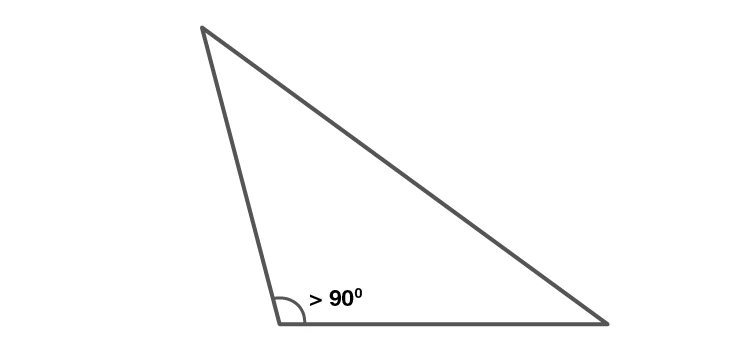
Obtuse triangle with an obtuse angle
Example Problem
Question: Identify the type of triangle with sides measuring 7 cm, 7 cm, and 10 cm, and classify it by its angles if one angle is \(90^\circ\).
Solution:
Since two sides are equal (7 cm and 7 cm), the triangle is isosceles.
Given one angle is \(90^\circ\), it is a right-angled triangle.
Therefore, the triangle is an isosceles right triangle.
Calculating Perimeter and Area of Triangles
Determining the Perimeter
The perimeter of a triangle is the total length around its boundary, calculated by adding the lengths of all three sides. If the sides of \(\triangle ABC\) are \(AB\), \(BC\), and \(AC\), then:
\[ \text{Perimeter} = AB + BC + AC \]
Area Calculation Using Base and Height
The area represents the two-dimensional space enclosed by the triangle. When the base and height are known, the area is computed as:
\[ \text{Area} = \frac{1}{2} \times \text{Base} \times \text{Height} \]
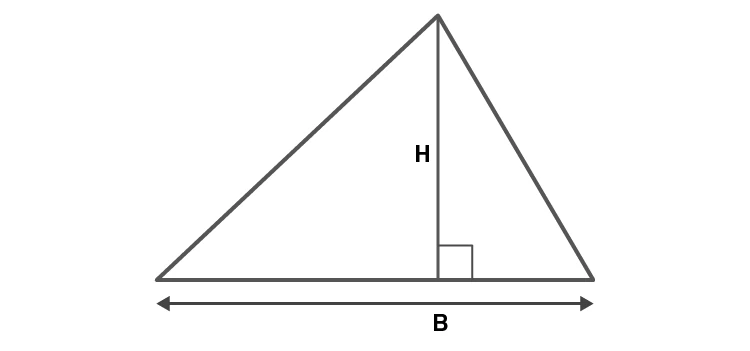
Triangle illustrating base and height
Example Problem
Question: Calculate the area of a triangle with a base of 8 cm and a height of 5 cm.
Solution:
\[ \text{Area} = \frac{1}{2} \times 8 \times 5 = 20 \text{ cm}^2 \]
Area Determination Using Heron's Formula
If the height is unknown but all three side lengths \(a\), \(b\), and \(c\) are given, Heron's formula provides the area:
First, calculate the semi-perimeter \(s\):
\[ s = \frac{a + b + c}{2} \]
Then, the area \(A\) is:
\[ A = \sqrt{s(s - a)(s - b)(s - c)} \]
Example Problem
Question: Find the area of a triangle with sides 6 units, 8 units, and 10 units using Heron's formula.
Solution:
Calculate semi-perimeter:
\[ s = \frac{6 + 8 + 10}{2} = 12 \]
Calculate area:
\[ A = \sqrt{12(12 - 6)(12 - 8)(12 - 10)} = \sqrt{12 \times 6 \times 4 \times 2} = \sqrt{576} = 24 \text{ square units} \]
Example Problem
Question: Calculate the perimeter of a triangle with sides measuring 4 cm, 7 cm, and 6 cm.
Solution:
\[ \text{Perimeter} = 4 + 7 + 6 = 17 \text{ cm} \]
Quick Reference: Triangle Essentials
Concept | Formula / Property |
|---|---|
Sum of interior angles | \(180^\circ\) |
Sum of exterior angles | \(360^\circ\) |
Perimeter | \(P = a + b + c\) |
Area (base-height) | \(A = \frac{1}{2} \times \text{base} \times \text{height}\) |
Area (Heron's formula) | \(A = \sqrt{s(s-a)(s-b)(s-c)}\), where \(s = \frac{a+b+c}{2}\) |
Scalene Triangle | All sides and angles different |
Isosceles Triangle | Two sides and opposite angles equal |
Equilateral Triangle | All sides and angles equal (\(60^\circ\)) |
Right Triangle | One angle is \(90^\circ\) |
Acute Triangle | All angles less than \(90^\circ\) |
Obtuse Triangle | One angle greater than \(90^\circ\) |
Glossary of Key Terms Related to Triangles
Term | Definition |
|---|---|
Triangle | A polygon with three sides and three vertices. |
Vertex | The point where two sides of a triangle meet. |
Interior Angle | The angle formed inside the triangle at a vertex. |
Exterior Angle | The angle formed outside the triangle by extending a side. |
Perimeter | The total length around the triangle. |
Area | The measure of the surface enclosed by the triangle. |
Scalene Triangle | A triangle with all sides and angles different. |
Isosceles Triangle | A triangle with two equal sides and two equal angles. |
Equilateral Triangle | A triangle with all sides and angles equal. |
Heron's Formula | A formula to calculate area when all side lengths are known. |
Semi-perimeter | Half of the perimeter of a triangle. |
Frequently Asked Questions About Triangles
What defines a triangle in geometry?
A triangle is a polygon with three sides and three vertices, where the sum of its interior angles is always \(180^\circ\).
How are triangles classified based on their sides?
Triangles are classified as scalene (all sides different), isosceles (two sides equal), and equilateral (all sides equal).
What are the main properties of triangle angles?
The interior angles sum to \(180^\circ\), exterior angles sum to \(360^\circ\), and each interior angle plus its adjacent exterior angle equals \(180^\circ\).
How do you calculate the perimeter and area of a triangle?
Perimeter is the sum of all sides. Area can be calculated using \(\frac{1}{2} \times \text{base} \times \text{height}\) or Heron's formula if all sides are known.
What distinguishes acute, right, and obtuse triangles?
An acute triangle has all angles less than \(90^\circ\), a right triangle has one \(90^\circ\) angle, and an obtuse triangle has one angle greater than \(90^\circ\).