Understanding Similarity and the Triangle Proportionality Theorem
Concept of Similar Figures and Their Properties
Defining Similarity in Geometric Figures
Two shapes are considered similar when they share the same form, regardless of their size differences. This means that although their dimensions may vary, their overall shape remains consistent. For instance, photographs of a person in various sizes such as passport or stamp photos are similar but not identical in size.
Certain geometric shapes inherently maintain similarity across all sizes. Circles are a prime example; no matter how the radius changes, the shape remains unchanged. Hence, all circles are similar to one another.
Likewise, squares retain their shape regardless of side length variations, making all squares similar figures.
Similarity Criteria for Triangles
For triangles, similarity is established when two conditions are met:
All corresponding angles between the triangles are equal.
The lengths of corresponding sides are proportional.
In other words, triangles \( \triangle ABC \) and \( \triangle PQR \) are similar if:
\[ \angle A = \angle P, \quad \angle B = \angle Q, \quad \angle C = \angle R \]
and
\[ \frac{AB}{PQ} = \frac{BC}{QR} = \frac{CA}{RP} \]
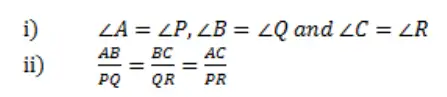
The image shows two mathematical statements about triangles: i) Three pairs of angles are equal: ∠A = ∠P, ∠B = ∠Q, and ∠C = ∠R. ii) The ratios of the corresponding sides of the triangles are equal: AB/PQ = BC/QR = AC/PR. Step-by-step explanation for high school students: 1. You have two triangles, let's call them triangle ABC and triangle PQR. 2. Statement (i) says that the angles in one triangle are the same as the angles in the other triangle. 3. Statement (ii) says that the sides in one triangle are proportional to the sides in the other triangle. 4. Together, these show that the two triangles are similar because their angles are equal and their sides are in the same ratio.
Example: Identifying Similar Triangles
Two triangles have angles measuring 40°, 60°, and 80°. If the sides of the first triangle are 6 cm, 8 cm, and 10 cm, and the second triangle has sides 9 cm, 12 cm, and 15 cm, determine if the triangles are similar.
Solution:
Since all corresponding angles are equal (40°, 60°, 80°), the first condition for similarity is satisfied.
Check the ratio of corresponding sides: \[ \frac{6}{9} = \frac{2}{3}, \quad \frac{8}{12} = \frac{2}{3}, \quad \frac{10}{15} = \frac{2}{3} \]
All side ratios are equal, confirming the triangles are similar.
Exploring the Triangle Proportionality Theorem
Statement and Explanation of the Theorem
The triangle proportionality theorem states that if a line is drawn parallel to one side of a triangle and intersects the other two sides, it divides those sides proportionally. This means the segments created on the two sides have the same ratio.
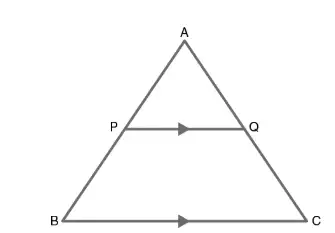
This image shows a triangle ABC with a line segment PQ inside it, where P lies on side AB and Q lies on side AC. Both segments PQ and BC have arrows pointing from left to right, indicating direction. Step-by-step explanation: 1. Identify the triangle ABC. 2. Notice that P is a point on side AB and Q is on side AC. 3. Observe the line segment PQ inside the triangle. 4. See that PQ is parallel to the base BC because both have arrows in the same direction. 5. This setup is commonly used in problems involving similarity of triangles or proportional segments inside triangles.
Consider triangle \( \triangle ABC \) with a line \( PQ \) drawn parallel to side \( BC \). According to the theorem, the following ratio holds:
\[ \frac{AP}{PB} = \frac{AQ}{QC} \]
Proof of the Triangle Proportionality Theorem
Given \( \triangle ABC \) with line segment \( PQ \) parallel to side \( BC \), we aim to prove the proportionality of the divided sides.
Construct lines \( BQ \) and \( CP \) by joining vertex \( B \) to point \( Q \) and vertex \( C \) to point \( P \). Then, draw perpendiculars \( QN \) and \( PM \) from points \( Q \) and \( P \) to sides \( AB \) and \( AC \) respectively.
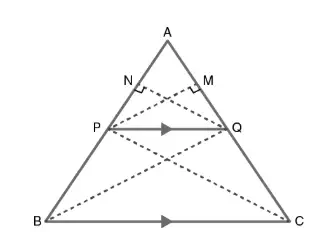
This image shows a triangle labeled ABC with several points and line segments inside. Points N and M lie on sides AB and AC, respectively. Points P and Q are on side BC. Dotted lines connect various points inside the triangle. Step-by-step explanation: 1. Identify the triangle ABC with vertices A, B, and C. 2. Locate points N and M on sides AB and AC. 3. Observe points P and Q placed on side BC. 4. Notice dotted lines connecting these points, forming smaller triangles inside ABC. 5. The arrows on BC and segment PQ indicate directions or relationships between these segments. 6. The image likely relates to properties of triangles, such as segment ratios or parallel lines formed inside the triangle.
By comparing the right triangles formed and using the properties of parallel lines and corresponding angles, it can be shown that:
\[ \frac{AP}{PB} = \frac{AQ}{QC} \]
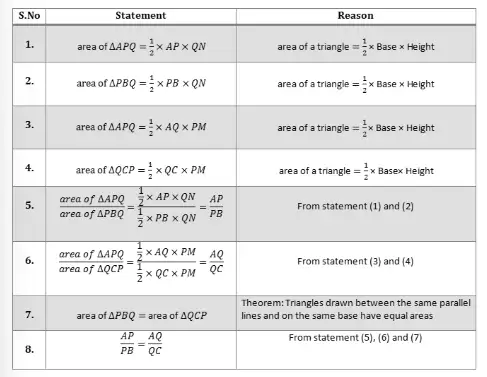
The image shows a table that proves a geometric theorem about triangles drawn between the same parallel lines. The table has three columns: statement, mathematical expressions about triangle areas, and reasons explaining those expressions. Step-by-step explanation for high school students: 1. The table starts with formulas for areas of triangles based on the formula for the area of a triangle \(\frac{1}{2} \times \text{Base} \times \text{Height}\). 2. It compares the areas of four triangles using their base and height measurements. 3. Ratios of these areas are written to connect the lengths of specific segments. 4. It uses a known theorem that triangles between the same parallel lines with the same base length have equal areas. 5. Finally, the table concludes by showing a proportionality relationship between segments using the results from area equalities. This stepwise approach helps prove that certain line segments in the figure are proportional.
This confirms the triangle proportionality theorem. Additionally, triangles \( \triangle ABC \) and \( \triangle APQ \) satisfy the similarity conditions, so \( \triangle ABC \sim \triangle APQ \).
Applying the Theorem: Problem Solving
Example: Finding a Missing Segment Using the Theorem
In triangle \( \triangle XYZ \), a line \( DE \) is drawn parallel to side \( YZ \). Given \( XD = 2 \text{ cm} \), \( DY = 4 \text{ cm} \), and \( ZE = 3 \text{ cm} \), find the length of segment \( DE \).
Solution:
Since \( DE \parallel YZ \), by the triangle proportionality theorem:
\[ \frac{XD}{DY} = \frac{ZE}{EC} \]
Substituting the known values:
\[ \frac{2}{4} = \frac{3}{EC} \]
Cross-multiplying:
\[ 2 \times EC = 4 \times 3 \]
\[ EC = \frac{12}{2} = 6 \text{ cm} \]
Therefore, the length of segment \( EC \) is \( 6 \text{ cm} \).
Summary and Key Points on Similarity and Proportionality
Concept | Definition/Property |
|---|---|
Similar Figures | Shapes with identical form but different sizes. |
Similarity in Triangles | Equal corresponding angles and proportional corresponding sides. |
Circles | All circles are similar regardless of radius. |
Squares | All squares are similar despite side length differences. |
Triangle Proportionality Theorem | A line parallel to one side divides the other two sides proportionally. |
Similarity from Proportionality | Triangles formed by the parallel line are similar to the original triangle. |
Glossary of Important Terms
Term | Meaning |
|---|---|
Similar Figures | Figures with the same shape but different sizes. |
Congruent Figures | Figures identical in shape and size. |
Corresponding Angles | Angles in the same relative position in similar figures. |
Proportional Sides | Sides having lengths in the same ratio. |
Triangle Proportionality Theorem | Theorem stating parallel lines divide sides proportionally. |
Parallel Lines | Lines in a plane that never meet. |
Perpendicular | A line at right angles to another line. |
Vertices | Points where two or more edges meet in a polygon. |
Segment | A part of a line bounded by two endpoints. |
Ratio | A comparison of two quantities by division. |
Frequently Asked Questions
What makes two triangles similar?
Two triangles are similar if their corresponding angles are equal and their corresponding sides are in proportion.
Are all circles similar?
Yes, all circles are similar because their shape remains the same regardless of the radius.
What does the triangle proportionality theorem state?
If a line is drawn parallel to one side of a triangle, it divides the other two sides proportionally.
How can similarity help in solving geometry problems?
Similarity allows us to find unknown lengths by setting up proportions between corresponding sides.
Can the triangle proportionality theorem be reversed?
Yes, if a line divides two sides of a triangle proportionally, then it is parallel to the third side.