Understanding Tangents and Lines in Circles
Fundamentals of Circles and Their Intersecting Lines
Defining a Circle and Its Radius
A circle is the collection of all points in a plane that are at an equal distance from a fixed point known as the center. This constant distance from the center to any point on the circle is called the radius.
Types of Lines in Relation to a Circle
When a line interacts with a circle, it can do so in three distinct ways:
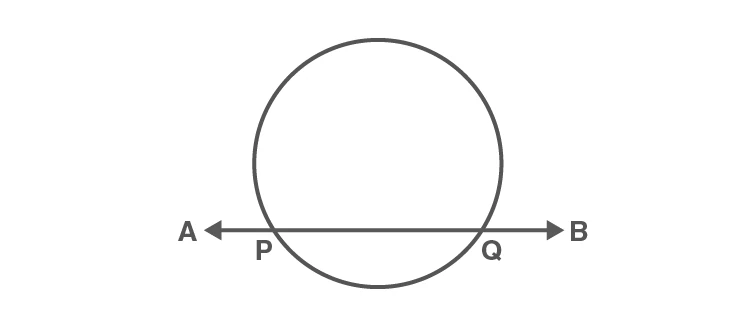
- Secant Line: A line that crosses the circle at two distinct points.
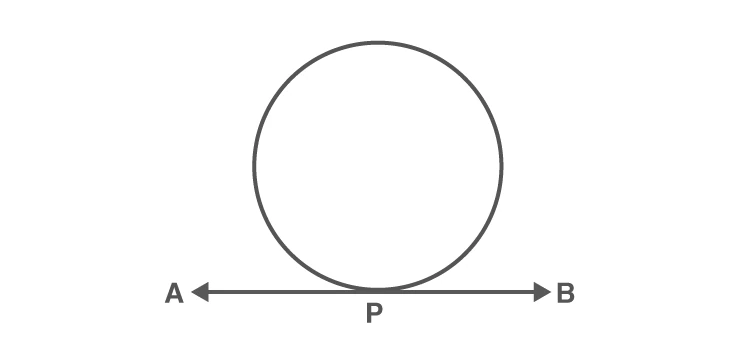
- Tangent Line: A line that touches the circle at exactly one point.
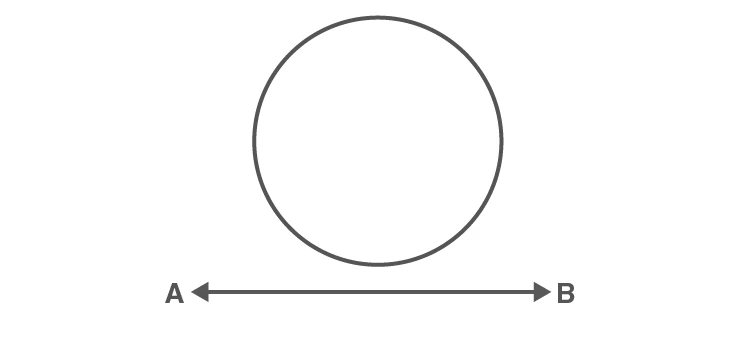
- Non-Intersecting Line: A line that does not touch the circle at any point.
Consider a line segment \( \overline{AB} \) and a circle. The following illustrations demonstrate these cases:
Example
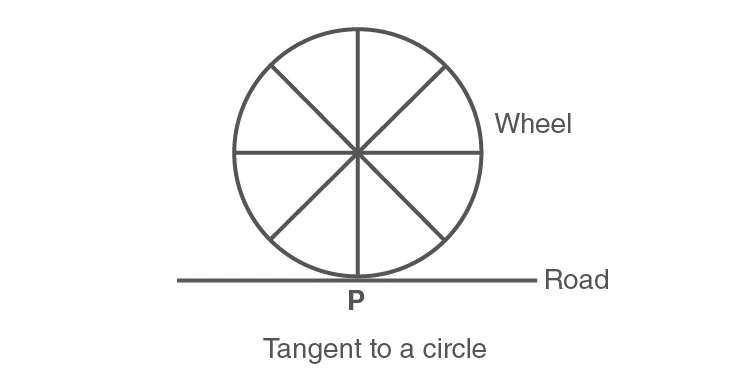
Imagine a bicycle wheel rolling on a flat surface. The point where the wheel contacts the ground is unique and singular. This contact point illustrates the concept of a tangent line, where the road acts as a tangent to the wheel's circular edge.
Characteristics and Uniqueness of Tangents on Circles
Uniqueness of the Tangent at a Point on a Circle
For any point located on the circumference of a circle, there exists exactly one tangent line passing through it. Any other line through that point will intersect the circle at a second point, thus becoming a secant.
To visualize this, consider multiple lines passing through a point \( P \) on the circle:
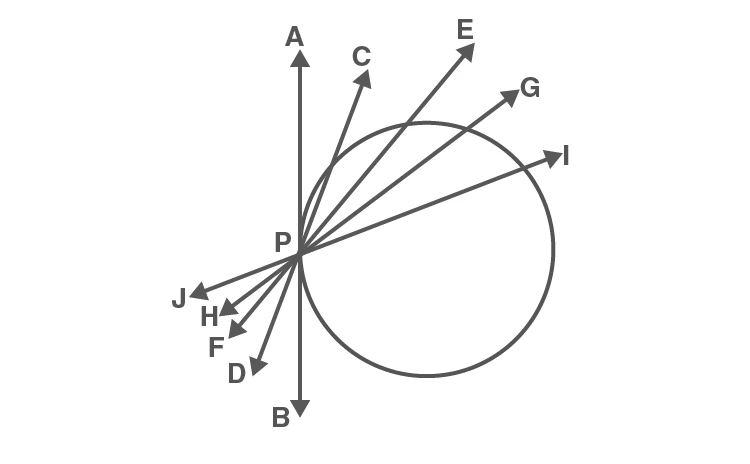
Here, \( \overleftrightarrow{AB} \) is the tangent line at \( P \), while the others are secants intersecting the circle at additional points.
Relation Between Tangents and Secants
A tangent can be viewed as a special type of secant where the two intersection points coincide, effectively reducing the chord length to zero. This means the tangent touches the circle at exactly one point, unlike a secant which crosses it at two.
Example
Suppose a circle has center \( O \) and radius \( 5 \text{ cm} \). A line touches the circle at point \( T \). If the distance from \( O \) to the line is \( 5 \text{ cm} \), prove that the line is a tangent.
Solution:
The radius \( OT = 5 \text{ cm} \). The shortest distance from the center \( O \) to the line is also \( 5 \text{ cm} \). Since the distance from the center to the line equals the radius, the line touches the circle at exactly one point.
Therefore, the line is a tangent to the circle at point \( T \).
Summary and Key Points on Circles and Tangents
| Concept | Definition | Key Property |
|---|---|---|
| Circle | Set of points equidistant from a center | Radius is constant for all points |
| Secant | Line intersecting circle at two points | Chord lies between intersection points |
| Tangent | Line touching circle at exactly one point | Perpendicular to radius at point of contact |
| Non-Intersecting Line | Line not touching the circle | No common points with circle |
Glossary of Important Terms
| Term | Meaning |
|---|---|
| Circle | Set of points equidistant from a fixed center |
| Radius | Distance from center to any point on the circle |
| Chord | Line segment joining two points on the circle |
| Secant | Line intersecting the circle at two points |
| Tangent | Line touching the circle at exactly one point |
| Point of Contact | The single point where tangent touches the circle |
| Center | Fixed point equidistant from all points on circle |
| Non-Intersecting Line | Line that does not meet the circle at any point |
| Perpendicular | Line at right angle (90°) to another line |
| Secant Chord | Chord formed by intersection points of a secant |
Frequently Asked Questions
What defines a tangent line to a circle?
A tangent is a line that touches the circle at exactly one point without crossing it.
Can a line intersect a circle at more than two points?
No, a line can intersect a circle at most at two points.
Is it possible to have more than one tangent at a single point on a circle?
No, only one unique tangent line passes through a given point on the circle.
How is a tangent related to the radius at the point of contact?
The tangent is perpendicular to the radius drawn to the point of contact.
What is the difference between a secant and a tangent?
A secant intersects the circle at two points, while a tangent touches it at only one point.