Calculating Surface Areas of Combined Solids
Understanding Surface Area in Composite Solids
Concept of Surface Area for Combined Shapes
In everyday objects, many solids are formed by joining two or more basic three-dimensional shapes such as cubes, cones, cylinders, and hemispheres. To determine the total surface area of such composite solids, it is essential to consider the curved surfaces of each individual part while excluding the areas where the solids are joined.
The total surface area (TSA) of a combined solid can be found by adding the curved surface areas (CSA) of each component, after subtracting any overlapping or common base areas that are not exposed.
This approach ensures an accurate calculation of the external surface area, which is crucial for applications like painting, wrapping, or manufacturing.
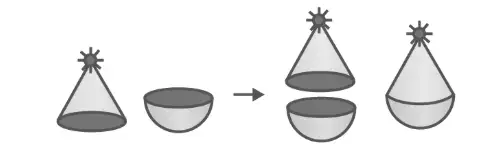
The image shows a cone being cut into two parts: a smaller cone on top and a frustum (the bottom part left after cutting the top cone). Step-by-step explanation: 1. Start with a full cone. 2. Slice the cone horizontally at some height, separating it into two parts. 3. The top part is a smaller cone. 4. The bottom part is called a frustum, which is the original cone minus the smaller top cone. 5. The image illustrates the shapes before and after the cut.
The formula to calculate the total surface area of such a solid is:
\[ \text{TSA} = \sum \text{CSA of individual solids} - \text{Area of common base(s)} \]
For example, when a cone and a hemisphere are joined at their bases, the radius of the cone's base must be equal to the radius of the hemisphere to ensure a smooth surface.
Thus, the total surface area of this combined solid is the sum of the curved surface area of the cone and the curved surface area of the hemisphere.
Calculating Surface Area for a Cube with a Hemisphere on Top
Step-by-step Approach to Surface Area of a Block
Consider a block formed by placing a hemisphere on top of a cube. The cube has an edge length of 6 cm, and the hemisphere has a diameter of 5 cm. To find the total surface area of this block, we must exclude the area of the cube's face where the hemisphere is attached, as it is not visible.
The total surface area of the block is calculated as:
\[ \text{Surface Area} = \text{TSA of cube} - \text{Base area of hemisphere} + \text{CSA of hemisphere} \]
Where:
TSA of cube = \(6a^2\)
Base area of hemisphere = \(\pi r^2\)
Curved surface area of hemisphere = \(2\pi r^2\)
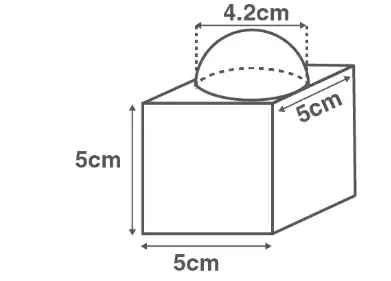
The image shows a cube with side lengths of 5 cm and a hemisphere on top with a diameter of 4.2 cm. Step-by-step explanation: 1. Identify the shape of the main object, which is a cube measuring 5 cm on all sides. 2. Note the hemisphere sitting on top of the cube, with a diameter of 4.2 cm. 3. The hemisphere is half a sphere; its radius is half the diameter, so 2.1 cm. 4. Understand that the hemisphere rests on one face of the cube, centered on top.
Example:
Calculate the total surface area of a block where the cube edge is 6 cm and the hemisphere diameter is 5 cm. Use \(\pi = \frac{22}{7}\).
Solution:
Given: \(a = 6 \text{ cm}\), diameter of hemisphere = 5 cm, so radius \(r = \frac{5}{2} = 2.5 \text{ cm}\).
TSA of cube = \(6a^2 = 6 \times 6^2 = 6 \times 36 = 216 \text{ cm}^2\).
Base area of hemisphere = \(\pi r^2 = \frac{22}{7} \times 2.5 \times 2.5 = \frac{22}{7} \times 6.25 = 19.64 \text{ cm}^2\).
Curved surface area of hemisphere = \(2\pi r^2 = 2 \times \frac{22}{7} \times 6.25 = 39.29 \text{ cm}^2\).
Total surface area of block:
\[ 216 - 19.64 + 39.29 = 235.65 \text{ cm}^2 \]
Therefore, the block's surface area is approximately \(235.65 \text{ cm}^2\).
Surface Area of a Birdbath Combining Cylinder and Hemisphere
Determining the External Surface Area of a Composite Birdbath
Imagine a birdbath shaped by joining a cylinder and a hemisphere at one end. The cylinder has a height of 1.5 m and a radius of 35 cm. To find the total surface area, we add the curved surface area of the cylinder and the curved surface area of the hemisphere, excluding the base where they join.
The formula for the total surface area is:
\[ \text{TSA} = \text{CSA of cylinder} + \text{CSA of hemisphere} = 2\pi r h + 2\pi r^2 = 2\pi r (h + r) \]
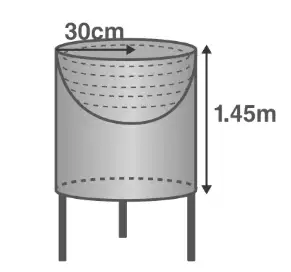
This image shows a cylindrical water tank on legs, with a circular opening at the top. The tank’s height is labeled as 1.45 meters, and the radius of the circular top opening is 30 cm. Step-by-step explanation for high school students: 1. Identify the shape: The tank is a cylinder. 2. Note the dimensions: Height = 1.45 m, radius of the top circle = 30 cm (convert to meters as 0.30 m if needed). 3. Understand that the radius is the distance from the center to the edge of the circular tank top. 4. Recognize the tank stands on legs, elevating it above the ground. 5. This setup is often used to store water or liquids safely.
Example:
Calculate the total surface area of a birdbath with cylinder height \(h = 150 \text{ cm}\) and radius \(r = 35 \text{ cm}\). Use \(\pi = \frac{22}{7}\).
Solution:
Using the formula:
\[ \text{TSA} = 2\pi r (h + r) = 2 \times \frac{22}{7} \times 35 \times (150 + 35) \]
\[ = 2 \times \frac{22}{7} \times 35 \times 185 = 2 \times 22 \times 5 \times 185 = 40600 \text{ cm}^2 \]
Convert to square meters:
\[ 40600 \text{ cm}^2 = 4.06 \text{ m}^2 \]
Hence, the birdbath's surface area is \(4.06 \text{ m}^2\).
Additional Practice: Surface Area of Various Combined Solids
Examples to Reinforce Surface Area Calculations
Below are some practice problems involving the surface area of solids formed by combining basic shapes. These examples help in understanding the application of formulas and concepts.
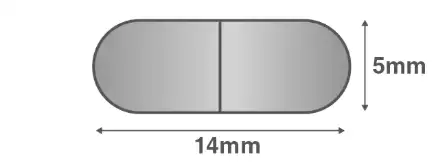
The image shows a capsule-shaped object with two main dimensions labeled: its length is 14 millimeters and its width (or height) is 5 millimeters. Step-by-step explanation: 1. Identify the object: It is shaped like a capsule or an elongated oval. 2. Note the measurements: The length from one end to the other is 14 millimeters. 3. Note the width: The distance across the object’s shorter side is 5 millimeters. 4. This kind of measurement helps describe the size of small objects accurately.
Practice Problem 1:
A toy is shaped by placing a cone of radius 4 cm on top of a hemisphere of the same radius. The total height of the toy is 16 cm. Calculate the total surface area of the toy.
Solution Outline:
Calculate the slant height \(l\) of the cone using \(l = \sqrt{h^2 - r^2}\), where \(h\) is the height of the cone.
Find the curved surface area of the cone: \(\pi r l\).
Find the curved surface area of the hemisphere: \(2\pi r^2\).
Add both to get the total surface area.
Practice Problem 2:
A medicine capsule is formed by joining a cylinder with two hemispheres at its ends. The diameter of the capsule is 6 mm, and the total length is 16 mm. Find the surface area of the capsule.
Solution Outline:
Radius \(r = 3 \text{ mm}\), length of cylinder \(h = 16 - 2 \times 3 = 10 \text{ mm}\).
Calculate curved surface area of cylinder: \(2\pi r h\).
Calculate curved surface area of two hemispheres (which make a sphere): \(4\pi r^2\).
Add both to get total surface area.
Practice Problem 3:
A tent consists of a cylindrical base with a conical top. The cylinder has a height of 2.2 m and diameter 4.2 m. The slant height of the cone is 3 m. Find the total canvas area needed to make the tent, excluding the base. Also, calculate the cost if the canvas price is Rs. 600 per square meter.
Solution Outline:
Calculate curved surface area of cylinder: \(2\pi r h\).
Calculate curved surface area of cone: \(\pi r l\).
Add both for total canvas area.
Multiply area by cost rate for total cost.
Summary Table: Surface Area Formulas for Combined Solids
Combination | Surface Area Formula | Notes |
|---|---|---|
Cone + Hemisphere (joined at base) | \( \text{TSA} = \pi r l + 2\pi r^2 \) | Radius of cone base = radius of hemisphere |
Cube + Hemisphere (on top) | \( \text{TSA} = 6a^2 - \pi r^2 + 2\pi r^2 = 6a^2 + \pi r^2 \) | Subtract base area of hemisphere from cube face |
Cylinder + Hemisphere | \( \text{TSA} = 2\pi r h + 2\pi r^2 = 2\pi r (h + r) \) | Radius common to both solids |
Capsule (Cylinder + 2 Hemispheres) | \( \text{TSA} = 2\pi r h + 4\pi r^2 = 2\pi r (h + 2r) \) | Two hemispheres form a sphere |
Cylinder + Cone (tent shape) | \( \text{TSA} = 2\pi r h + \pi r l \) | Exclude base area if not covered |
Glossary of Key Terms
Term | Definition |
|---|---|
Curved Surface Area (CSA) | The area of the curved surface of a 3D shape, excluding bases or flat faces. |
Total Surface Area (TSA) | The sum of all external surfaces of a solid, including curved and flat faces. |
Hemisphere | Half of a sphere, formed by cutting a sphere along its diameter. |
Slant Height | The length of the inclined side of a cone or pyramid from base to apex. |
Radius (r) | The distance from the center to the edge of a circle or sphere. |
Diameter | The length of a straight line passing through the center of a circle or sphere. |
Cube | A solid with six equal square faces. |
Cylinder | A solid with two parallel circular bases connected by a curved surface. |
Composite Solid | A solid formed by joining two or more basic solids. |
Base Area | The area of the flat face on which a solid rests or is joined. |
Frequently Asked Questions
How do you find the surface area of combined solids?
Calculate the curved surface areas of each individual solid, subtract the overlapping base areas where solids join, and then add the remaining areas to get the total surface area.
What is the difference between curved surface area and total surface area?
Curved surface area includes only the curved parts of a solid, while total surface area includes all surfaces, both curved and flat.
How is the surface area of a capsule calculated?
By adding the curved surface area of the cylinder and the curved surface area of the two hemispheres (which together form a sphere).
Why do we subtract the base area in combined solids?
Because the base where two solids join is not exposed, so it should not be counted in the total surface area.
Can the radius of joined solids be different?
No, for a smooth joint, the radius of the adjoining faces must be equal to avoid gaps or overlaps.