Essential Principles for Triangle Similarity with Proofs and Examples
Fundamentals of Triangle Similarity
Understanding When Two Triangles Are Similar
A triangle is a polygon with three sides and three angles, forming the simplest closed two-dimensional shape. A key property of triangles is that the sum of their interior angles always equals 180°. Two triangles are considered similar if their corresponding angles are equal and their corresponding sides are proportional.
For instance, consider triangles \( \triangle ABC \) and \( \triangle DEF \). They are similar if:
\[ \angle A = \angle D, \quad \angle B = \angle E, \quad \angle C = \angle F \]
and
\[ \frac{AB}{DE} = \frac{BC}{EF} = \frac{CA}{FD} \]
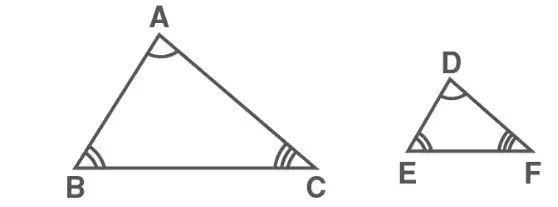
This image shows two triangles labeled ABC and DEF. Each triangle has marks on the angles indicating which angles are equal. Step-by-step explanation: 1. Triangle ABC and triangle DEF both have three angles. 2. The angle at A in triangle ABC is marked as equal to the angle at D in triangle DEF. 3. The angle at B in triangle ABC is marked as equal to the angle at F in triangle DEF. 4. The angle at C in triangle ABC is marked as equal to the angle at E in triangle DEF. 5. These marks mean the triangles have corresponding equal angles. This is usually used to show the triangles are similar by angle similarity.
When these conditions hold, the two triangles share the same shape but may differ in size.
Example: Given two triangles with angles \( \angle A = 50^\circ \), \( \angle B = 60^\circ \), and \( \angle C = 70^\circ \), and the corresponding angles of the second triangle are equal, can we say the triangles are similar?
Solution: Since all corresponding angles are equal, the triangles are similar by definition.
Key Criteria to Establish Triangle Similarity
Angle-Angle-Angle (AAA) Criterion
The AAA criterion states that if all three corresponding angles of two triangles are equal, then the triangles are similar. This implies their corresponding sides are in proportion.
To prove this, consider triangles \( \triangle ABC \) and \( \triangle DEF \) with \( \angle A = \angle D \), \( \angle B = \angle E \), and \( \angle C = \angle F \). By constructing a segment \( PQ \) parallel to side \( EF \) in \( \triangle DEF \), and using the Basic Proportionality Theorem, it can be shown that:
\[ \frac{AB}{DE} = \frac{BC}{EF} = \frac{AC}{DF} \]
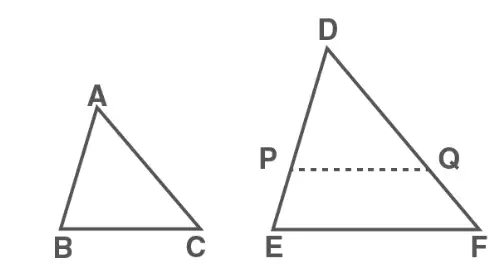
The image shows two triangles: a smaller triangle ABC and a larger triangle DEF. Inside triangle DEF, a line segment PQ is drawn parallel to the base EF. Step-by-step explanation: 1. Look at the smaller triangle ABC and the larger triangle DEF. 2. Notice the line PQ inside triangle DEF, which is parallel to the base EF. 3. The line PQ divides the larger triangle into two parts: the smaller triangle DPQ and the trapezoid PQFE. 4. This setup is commonly used to show relationships in geometry, such as similarity between triangles. 5. If line PQ is parallel to EF, the triangles DPQ and DEF are similar, meaning their corresponding angles and side ratios are equal.
Example: Triangles \( \triangle XYZ \) and \( \triangle PQR \) have angles \( \angle X = 40^\circ \), \( \angle Y = 70^\circ \), and \( \angle Z = 70^\circ \), and \( \angle P = 40^\circ \), \( \angle Q = 70^\circ \), \( \angle R = 70^\circ \). Are these triangles similar?
Solution: Since all corresponding angles are equal, the triangles are similar by the AAA criterion.
Angle-Angle (AA) Criterion
The AA criterion simplifies similarity verification by requiring only two pairs of corresponding angles to be equal. Since the sum of angles in a triangle is always 180°, equality of two angles guarantees the third pair is also equal, confirming similarity.
Example: If in triangles \( \triangle MNO \) and \( \triangle STU \), \( \angle M = \angle S = 55^\circ \) and \( \angle N = \angle T = 65^\circ \), are the triangles similar?
Solution: By AA criterion, the triangles are similar because two pairs of angles are equal.
Side-Side-Side (SSS) Criterion
The SSS criterion states that if the three sides of one triangle are proportional to the three sides of another triangle, then the triangles are similar. This also implies equality of corresponding angles.
Using the earlier figure, if:
\[ \frac{AB}{DE} = \frac{BC}{EF} = \frac{AC}{DF} \]
then \( \triangle ABC \sim \triangle DEF \).
Example: Triangles \( \triangle GHI \) and \( \triangle JKL \) have sides \( GH = 4 \text{ cm} \), \( HI = 6 \text{ cm} \), \( GI = 5 \text{ cm} \) and \( JK = 8 \text{ cm} \), \( KL = 12 \text{ cm} \), \( JL = 10 \text{ cm} \). Are these triangles similar?
Solution: Check ratios:
\[ \frac{GH}{JK} = \frac{4}{8} = \frac{1}{2}, \quad \frac{HI}{KL} = \frac{6}{12} = \frac{1}{2}, \quad \frac{GI}{JL} = \frac{5}{10} = \frac{1}{2} \]
Since all ratios are equal, the triangles are similar by SSS criterion.
Side-Angle-Side (SAS) Criterion
The SAS criterion confirms similarity when one angle of a triangle equals the corresponding angle of another triangle, and the sides including these angles are proportional.
For triangles \( \triangle ABC \) and \( \triangle DEF \), if:
\[ \angle A = \angle D, \quad \frac{AB}{DE} = \frac{AC}{DF} \]
then \( \triangle ABC \sim \triangle DEF \).
Example: In triangles \( \triangle RST \) and \( \triangle UVW \), \( \angle R = \angle U = 60^\circ \), \( RS = 5 \text{ cm} \), \( UV = 10 \text{ cm} \), \( RT = 7 \text{ cm} \), and \( UW = 14 \text{ cm} \). Are the triangles similar?
Solution: Check side ratios:
\[ \frac{RS}{UV} = \frac{5}{10} = \frac{1}{2}, \quad \frac{RT}{UW} = \frac{7}{14} = \frac{1}{2} \]
Since the included angle is equal and sides are proportional, the triangles are similar by SAS criterion.
Practical Applications and Problem Solving Using Similarity
Determining Unknown Angles Using Similarity
Similarity criteria can be used to find unknown angles in triangles by establishing proportionality and angle equality.
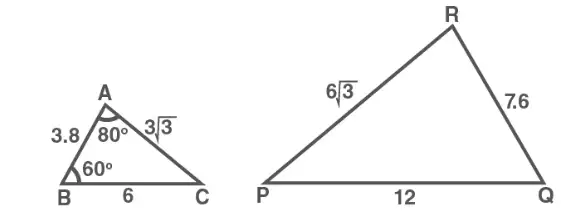
This image shows two triangles with different side lengths and angles labeled. The left triangle has angles 80°, 60°, and a side labeled with a square root. The right triangle has side lengths labeled but no angles shown. ### Explanation: 1. The first triangle has: - One side labeled 6. - Two angles labeled 80° and 60°. - Two sides involving the number 3 and its square root (3√3). 2. The second triangle has: - Two sides labeled 6√3 and 7.6. - A base labeled 12. 3. These triangles could be used to understand relationships between sides and angles, possibly involving the Law of Sines or Cosines. 4. You compare sides and angles to solve for missing lengths or angles. This is a basic geometric problem involving triangles and their properties.
Example: In triangles \( \triangle ABC \) and \( \triangle PQR \), the sides satisfy:
\[ \frac{AB}{RQ} = \frac{3.6}{7.2} = \frac{1}{2}, \quad \frac{BC}{QP} = \frac{5}{10} = \frac{1}{2}, \quad \frac{CA}{PR} = \frac{3\sqrt{3}}{6\sqrt{3}} = \frac{1}{2} \]
Find the measure of \( \angle P \) if \( \angle A = 80^\circ \) and \( \angle B = 60^\circ \).
Solution:
Since the sides are proportional, \( \triangle ABC \sim \triangle PQR \) by SSS criterion.
Corresponding angles are equal, so \( \angle C = \angle P \). Using the angle sum property:
\[ \angle C = 180^\circ - 80^\circ - 60^\circ = 40^\circ \]
Therefore, \( \angle P = 40^\circ \).
Proving Similarity Using Parallel Lines and Angles
Parallel lines create equal alternate and corresponding angles, which can be used to establish triangle similarity.
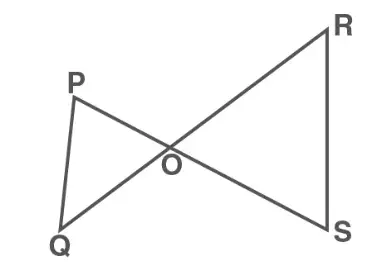
This image shows two triangles, △PQO and △RSO, sharing a common point O, and they are connected such that the lines PQ and RS intersect at O. Step-by-step explanation: 1. Identify the two triangles: △PQO on the left and △RSO on the right. 2. Notice that both triangles meet at point O. 3. The line segment PQ crosses the line segment RS at point O. 4. This setup can be used to explore properties like angles, similarity, or congruence of triangles.
Example: Given \( PQ \parallel RS \), prove \( \triangle POQ \sim \triangle SOR \).
Solution:
Since \( PQ \parallel RS \), alternate interior angles satisfy:
\[ \angle P = \angle S, \quad \angle Q = \angle R \]
Vertically opposite angles give:
\[ \angle POQ = \angle SOR \]
With all corresponding angles equal, \( \triangle POQ \sim \triangle SOR \) by AAA criterion.
Additional Practice Problems
Try solving these to strengthen your understanding:
Given \( \triangle ABE \cong \triangle ACD \), prove \( \triangle ADE \sim \triangle ABC \).
In a figure where \( \frac{QR}{QS} = \frac{QT}{PR} \) and \( \angle 1 = \angle 2 \), show \( \triangle PQS \sim \triangle TQR \).
Calculate the height of a tower if a 6 m pole casts a 4 m shadow and the tower casts a 28 m shadow simultaneously.
Summary Table for Triangle Similarity Criteria
Criterion | Condition | Result |
|---|---|---|
AAA | All three pairs of corresponding angles are equal | Triangles are similar; sides are proportional |
AA | Two pairs of corresponding angles are equal | Triangles are similar; third angles equal by angle sum property |
SSS | All three pairs of sides are in the same ratio | Triangles are similar; corresponding angles equal |
SAS | One pair of equal angles included between proportional sides | Triangles are similar |
Glossary of Key Terms
Term | Definition |
|---|---|
Triangle | A polygon with three sides and three angles |
Similar Triangles | Triangles with equal corresponding angles and proportional sides |
AAA Criterion | Similarity condition based on all three angles being equal |
AA Criterion | Similarity condition based on two pairs of equal angles |
SSS Criterion | Similarity condition based on proportionality of all three sides |
SAS Criterion | Similarity condition based on one equal angle between proportional sides |
Basic Proportionality Theorem | If a line is drawn parallel to one side of a triangle, it divides the other two sides proportionally |
Corresponding Angles | Angles in the same relative position in two similar triangles |
Alternate Interior Angles | Angles formed on opposite sides of a transversal intersecting parallel lines |
Angle Sum Property | The sum of interior angles of a triangle is always 180° |
Frequently Asked Questions
What defines two triangles as similar?
Two triangles are similar if their corresponding angles are equal and their corresponding sides are in proportion.
How does the AA criterion prove similarity?
If two angles of one triangle are equal to two angles of another, the third angles must also be equal, confirming similarity.
Can triangles be similar if only sides are proportional?
Yes, if all three pairs of sides are proportional (SSS criterion), the triangles are similar.
What role does the Basic Proportionality Theorem play in similarity?
It helps prove similarity by showing that a line parallel to one side divides the other sides proportionally.
How to find an unknown angle using similarity?
Use the angle sum property and corresponding angles of similar triangles to calculate the unknown angle.