Comprehensive Guide to Real Numbers and Their Properties
Understanding the Nature of Real Numbers
Defining Real Numbers and Their Scope
Real numbers encompass all rational and irrational numbers combined into a single set, symbolized by \( \mathbb{R} \). This set includes positive and negative values, fractions, decimals, and irrational constants such as \( \pi \). Unlike imaginary numbers, which cannot be placed on the number line, real numbers are represented along a continuous line, allowing all arithmetic operations to be performed on them.
Examples of real numbers include integers like 23 and -12, decimals such as 6.99, fractions like \( \frac{5}{2} \), and irrational numbers such as \( \pi \).
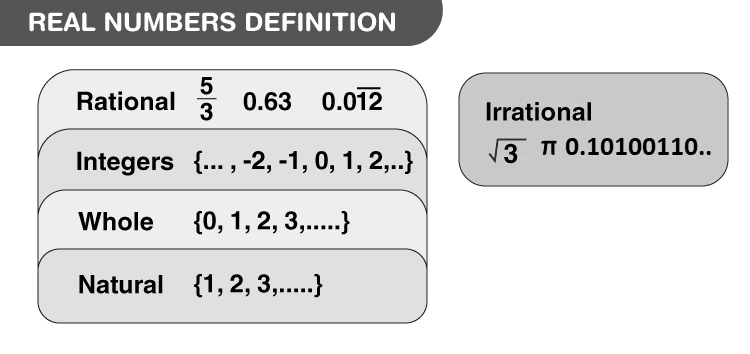
Illustration showing the classification of real numbers
Example Problem
Identify whether the number \( \sqrt{5} \) is a real number and classify it.
Solution: Since \( \sqrt{5} \) cannot be expressed as a fraction of integers, it is an irrational number. As irrational numbers are part of the real number set, \( \sqrt{5} \) is a real number.
Classification and Representation of Real Numbers
Exploring the Subsets of Real Numbers
The real number system is divided into several subsets including natural numbers (\( \mathbb{N} \)), whole numbers (\( \mathbb{W} \)), integers, rational numbers, and irrational numbers. Each subset has distinct characteristics and examples:
Natural numbers: \( \mathbb{N} = \{1, 2, 3, 4, \ldots\} \)
Whole numbers: \( \mathbb{W} = \{0, 1, 2, 3, \ldots\} \)
Integers: All positive and negative whole numbers including zero
Rational numbers: Numbers expressible as \( \frac{p}{q} \) where \( p, q \in \mathbb{Z} \) and \( q \neq 0 \)
Irrational numbers: Numbers that cannot be expressed as fractions, e.g., \( \pi, \sqrt{2} \)
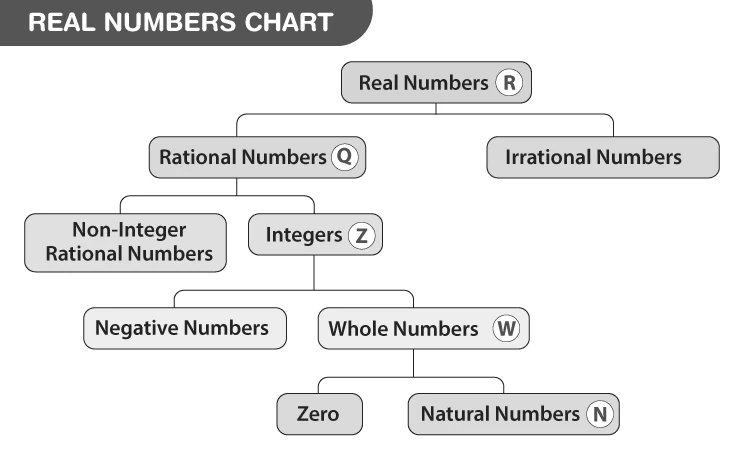
Diagram illustrating the subsets within the real number system
Example Problem
Classify the number \(-7\) and \(0.75\) within the real number subsets.
Solution:
\(-7\) is an integer and also a rational number since it can be written as \( \frac{-7}{1} \).
\(0.75\) is a rational number because it can be expressed as \( \frac{3}{4} \).
Fundamental Properties of Real Numbers
Key Characteristics Governing Real Number Operations
Real numbers follow several essential properties that govern their arithmetic operations. These properties ensure consistency and predictability in calculations involving real numbers. The main properties include:
Commutative Property: The order of addition or multiplication does not affect the result.
Associative Property: Grouping of numbers in addition or multiplication does not change the outcome.
Distributive Property: Multiplication distributes over addition.
Identity Property: Existence of additive and multiplicative identities.
Let \( m, n, r \in \mathbb{R} \) be any real numbers. These properties can be expressed as follows:
Commutative: \( m + n = n + m \) and \( m \times n = n \times m \)
Associative: \( m + (n + r) = (m + n) + r \) and \( (m \times n) \times r = m \times (n \times r) \)
Distributive: \( m \times (n + r) = m \times n + m \times r \)
Identity: \( m + 0 = m \) and \( m \times 1 = m \)
Example Problem
Verify the distributive property for \( m = 4 \), \( n = 3 \), and \( r = 5 \).
Solution:
Calculate the left side:
\[ m \times (n + r) = 4 \times (3 + 5) = 4 \times 8 = 32 \]
Calculate the right side:
\[ m \times n + m \times r = 4 \times 3 + 4 \times 5 = 12 + 20 = 32 \]
Since both sides equal 32, the distributive property holds true.
Practical Applications and Problem Solving with Real Numbers
Finding Rational Numbers Between Two Values
One common task is to identify rational numbers lying between two given rational numbers. This involves expressing both numbers with a common denominator and then listing intermediate fractions.
Visual representation of rational numbers between two fractions
Example Problem
Find four rational numbers between \( \frac{3}{7} \) and \( \frac{2}{3} \).
Solution:
First, express both fractions with a common denominator:
\[ \frac{3}{7} = \frac{3 \times 3}{7 \times 3} = \frac{9}{21}, \quad \frac{2}{3} = \frac{2 \times 7}{3 \times 7} = \frac{14}{21} \]
Next, find fractions between \( \frac{9}{21} \) and \( \frac{14}{21} \):
\[ \frac{10}{21}, \quad \frac{11}{21}, \quad \frac{12}{21}, \quad \frac{13}{21} \]
These are four rational numbers between the given fractions.
Converting Fractions to Decimal Form
Converting rational numbers to decimals helps in understanding their approximate values and comparing magnitudes.
Examples of fraction to decimal conversions
Example Problem
Convert the following fractions to their decimal equivalents:
(i) \( \frac{3}{8} \) (ii) \( \frac{7}{20} \) (iii) \( \frac{5}{4} \)
Solution:
(i) \( \frac{3}{8} = \frac{3 \times 125}{8 \times 125} = \frac{375}{1000} = 0.375 \)
(ii) \( \frac{7}{20} = \frac{7 \times 5}{20 \times 5} = \frac{35}{100} = 0.35 \)
(iii) \( \frac{5}{4} = \frac{5 \times 25}{4 \times 25} = \frac{125}{100} = 1.25 \)
Determining Multiplicative Inverses
Finding the number which, when multiplied by a given real number, results in 1 is essential in solving equations and understanding reciprocal relationships.
Conceptual illustration of multiplicative inverse
Example Problem
What number must be multiplied by 0.8 to yield 1?
Solution:
Express 0.8 as a fraction:
\[ 0.8 = \frac{8}{10} = \frac{4}{5} \]
The multiplicative inverse is the reciprocal:
\[ \frac{5}{4} = 1.25 \]
Therefore, multiplying 0.8 by 1.25 gives 1.
Summary Table: Essential Real Number Concepts
Concept | Description | Example |
|---|---|---|
Real Numbers (\( \mathbb{R} \)) | All rational and irrational numbers combined | 23, \( \pi \), -4.5, \( \sqrt{2} \) |
Rational Numbers | Numbers expressible as \( \frac{p}{q} \), \( q \neq 0 \) | \( \frac{3}{4} \), -2, 0.75 |
Irrational Numbers | Numbers not expressible as fractions | \( \pi \), \( \sqrt{3} \) |
Commutative Property | Order of addition or multiplication does not matter | \( 5 + 3 = 3 + 5 \) |
Associative Property | Grouping of numbers does not affect sum or product | \( (2 + 3) + 4 = 2 + (3 + 4) \) |
Distributive Property | Multiplication distributes over addition | \( 4 \times (2 + 3) = 4 \times 2 + 4 \times 3 \) |
Identity Property | Additive identity is 0; multiplicative identity is 1 | \( 7 + 0 = 7 \), \( 7 \times 1 = 7 \) |
Glossary of Key Terms
Term | Definition |
|---|---|
Real Numbers | Numbers including all rational and irrational numbers represented on the number line |
Rational Numbers | Numbers that can be expressed as a ratio of two integers |
Irrational Numbers | Numbers that cannot be expressed as a simple fraction |
Natural Numbers | Counting numbers starting from 1 upwards |
Whole Numbers | Natural numbers including zero |
Commutative Property | Property where changing the order does not change the result |
Associative Property | Property where grouping of numbers does not affect the outcome |
Distributive Property | Property that links multiplication and addition |
Identity Property | Existence of elements that leave numbers unchanged under addition or multiplication |
Multiplicative Inverse | A number which when multiplied by the original number yields 1 |
Frequently Asked Questions
What distinguishes natural numbers from real numbers?
Natural numbers are positive integers starting from 1, used for counting. Real numbers include all natural numbers plus fractions, decimals, and irrational numbers, covering a broader range.
Is zero considered a real number?
Yes, zero is a real number. It acts as the additive identity and is included in the set of whole numbers and integers.
Can a number be both rational and irrational?
No, a number cannot be both rational and irrational. These sets are mutually exclusive within the real numbers.
Are all real numbers also complex numbers?
Yes, real numbers are a subset of complex numbers where the imaginary part is zero.
What is the significance of the distributive property in real numbers?
The distributive property allows multiplication to be spread over addition, simplifying expressions and solving equations efficiently.