Understanding the Pythagorean Theorem and Its Applications
Fundamentals of the Pythagorean Theorem
Core Principle and Triangle Components
The Pythagorean theorem is a fundamental rule in geometry that relates the lengths of the sides in a right-angled triangle. It states that the square of the longest side, known as the hypotenuse, equals the sum of the squares of the other two sides, often called the base and the perpendicular. This relationship is essential for calculating unknown side lengths in right triangles.
In any right triangle, the hypotenuse is always opposite the right angle and is the longest side. The other two sides are perpendicular to each other. When the lengths of these sides are positive integers satisfying the theorem's equation, they form what is called a Pythagorean triple.
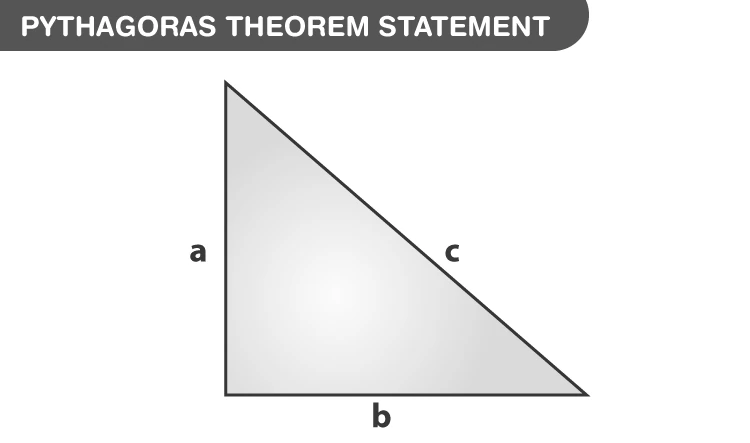
Illustration of a Right-Angled Triangle
Example: Calculating the Hypotenuse
Consider a right triangle where the base measures 7 units and the perpendicular side measures 24 units. Find the length of the hypotenuse.
Using the Pythagorean theorem:
\[ c^2 = a^2 + b^2 \]
Here, \(a = 7\), \(b = 24\), so
\[ c^2 = 7^2 + 24^2 = 49 + 576 = 625 \]
Taking the square root,
\[ c = \sqrt{625} = 25 \text{ units} \]
Therefore, the hypotenuse is 25 units long.
Deriving and Understanding the Theorem's Formula
Mathematical Expression and Visual Representation
Label the sides of a right triangle as follows: \(a\) for the perpendicular, \(b\) for the base, and \(c\) for the hypotenuse. The Pythagorean theorem can be expressed mathematically as:
\[ c^2 = a^2 + b^2 \]
This formula confirms that the square of the hypotenuse equals the sum of the squares of the other two sides. The hypotenuse is always the longest side because it lies opposite the right angle, which is the largest angle in the triangle.
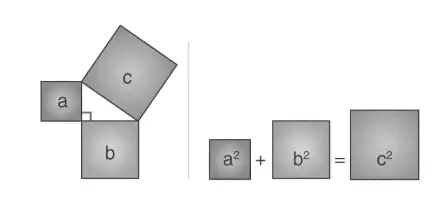
This image shows a visual proof of the Pythagorean theorem, which states that in a right triangle, the square of the longest side (hypotenuse) is equal to the sum of the squares of the other two sides. Step-by-step explanation: 1. Identify the right triangle with sides labeled \(a\), \(b\), and the hypotenuse \(c\). 2. Each side is associated with a square whose side length matches the triangle’s side. 3. The two smaller squares have areas \(a^2\) and \(b^2\). 4. The largest square, built on the hypotenuse, has area \(c^2\). 5. The image shows how areas of the small squares combine to equal the area of the largest square. 6. This illustrates the formula \(a^2 + b^2 = c^2\).
Imagine squares constructed on each side of the triangle. The combined area of the squares on the two shorter sides equals the area of the square on the hypotenuse.
Example: Finding a Missing Side
In a right triangle, the hypotenuse measures 13 units, and one leg is 5 units long. Determine the length of the other leg.
Applying the theorem:
\[ c^2 = a^2 + b^2 \]
Let the unknown side be \(b\), so
\[ 13^2 = 5^2 + b^2 \]
\[ 169 = 25 + b^2 \]
\[ b^2 = 169 - 25 = 144 \]
\[ b = \sqrt{144} = 12 \text{ units} \]
The missing side is 12 units long.
Proof of the Pythagorean Theorem Using Similar Triangles
Step-by-Step Logical Demonstration
Consider a right triangle \(ABC\) with the right angle at \(B\). Draw a perpendicular from \(B\) to the hypotenuse \(AC\), meeting it at point \(D\). This construction creates two smaller triangles, \(ADB\) and \(BDC\), which are similar to the original triangle \(ABC\).
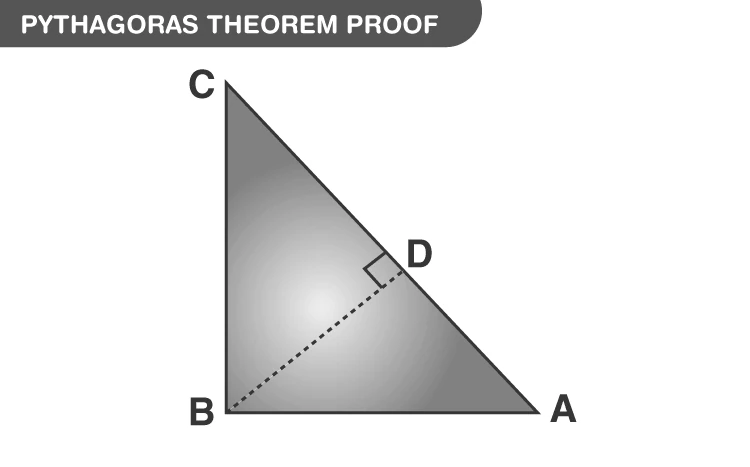
Diagram for Proof Using Similar Triangles
From the similarity of triangles, the following ratios hold:
\[ \frac{AD}{AB} = \frac{AB}{AC} \implies AB^2 = AD \times AC \]
\[ \frac{CD}{BC} = \frac{BC}{AC} \implies BC^2 = CD \times AC \]
Adding these two equations:
\[ AB^2 + BC^2 = AD \times AC + CD \times AC = AC (AD + CD) \]
Since \(AD + CD = AC\), it follows that:
\[ AB^2 + BC^2 = AC^2 \]
This completes the proof that the square of the hypotenuse equals the sum of the squares of the other two sides.
Example: Verifying the Theorem with Given Sides
Check if a triangle with sides 9 units, 40 units, and 41 units is right-angled.
Identify the longest side as the hypotenuse: \(c = 41\).
Calculate the sum of squares of the other two sides:
\[ 9^2 + 40^2 = 81 + 1600 = 1681 \]
Calculate the square of the longest side:
\[ 41^2 = 1681 \]
Since both values are equal, the triangle satisfies the Pythagorean theorem and is right-angled.
Practical Uses and Applications of the Theorem
Real-World Problem Solving and Triangle Classification
The Pythagorean theorem is widely used to determine unknown side lengths in right triangles, verify if a triangle is right-angled, and calculate distances such as diagonals in squares and rectangles. It is a vital tool in fields like construction, navigation, and physics.
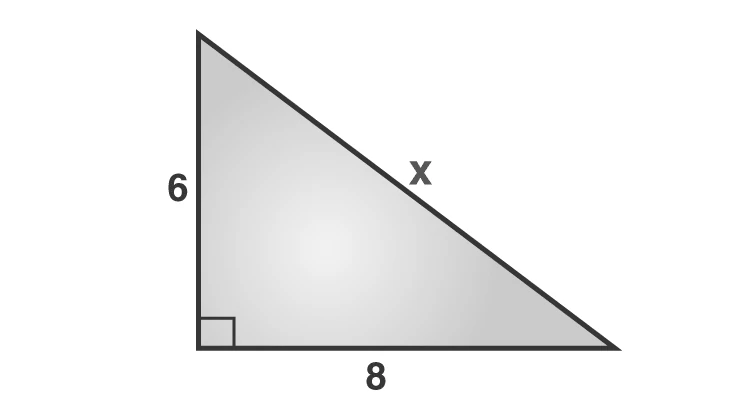
Right Triangle with Known Sides
Example: Determining an Unknown Side Length
In a right triangle, the perpendicular side measures 9 cm, and the hypotenuse is 15 cm. Find the length of the base.
Using the theorem:
\[ a^2 + b^2 = c^2 \]
Let the base be \(b\), so
\[ 9^2 + b^2 = 15^2 \]
\[ 81 + b^2 = 225 \]
\[ b^2 = 225 - 81 = 144 \]
\[ b = \sqrt{144} = 12 \text{ cm} \]
The base is 12 cm long.
Example: Calculating the Diagonal of a Square
A square has sides measuring 6 cm each. Find the length of its diagonal.
Since the diagonal divides the square into two right triangles, apply the theorem:
\[ d^2 = 6^2 + 6^2 = 36 + 36 = 72 \]
\[ d = \sqrt{72} = 6\sqrt{2} \text{ cm} \]
The diagonal measures \(6\sqrt{2}\) cm.
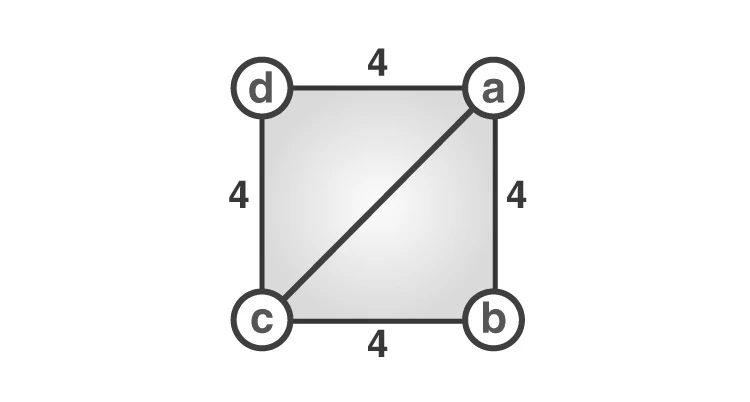
Square with Diagonal Marked
Summary Table for Quick Review
Concept | Explanation | Formula/Value |
|---|---|---|
Hypotenuse | Longest side opposite the right angle | \(c\) |
Base and Perpendicular | Other two sides forming the right angle | \(a, b\) |
Pythagorean Theorem | Relation between sides of right triangle | \(c^2 = a^2 + b^2\) |
Right Triangle Check | Verify if triangle is right-angled | Check if \(c^2 = a^2 + b^2\) |
Diagonal of Square | Length of diagonal using side length | \(d = s\sqrt{2}\) |
Glossary of Key Terms
Term | Definition |
|---|---|
Hypotenuse | The longest side of a right-angled triangle, opposite the right angle. |
Right Angle | An angle of exactly 90 degrees. |
Base | One of the two sides forming the right angle in a triangle. |
Perpendicular | The other side forming the right angle, perpendicular to the base. |
Pythagorean Triple | A set of three positive integers that satisfy the Pythagorean theorem. |
Square of a Number | The product of a number multiplied by itself. |
Diagonal | A line segment connecting opposite corners of a polygon, such as a square. |
Similar Triangles | Triangles with the same shape but possibly different sizes, having equal corresponding angles. |
Construction | A geometric drawing used to aid in proofs or problem solving. |
Square Root | A value that, when multiplied by itself, gives the original number. |
Frequently Asked Questions
What is the main formula of the Pythagorean theorem?
The theorem is expressed as \(c^2 = a^2 + b^2\), where \(c\) is the hypotenuse and \(a, b\) are the other two sides of a right triangle.
Can the Pythagorean theorem be applied to any triangle?
No, it only applies to right-angled triangles where one angle is exactly 90 degrees.
How can I verify if a triangle is right-angled using side lengths?
Check if the square of the longest side equals the sum of the squares of the other two sides. If yes, the triangle is right-angled.
Is it possible to find the diagonal of a square using this theorem?
Yes, the diagonal forms a right triangle with two sides equal to the square's side, so the diagonal length is \(s\sqrt{2}\), where \(s\) is the side length.
What are some common methods to prove the Pythagorean theorem?
Proofs include using similar triangles, algebraic methods, Euclid’s geometric proof, and differential calculus approaches.