Understanding the Unique Prime Factorization of Natural Numbers
Prime Factorization and Its Significance
Concept of Prime Factorization
Every natural number greater than 1 can be broken down into a product of prime numbers, which are numbers divisible only by 1 and themselves. This process, known as prime factorization, reveals the fundamental building blocks of any integer. For instance, the number 42 can be expressed as:
\[ 42 = 2 \times 3 \times 7 \]
Here, 2, 3, and 7 are prime factors of 42. This decomposition is essential for understanding the structure of numbers and plays a crucial role in various mathematical applications.
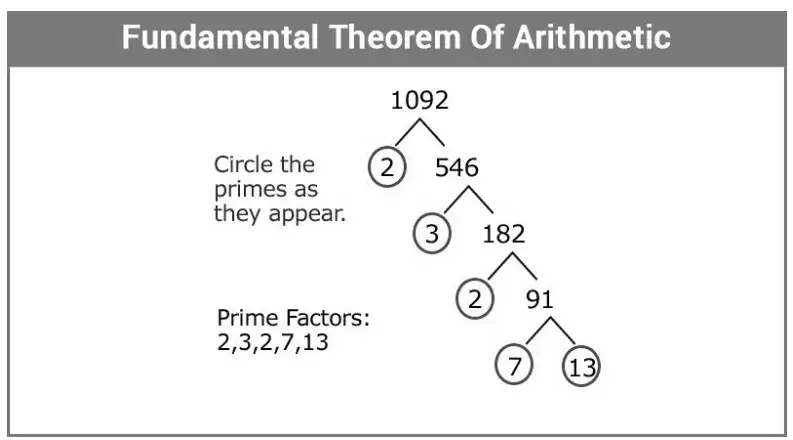
This image explains the Fundamental Theorem of Arithmetic using the number 1092 and its prime factorization. Step-by-step explanation: 1. Start with the number 1092. 2. Divide 1092 by the smallest prime number, 2, to get 546. Circle 2. 3. Divide 546 by 3 (the next prime) to get 182. Circle 3. 4. Divide 182 by 2 again to get 91. Circle 2. 5. Divide 91 by 7 (a prime) to get 13. Circle 7. 6. The last number, 13, is also a prime, so circle it. 7. The prime factors of 1092, gathered from the circled numbers, are 2, 3, 2, 7, and 13. This shows that every number can be uniquely broken down into prime factors.
Example Problem
Express the number 1980 as a product of its prime factors.
Solution:
Start by dividing 1980 by the smallest prime number:
\[ 1980 \div 2 = 990 \]
Divide 990 by 2 again:
\[ 990 \div 2 = 495 \]
Next, divide 495 by 3:
\[ 495 \div 3 = 165 \]
Divide 165 by 3:
\[ 165 \div 3 = 55 \]
Divide 55 by 5:
\[ 55 \div 5 = 11 \]
Finally, 11 is a prime number.
Therefore, the prime factorization of 1980 is:
\[ 1980 = 2^2 \times 3^2 \times 5 \times 11 \]
Uniqueness of Prime Factorization
Proof and Explanation of the Theorem
The Fundamental Theorem of Arithmetic states that every natural number greater than 1 has a unique prime factorization, except for the order of the factors. This means that no matter how you factorize a number into primes, the set of prime factors and their powers remain the same.
For example, consider the number 360. Its prime factors can be arranged in any order, but the factorization itself is unique:
\[ 360 = 2^3 \times 3^2 \times 5 \]
Writing the prime factors in ascending order ensures a standardized and unique representation. This uniqueness is fundamental in number theory and underpins many mathematical concepts.
Example Problem
Show that the prime factorization of 2520 is unique by expressing it in prime factors.
Solution:
Divide 2520 by 2 repeatedly:
\[ 2520 \div 2 = 1260, \quad 1260 \div 2 = 630, \quad 630 \div 2 = 315 \]
Divide 315 by 3 repeatedly:
\[ 315 \div 3 = 105, \quad 105 \div 3 = 35 \]
Divide 35 by 5:
\[ 35 \div 5 = 7 \]
7 is prime.
Thus, the prime factorization is:
\[ 2520 = 2^3 \times 3^2 \times 5 \times 7 \]
This factorization is unique regardless of the order of multiplication.
Applications of Prime Factorization in Problem Solving
Using Prime Factors to Find Common Multiples
Prime factorization is a powerful tool to solve problems involving multiples and divisors. For example, to find when two events coincide, we can calculate the Least Common Multiple (LCM) of their cycles by using their prime factors.
Race cars completing laps on a track
Example Problem
Two runners complete a lap in 24 minutes and 36 minutes respectively. After how many minutes will they meet again at the starting point?
Solution:
Prime factorize the times:
\[ 24 = 2^3 \times 3 \]
\[ 36 = 2^2 \times 3^2 \]
The LCM is found by taking the highest powers of each prime:
\[ \text{LCM} = 2^3 \times 3^2 = 8 \times 9 = 72 \text{ minutes} \]
Therefore, both runners will simultaneously reach the starting point after 72 minutes.
Visual representation of time intervals
Summary of Key Points
Concept | Explanation |
|---|---|
Prime Factorization | Expressing a natural number as a product of prime numbers. |
Fundamental Theorem of Arithmetic | Every natural number greater than 1 has a unique prime factorization, except for the order of factors. |
Uniqueness | The prime factors and their powers are uniquely determined for each number. |
Prime Factors | Numbers divisible only by 1 and themselves. |
LCM Calculation | Use prime factorization to find the least common multiple by taking highest powers of primes. |
Glossary of Important Terms
Term | Definition |
|---|---|
Prime Number | A number greater than 1 with no divisors other than 1 and itself. |
Composite Number | A natural number greater than 1 that is not prime. |
Prime Factorization | Breaking down a number into a product of prime numbers. |
Fundamental Theorem of Arithmetic | The theorem stating the uniqueness of prime factorization. |
Least Common Multiple (LCM) | The smallest number divisible by two or more numbers. |
Greatest Common Divisor (GCD) | The largest number dividing two or more numbers exactly. |
Exponent | The power to which a prime factor is raised in factorization. |
Divisor | A number that divides another number without leaving a remainder. |
Natural Number | Positive integers starting from 1 upwards. |
Unique Factorization | The property that prime factorization is one-of-a-kind for each number. |