Comprehensive Guide to Linear Equations in Two Variables
Understanding Linear Equations and Their Characteristics
Fundamentals of Linear Equations and Polynomials
A linear equation in two variables is an algebraic expression of the form \( ax + by + c = 0 \), where \( a \), \( b \), and \( c \) are real numbers, and both \( a \) and \( b \) are non-zero. This equation represents a straight line on the Cartesian plane. In contrast, polynomials are algebraic expressions involving variables raised to non-negative integer powers. For instance, \( x^4 + 3x^3 + 2x^9 \) is a polynomial, whereas expressions like \( x^{3/5} + 3x^{0.6} \) are not.
The degree of a polynomial is the highest power of the variable present. A polynomial of degree 1 is called a linear polynomial, degree 2 is quadratic, and degree 3 is cubic. Since linear equations in two variables correspond to polynomials of degree 1, they form the foundation for this study.
Example: Identify the degree and type of the polynomial \( 4x^2 + 7x - 5 \).
Solution: The highest power of \( x \) is 2, so the polynomial is of degree 2, making it a quadratic polynomial.
Exploring Systems of Linear Equations in Two Variables
Concept and Necessity of Two Equations for Two Variables
When dealing with two variables, such as \( x \) and \( y \), a single linear equation cannot provide a unique solution because it represents infinitely many points on a line. To find a specific solution, two independent linear equations are required. These form a system of linear equations, where the solution corresponds to the point of intersection of the two lines represented by the equations.
For example, consider the system:
\[ \begin{cases} 4x + 3y = 18 \\ 2x - y = 3 \end{cases} \]
This system can be solved to find unique values of \( x \) and \( y \).
Example: Why does the equation \( 5x + 2y = 7 \) alone not have a unique solution for \( x \) and \( y \)?
Answer:
It represents a line with infinitely many points.
There is only one equation but two unknowns.
Without a second independent equation, the values of \( x \) and \( y \) cannot be uniquely determined.
Graphical Interpretation of Two Linear Equations
Visualizing Solutions Through Line Intersections
Graphically, each linear equation in two variables corresponds to a straight line on the coordinate plane. The solution to a system of two linear equations is the point where these lines intersect. There are three possible scenarios:
The lines intersect at a single point (unique solution).
The lines are parallel and never intersect (no solution).
The lines coincide, meaning they are the same line (infinitely many solutions).
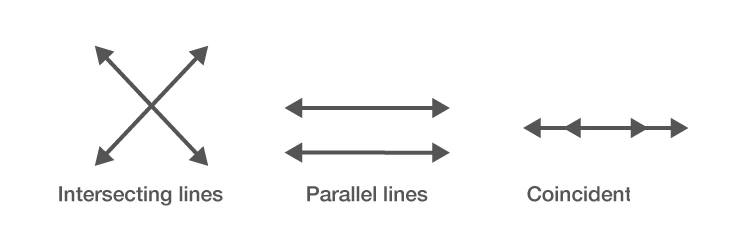
Graph showing intersecting, parallel, and coincident lines
For instance, the equations \( x + y = 5 \) and \( 2x + 2y = 10 \) represent the same line, indicating infinitely many solutions.
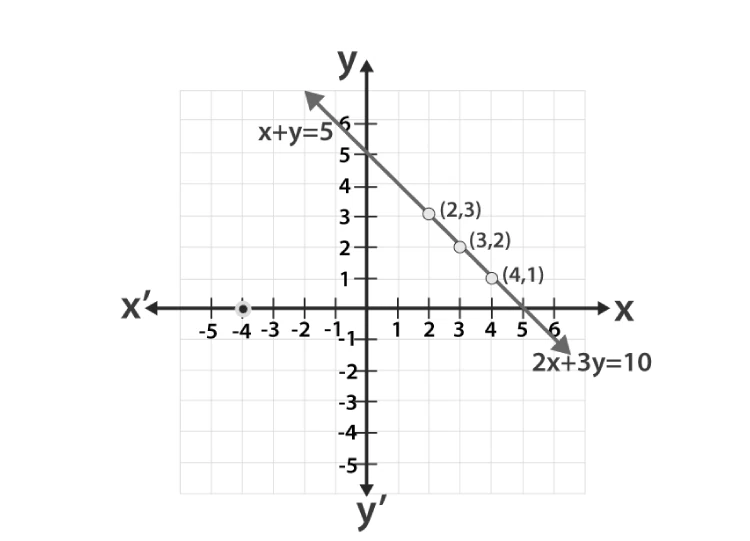
Graph of coincident lines for the given equations
Algebraic Techniques for Solving Linear Systems
Methods to Find Exact Solutions
While graphical methods provide a visual understanding, they are not always practical, especially when solutions involve non-integer or irrational numbers. Algebraic methods offer precise solutions through systematic procedures. The main algebraic techniques include:
Substitution Method: Solve one equation for one variable and substitute into the other.
Elimination Method: Add or subtract equations to eliminate one variable.
Cross-Multiplication Method: Use determinants to directly find the values of variables.
Consider a real-life scenario: You buy two types of fruits. The cost of the first type is twice the cost of the second, and the total amount spent is Rs. 90. Let the cost of the second fruit be Rs. \( y \) and the first be Rs. \( x \). Then:
\[ \begin{cases} x = 2y \\ x + y = 90 \end{cases} \]
Using substitution, replace \( x \) in the second equation:
\[ 2y + y = 90 \implies 3y = 90 \implies y = 30 \]
Then, \( x = 2 \times 30 = 60 \). So, the costs are Rs. 60 and Rs. 30 respectively.
Example: Solve the system using elimination method:
\[ \begin{cases} 3x + 4y = 20 \\ 5x - 2y = 10 \end{cases} \]
Solution:
Multiply the first equation by 2 and the second by 4 to align coefficients of \( y \):
\[ \begin{cases} 6x + 8y = 40 \\ 20x - 8y = 40 \end{cases} \]
Add the two equations:
\[ 6x + 8y + 20x - 8y = 40 + 40 \implies 26x = 80 \implies x = \frac{80}{26} = \frac{40}{13} \]
Substitute \( x \) into the first original equation:
\[ 3 \times \frac{40}{13} + 4y = 20 \implies \frac{120}{13} + 4y = 20 \implies 4y = 20 - \frac{120}{13} = \frac{260 - 120}{13} = \frac{140}{13} \]
\[ y = \frac{140}{13 \times 4} = \frac{140}{52} = \frac{35}{13} \]
Thus, the solution is \( \left(\frac{40}{13}, \frac{35}{13}\right) \).
Summary Table for Quick Revision
Concept | Definition/Formula | Key Points |
|---|---|---|
Linear Equation in Two Variables | \( ax + by + c = 0 \), \( a,b \neq 0 \) | Represents a straight line; infinite solutions for one equation |
System of Linear Equations | Two equations with two variables | Unique solution exists if lines intersect; no solution if parallel; infinite if coincident |
Degree of Polynomial | Highest power of variable | Degree 1: Linear, Degree 2: Quadratic, Degree 3: Cubic |
Substitution Method | Express one variable and substitute | Useful when one variable is easily isolated |
Elimination Method | Add or subtract equations to remove a variable | Effective for aligning coefficients |
Cross-Multiplication Method | \[ x = \frac{b_1 c_2 - b_2 c_1}{a_1 b_2 - a_2 b_1}, \quad y = \frac{c_1 a_2 - c_2 a_1}{a_1 b_2 - a_2 b_1} \] | Direct formula for solution if denominator non-zero |
Glossary of Important Terms
Term | Meaning |
|---|---|
Linear Equation | An equation of degree one in variables representing a straight line |
Polynomial | An algebraic expression with variables raised to non-negative integer powers |
Degree | The highest exponent of the variable in a polynomial |
System of Equations | Two or more equations solved together to find common solutions |
Consistent System | A system with at least one solution |
Inconsistent System | A system with no solution |
Dependent System | A system where equations represent the same line, infinite solutions |
Substitution Method | Solving one equation for a variable and substituting in another |
Elimination Method | Adding or subtracting equations to eliminate a variable |
Cross-Multiplication | Method using determinants to solve linear systems |
Frequently Asked Questions
When is a system of linear equations called consistent?
A system is consistent if it has at least one solution, meaning the lines intersect or coincide.
What defines an inconsistent system of linear equations?
It is inconsistent if there is no solution, which happens when the lines are parallel and distinct.
What is a polynomial of degree one called?
A polynomial of degree one is called a linear polynomial.
How is a quadratic polynomial characterized?
A polynomial with the highest degree of two is known as a quadratic polynomial.
What does it mean if two linear equations are dependent?
Dependent equations represent the same line, resulting in infinitely many solutions.
Visual Example of Linear Equations Solutions
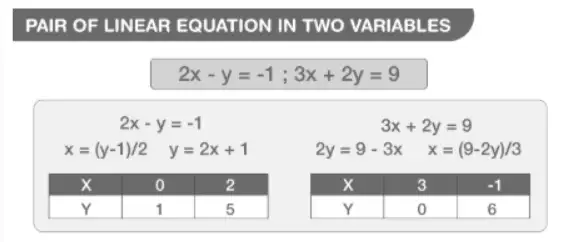
The image shows two linear equations with two variables, \(x\) and \(y\). It also shows how to express one variable in terms of the other from each equation, and then provides tables of values for \(x\) and \(y\) that satisfy each equation. Step-by-step explanation: 1. The two given equations are: \[ 2x - y = -1 \] and \[ 3x + 2y = 9 \] 2. For the first equation, solve for \(x\) and \(y\): - \(x = \frac{y - 1}{2}\) - \(y = 2x + 1\) 3. For various values of \(x\), calculate \(y\), and for various values of \(y\), calculate \(x\). This is shown in the first table. 4. For the second equation, rearrange to solve for: - \(2y = 9 - 3x\) - \(x = \frac{9 - 2y}{3}\) 5. Again, pick values of \(x\) and \(y\), calculate the matching values of the other variable, and list them in the second table. 6. These tables help visualize points that satisfy each equation on a graph.
Illustration of linear equations and their graphical representation