Understanding Tangents from a Point to a Circle
Exploring Tangents and Their Relationship with Circles
Fundamentals of Tangents and Their Interaction with Circles
A circle is a closed curve where every point on its circumference is equally distant from a fixed center point, known as the radius. A tangent to a circle is a straight line that touches the circle at exactly one point, called the point of contact. Depending on the position of a point relative to the circle, the number of tangents that can be drawn from that point varies.
There are three distinct scenarios regarding the number of tangents from a point:
No tangent if the point lies inside the circle.
Exactly one tangent if the point lies on the circle.
Two tangents if the point lies outside the circle.
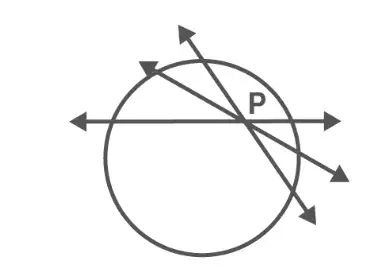
This image shows a circle with a point labeled P outside the circle. From point P, three lines or rays are drawn: one touching the circle at one point (a tangent), and two crossing the circle at two points each (secants). Step-by-step explanation for high school students: 1. Identify point P outside the circle. 2. Note how one line from P just touches the circle at exactly one point — this is called a tangent. 3. The other lines from P cross the circle at two points — these are called secants. 4. This setup is often used to explore tangent-secant angle theorems in geometry, which relate the lengths of segments formed by these lines.
Single Tangent from a Point on the Circle
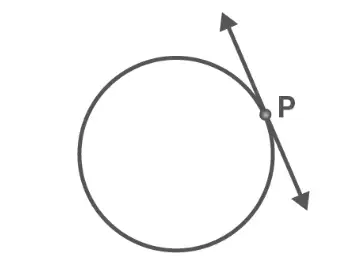
This image shows a circle with a tangent line touching the circle at exactly one point, labeled P. Step-by-step explanation: 1. Identify the circle and the point P where the line just touches the circle. 2. Understand that the line touching the circle at point P is called a tangent. 3. Note that a tangent only touches the circle at one point and does not cross inside it. 4. The tangent line is perpendicular to the radius drawn from the center of the circle to point P.
In the last case, the two tangents from an external point \( P \) are denoted as \( PT_1 \) and \( PT_2 \), with \( T_1 \) and \( T_2 \) being their respective points of contact on the circle. The length of a tangent is the segment from the external point to the point of contact on the circle.
Key Theorems on Tangents from a Point to a Circle
Perpendicularity of Tangent and Radius at the Point of Contact
One fundamental property states that the tangent line at any point on a circle is perpendicular to the radius drawn to the point of contact. This means if \( XY \) is a tangent touching the circle at point \( P \), and \( O \) is the center, then the radius \( OP \) is perpendicular to \( XY \).
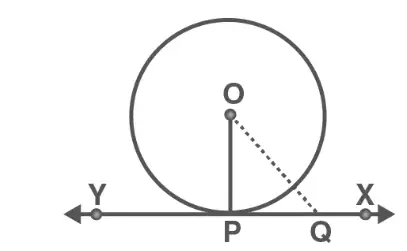
The image shows a circle with center O resting on a straight horizontal line marked with points Y, P, Q, and X. The point P is where the circle touches the line. Inside the circle, a vertical line segment from O to P is drawn, and another line segment from O to Q is shown inside the circle, with Q lying on the horizontal line beyond P. ### Step-by-step explanation: 1. A circle is drawn with center O. 2. The circle is touching a straight horizontal line at point P (this is the point of tangency). 3. A vertical radius line OP is drawn from the center O to the tangent point P. 4. Another point Q is marked on the horizontal line, to the right of P. 5. The line segment OQ is drawn from the center to this point Q on the line, showing a relationship between the radius and another line segment extending beyond the tangent point. This image may be used to explain properties of circles related to tangents and radii, such as how the radius at the tangent point is perpendicular to the tangent line.
Proof Outline: Consider any other point \( Q \) on the tangent line \( XY \) different from \( P \). Since \( Q \) lies outside the circle, the distance \( OQ \) is greater than \( OP \). This implies \( OP \) is the shortest distance from the center to the tangent line, which is only possible if \( OP \) is perpendicular to \( XY \).
Equality of Tangent Lengths from an External Point
Another important theorem states that the lengths of tangents drawn from a single external point to a circle are equal. If \( P \) is outside the circle with center \( O \), and \( PQ \) and \( PR \) are tangents touching the circle at points \( Q \) and \( R \) respectively, then \( PQ = PR \).
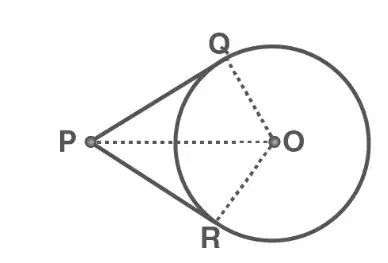
This image shows a circle with center O, and two lines from a point P outside the circle touching the circle at points Q and R. These lines are called tangents to the circle. Step-by-step explanation: 1. Point O is the center of the circle. 2. Point P is outside the circle. 3. Two lines are drawn from P to touch the circle exactly at Q and R. 4. Lines PQ and PR just touch the circle without crossing it; these are tangent lines. 5. PQ and PR are equal in length because tangents from the same external point are equal.
Proof Sketch: Join points \( OQ \) and \( OR \). Since \( OQ \) and \( OR \) are radii, they are equal. Also, \( OP \) is common to both triangles \( \triangle OQP \) and \( \triangle ORP \). Both angles \( \angle OQP \) and \( \angle ORP \) are right angles because the radius is perpendicular to the tangent. By RHS congruence, the triangles are congruent, so \( PQ = PR \) by CPCT (Corresponding Parts of Congruent Triangles).
Applying Tangent Theorems: Problem Solving
Relating Angles Formed by Tangents and Radii
Consider a circle with center \( O \) and an external point \( T \) from which two tangents \( TP \) and \( TQ \) are drawn, touching the circle at points \( P \) and \( Q \) respectively. We aim to prove the relationship between the angle formed by the tangents and the angle formed by the radius and tangent.
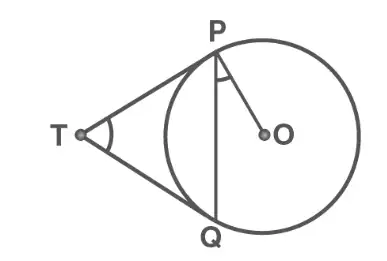
This image shows a circle with center \( O \) and a tangent \( TP \) touching the circle at point \( P \). The line segment \( PQ \) is a radius drawn from \( O \) to \( P \), and there is a right angle between \( TP \) and \( PQ \). Step-by-step explanation: 1. Identify the circle with center \( O \). 2. Notice the point \( P \) where the tangent \( TP \) touches the circle. 3. The line \( OP \) is the radius of the circle. 4. The tangent \( TP \) forms a right angle (90°) with the radius \( OP \) at the point of tangency \( P \). 5. The angle at point \( T \) is formed by lines \( TP \) and \( TQ \), where \( TQ \) seems to be a line outside the circle. This diagram demonstrates that a tangent to a circle is perpendicular to the radius drawn to the point of tangency.
Problem: In the above setup, prove that the angle between the two tangents, \( \angle PTQ \), is twice the angle \( \angle OPQ \) formed between the radius and one tangent.
Solution:
Let \( \angle PTQ = \theta \). Since \( TP = TQ \) (equal tangents from an external point), triangle \( TPQ \) is isosceles.
Therefore, the base angles are equal:
\[ \angle TPQ = \angle TQP = \frac{180^\circ - \theta}{2} = 90^\circ - \frac{\theta}{2} \]
From the theorem that the tangent is perpendicular to the radius at the point of contact, we have:
\[ \angle OPT = 90^\circ \]
Now, consider \( \angle OPQ \):
\[ \angle OPQ = \angle OPT - \angle TPQ = 90^\circ - \left(90^\circ - \frac{\theta}{2}\right) = \frac{\theta}{2} \]
Thus,
\[ \angle PTQ = 2 \times \angle OPQ \]
This completes the proof.
Summary of Tangent Properties and Theorems
Concept | Key Point | Implication |
|---|---|---|
Number of Tangents from a Point | 0 inside, 1 on, 2 outside the circle | Determines tangent existence and count |
Tangent-Radius Perpendicularity | Tangent is perpendicular to radius at contact | Shortest distance from center to tangent line |
Equal Tangent Lengths | Tangents from external point have equal lengths | Used in congruence and geometric proofs |
Angle Relation in Tangents | \( \angle PTQ = 2 \times \angle OPQ \) | Connects tangent and radius angles |
Glossary of Important Terms
Term | Definition |
|---|---|
Circle | A set of points equidistant from a center point |
Radius | Distance from center to any point on the circle |
Tangent | A line touching the circle at exactly one point |
Point of Contact | The single point where tangent touches the circle |
Secant | A line intersecting the circle at two points |
External Point | A point located outside the circle |
Internal Point | A point located inside the circle |
Congruent Triangles | Triangles identical in shape and size |
CPCT | Corresponding Parts of Congruent Triangles |
RHS Rule | Right angle-Hypotenuse-Side congruence criterion |
Frequently Asked Questions
How many tangents can be drawn from a point inside a circle?
No tangents can be drawn from a point located inside the circle because any line through that point will intersect the circle at two points, making it a secant, not a tangent.
Why is the tangent perpendicular to the radius at the point of contact?
The radius to the point of contact is the shortest distance from the center to the tangent line, which geometrically means the radius must be perpendicular to the tangent.
Are the lengths of tangents from an external point always equal?
Yes, tangents drawn from the same external point to a circle have equal lengths due to the congruence of the triangles formed by the radii and tangents.
Can a tangent touch a circle at more than one point?
No, by definition, a tangent touches the circle at exactly one point. If it intersects at two points, it is a secant.
How is the angle between two tangents related to the angle between radius and tangent?
The angle formed between two tangents from an external point is twice the angle between the radius and one of the tangents at the point of contact, i.e., \( \angle PTQ = 2 \times \angle OPQ \).