Understanding the Nature of Roots in Quadratic Equations
Fundamentals of Quadratic Equations and Their Roots
Defining Quadratic Equations and Root Basics
A quadratic equation is a polynomial expression of degree two, typically written as:
\[ ax^2 + bx + c = 0 \]
Here, \(a\), \(b\), and \(c\) are real constants with \(a \neq 0\), and \(x\) represents the variable. The degree of the polynomial indicates the number of roots it possesses, so a quadratic equation always has two roots, which may be real or complex.
Common techniques to find these roots include:
Factorization
Using the Quadratic Formula
Completing the Square
When the roots are real, the quadratic can be factorized, and its graph intersects the x-axis at the root points. If the roots are not real, the graph does not cross the x-axis, and factorization over real numbers is not possible.
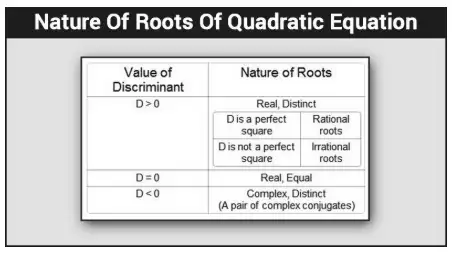
The image shows a chart explaining the nature of roots of a quadratic equation based on the value of the discriminant (D). Step-by-step explanation: 1. Look at the value of the discriminant \(D\) in the quadratic formula. 2. If \(D > 0\), the roots are real and distinct: - If \(D\) is a perfect square, the roots are rational. - If \(D\) is not a perfect square, the roots are irrational. 3. If \(D = 0\), the roots are real and equal. 4. If \(D < 0\), the roots are complex and come as a pair of complex conjugates.
Example: Consider the quadratic equation \(x^2 - 7x + 10 = 0\). Using factorization, it can be written as \((x - 5)(x - 2) = 0\), giving roots \(x = 5\) and \(x = 2\), both real and distinct.
Discriminant and Its Role in Determining Root Types
Understanding the Discriminant and Root Classification
The roots of the quadratic equation can be found using the quadratic formula:
\[ x = \frac{-b \pm \sqrt{b^2 - 4ac}}{2a} \]
The expression under the square root, \(b^2 - 4ac\), is called the discriminant and is denoted by \(D\). This value is crucial in identifying the nature of the roots:
If \(D > 0\), the equation has two distinct real roots.
If \(D = 0\), the equation has two equal real roots.
If \(D < 0\), the equation has two complex conjugate roots.
Note that the square root of a negative number is not a real number, which leads to complex roots when \(D < 0\).
The roots can be expressed in terms of \(D\) as:
\[ x = \frac{-b \pm \sqrt{D}}{2a} \]
Example: For the quadratic \(2x^2 - 4x + 1 = 0\), calculate \(D\):
\[ D = (-4)^2 - 4 \times 2 \times 1 = 16 - 8 = 8 > 0 \]
Since \(D > 0\), the roots are real and distinct.
Analyzing Root Types Through Practical Examples
Applying Discriminant to Identify Roots
Let's explore different quadratic equations to see how the discriminant affects the roots:
Example 1: Solve \(x^2 + 6x + 8 = 0\).
Calculate discriminant:
\[ D = 6^2 - 4 \times 1 \times 8 = 36 - 32 = 4 > 0 \]
Roots:
\[ x = \frac{-6 \pm \sqrt{4}}{2 \times 1} = \frac{-6 \pm 2}{2} \]
So,
\[ x = -2 \quad \text{or} \quad x = -4 \]
Both roots are real and distinct.
Example 2: Consider \(x^2 + 4x + 5 = 0\).
Discriminant:
\[ D = 4^2 - 4 \times 1 \times 5 = 16 - 20 = -4 < 0 \]
Since \(D < 0\), roots are complex:
\[ x = \frac{-4 \pm \sqrt{-4}}{2} = \frac{-4 \pm 2i}{2} = -2 \pm i \]
Example 3: Solve \(9x^2 + 12x + 4 = 0\).
Discriminant:
\[ D = 12^2 - 4 \times 9 \times 4 = 144 - 144 = 0 \]
Roots:
\[ x = \frac{-12}{2 \times 9} = \frac{-12}{18} = -\frac{2}{3} \]
Both roots are equal and real.
Quick Reference: Summary of Root Types Based on Discriminant
Discriminant \(D = b^2 - 4ac\) | Nature of Roots | Graphical Interpretation | Root Formula |
|---|---|---|---|
\(D > 0\) | Two distinct real roots | Graph intersects x-axis at two points | \(x = \frac{-b \pm \sqrt{D}}{2a}\) |
\(D = 0\) | Two equal real roots | Graph touches x-axis at one point | \(x = \frac{-b}{2a}\) |
\(D < 0\) | Two complex conjugate roots | Graph does not intersect x-axis | \(x = \frac{-b \pm i\sqrt{|D|}}{2a}\) |
Glossary of Key Terms
Term | Definition |
|---|---|
Quadratic Equation | A polynomial equation of degree two, generally \(ax^2 + bx + c = 0\). |
Root | A solution of the equation where the polynomial equals zero. |
Discriminant | The expression \(b^2 - 4ac\) that determines the nature of roots. |
Real Roots | Solutions that are real numbers, where the graph crosses the x-axis. |
Complex Roots | Non-real solutions involving imaginary numbers, occurring when \(D < 0\). |
Factorization | Expressing the quadratic as a product of two binomials. |
Completing the Square | A method to rewrite the quadratic in a perfect square form. |
Quadratic Formula | The formula \(x = \frac{-b \pm \sqrt{b^2 - 4ac}}{2a}\) used to find roots. |
Degree | The highest power of the variable in a polynomial. |
Imaginary Unit | Denoted by \(i\), where \(i^2 = -1\), used in complex roots. |
Frequently Asked Questions
What does the discriminant tell us about a quadratic equation?
The discriminant indicates whether the roots are real or complex and whether they are distinct or equal.
Can a quadratic equation have only one root?
Yes, when the discriminant is zero, the quadratic has two equal roots, effectively one unique root.
Why can't the square root of a negative number be real?
Because no real number squared gives a negative result; thus, the square root of a negative number is imaginary.
How does the graph of a quadratic relate to its roots?
The roots correspond to the x-intercepts of the parabola represented by the quadratic equation.
Is factorization always possible for quadratic equations?
Factorization over real numbers is possible only if the quadratic has real roots (i.e., discriminant ≥ 0).