Understanding the Division of a Line Segment
Fundamentals of Lines and Line Segments
Defining Lines and Their Characteristics
A line is an infinite set of points arranged straightly, extending endlessly in both directions without any endpoints. It represents a continuous path without boundaries.
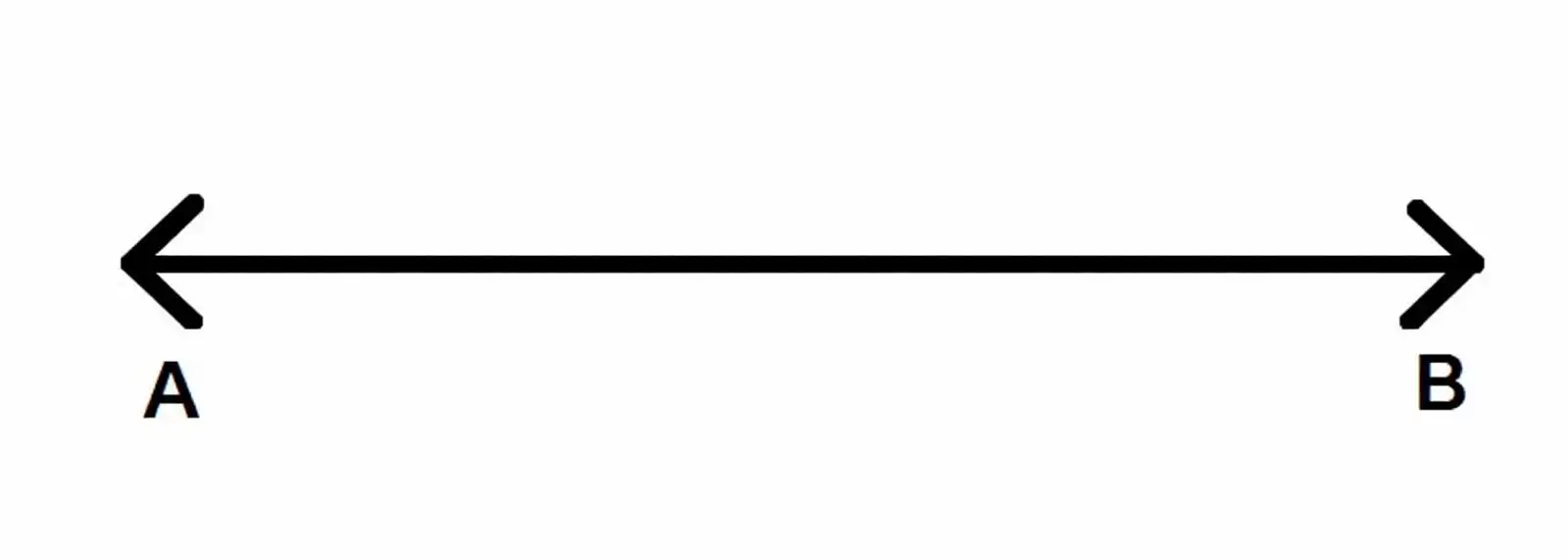
Illustration of a line extending infinitely
For example, the line AB continues indefinitely beyond points A and B.
Understanding Line Segments and Their Limits
A line segment is a finite portion of a line bounded by two distinct endpoints. It represents the shortest path connecting these two points.
Consider PQ as a line segment with endpoints P and Q lying on the line AB.
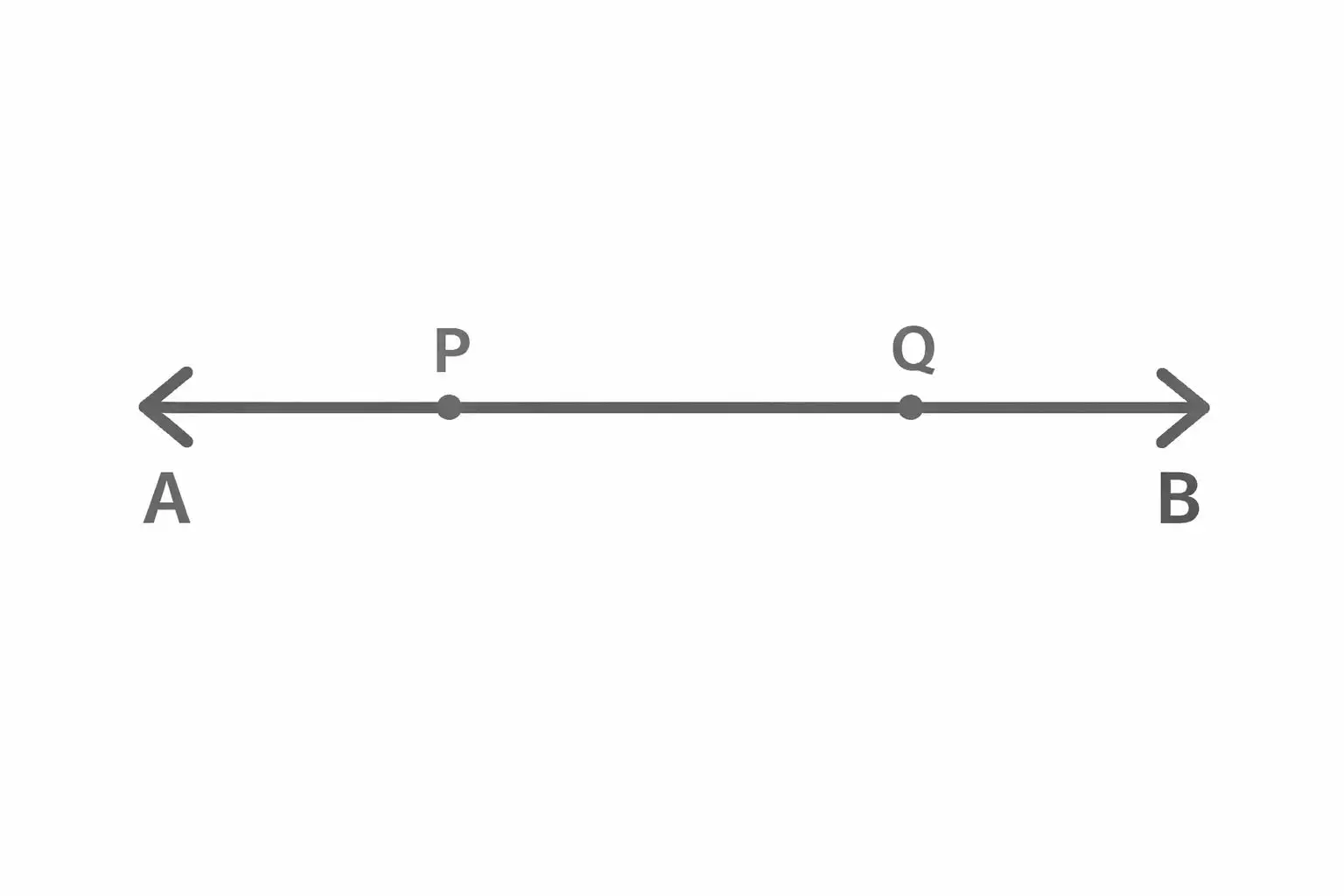
Diagram showing a line segment PQ on line AB
Example: If a line segment RS measures 8 cm, then RS is the part of the line between points R and S, and it has a definite length of 8 cm.
Methods to Divide a Line Segment into Equal Parts
Dividing a Segment into Equal Divisions
Any line segment can be split into a number of equal parts, where the number of parts is a natural number. This is useful in construction and measurement tasks.
For instance, a 12 cm line segment can be divided into three equal parts by marking points at 4 cm intervals from one endpoint.
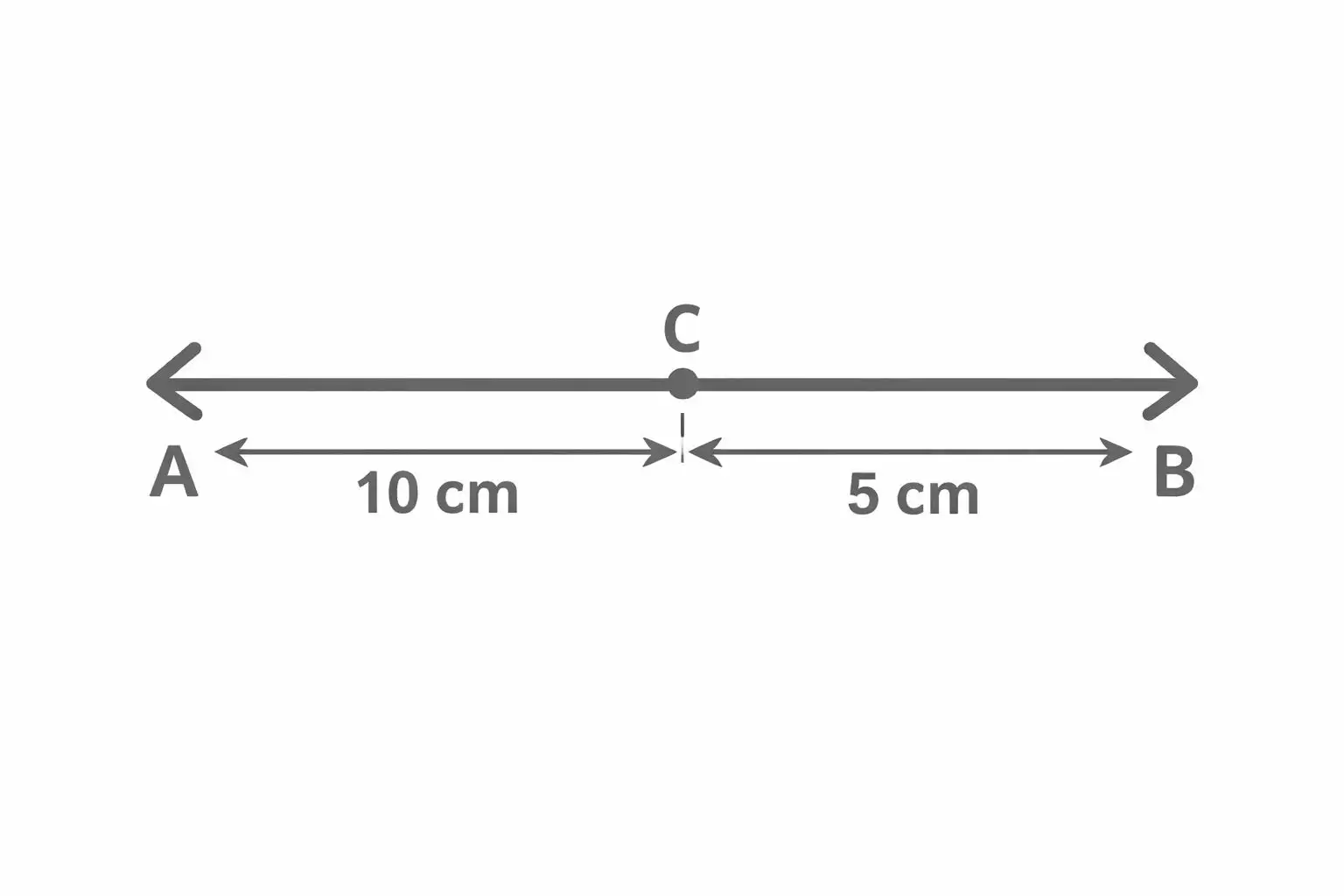
Line segment divided into equal parts
Example: A 12 cm segment is divided into 3 equal parts. Each part measures:
\[ \frac{12 \text{ cm}}{3} = 4 \text{ cm} \]
Mark points at 4 cm and 8 cm from one end to create three equal segments.
Dividing a Segment in a Given Ratio
Sometimes, a line segment needs to be divided into parts that are not equal but have a specific ratio. For example, dividing a 15 cm segment in the ratio 3:2 means the segment is split into two parts where one is 3 parts long and the other 2 parts long.
Let AB be 15 cm, and point C divides AB in the ratio 3:2. If we let the smaller part be \( x \), then the larger part is \( 3x/2 \) or equivalently, since ratio is 3:2, let:
\[ AC = 3k, \quad CB = 2k \]
Since \( AC + CB = AB \), we have:
\[ 3k + 2k = 15 \implies 5k = 15 \implies k = 3 \]
Therefore:
\[ AC = 3 \times 3 = 9 \text{ cm}, \quad CB = 2 \times 3 = 6 \text{ cm} \]
Example: Mark point C on AB such that AC = 9 cm and CB = 6 cm to divide AB in the ratio 3:2.
Constructing a Division of a Line Segment Using Geometric Methods
Step-by-Step Construction for Ratio Division
When precise measurement tools are unavailable, a geometric construction can divide a line segment into a given ratio using a compass and ruler.
Suppose we want to divide the line segment \( \overline{PQ} \) in the ratio \( m:n \), where \( m \) and \( n \) are positive integers. For example, let \( m=3 \) and \( n=1 \), so the ratio is 3:1.
Follow these steps:
Draw a ray \( PX \) from point \( P \) making an acute angle with \( \overline{PQ} \).
Since the ratio is 3:1, mark 4 equal segments on \( PX \) using a compass. Label these points \( A, B, C, D \) such that \( PA = AB = BC = CD \).
Connect point \( D \) to point \( Q \) with a straight line.
Draw a line through point \( C \) parallel to \( \overline{DQ} \). Let this line intersect \( \overline{PQ} \) at point \( R \).
Point \( R \) divides \( \overline{PQ} \) in the ratio 3:1.
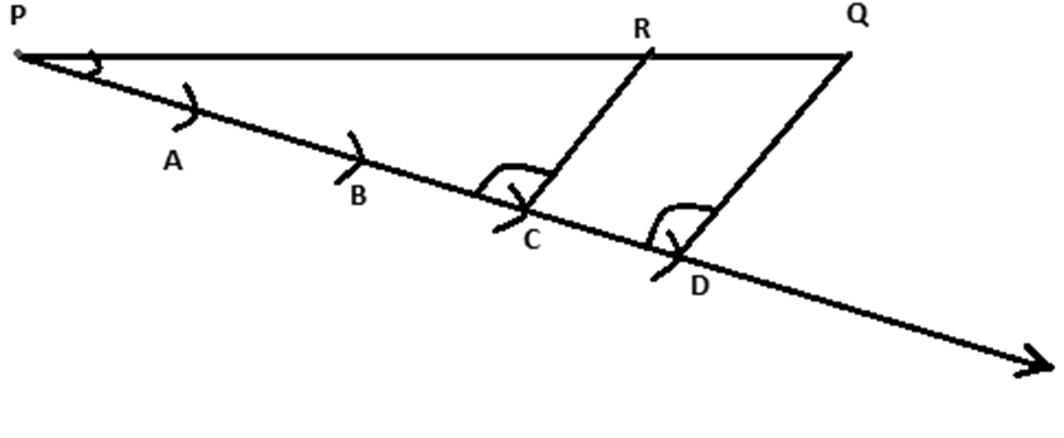
Geometric construction for dividing a line segment in ratio 3:1
By the Basic Proportionality Theorem, since \( CR \parallel DQ \),
\[ \frac{PR}{RQ} = \frac{PC}{CD} \]
From construction,
\[ \frac{PC}{CD} = \frac{3}{1} \]
Therefore,
\[ \frac{PR}{RQ} = \frac{3}{1} \]
Example: If \( PQ = 20 \text{ cm} \), dividing it in the ratio 3:1 means:
\[ PR = \frac{3}{4} \times 20 = 15 \text{ cm}, \quad RQ = \frac{1}{4} \times 20 = 5 \text{ cm} \]
Mark point \( R \) at 15 cm from \( P \) on \( \overline{PQ} \).
Summary Table for Line Segment Division
Concept | Definition | Key Formula/Method |
|---|---|---|
Line | Infinite set of points extending in both directions | Extends without endpoints |
Line Segment | Part of a line bounded by two endpoints | Finite length between endpoints |
Equal Division | Splitting segment into equal parts | Length of each part = \( \frac{\text{Total length}}{n} \) |
Ratio Division | Dividing segment in ratio \( m:n \) | \( AC = \frac{m}{m+n} \times AB, \quad CB = \frac{n}{m+n} \times AB \) |
Geometric Construction | Using compass and ruler to divide segment | Basic Proportionality Theorem and parallel lines |
Glossary of Key Terms
Term | Meaning |
|---|---|
Line | An infinite set of points extending in both directions without endpoints |
Line Segment | A finite part of a line bounded by two endpoints |
Endpoint | A point that marks the end of a line segment |
Ratio | A comparison of two quantities expressed as \( m:n \) |
Ray | A part of a line that starts at one point and extends infinitely in one direction |
Basic Proportionality Theorem | If a line is drawn parallel to one side of a triangle, it divides the other two sides proportionally |
Compass | A tool used to draw arcs and circles |
Parallel Lines | Lines in the same plane that never intersect |
Acute Angle | An angle less than 90 degrees |
Construction | Drawing geometric figures accurately using tools |
Frequently Asked Questions
What is the difference between a line and a line segment?
A line extends infinitely in both directions without endpoints, while a line segment has two fixed endpoints and a definite length.
How can a line segment be divided into equal parts without measuring?
By drawing a ray at an angle and marking equal segments on it using a compass, then connecting and drawing parallel lines, the segment can be divided accurately without direct measurement.
What does dividing a line segment in the ratio 2:3 mean?
It means splitting the segment into two parts where the first part is 2 units long and the second part is 3 units long, relative to each other.
Why is the Basic Proportionality Theorem important in dividing line segments?
It ensures that when a line is drawn parallel to one side of a triangle, it divides the other sides proportionally, which helps in accurate ratio division of segments.
Can the division method be used for any ratio?
Yes, the geometric construction method works for any positive integer ratio by marking the total number of equal segments on the auxiliary ray.