Fundamentals of Trigonometry: Functions, Formulas, and Applications
Understanding Trigonometric Ratios and Their Foundations
Core Trigonometric Ratios in Right Triangles
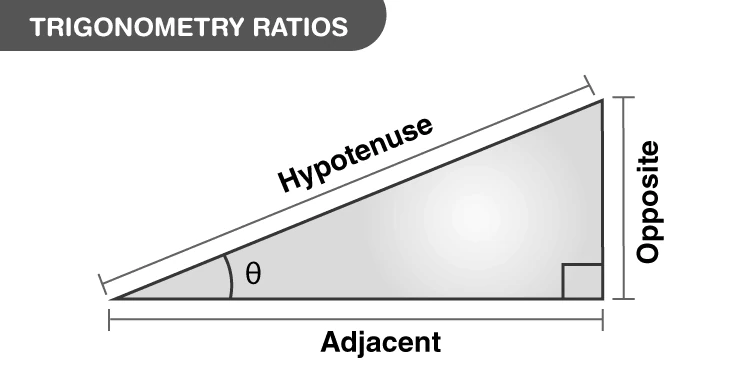
Trigonometry primarily explores the connections between the angles and sides of right-angled triangles. The three fundamental ratios—sine, cosine, and tangent—are defined based on the triangle's sides relative to a chosen angle. The hypotenuse is the longest side opposite the right angle, while the other two sides are termed adjacent and opposite with respect to the angle in question.
These ratios are expressed as:
- Sine (sin θ): Ratio of the length of the side opposite to angle θ to the hypotenuse.
- Cosine (cos θ): Ratio of the length of the side adjacent to angle θ to the hypotenuse.
- Tangent (tan θ): Ratio of the length of the side opposite to angle θ to the adjacent side.
Example:
In a right triangle, if the side opposite angle \( \theta \) measures 7 cm and the hypotenuse is 25 cm, calculate \( \sin \theta \), \( \cos \theta \), and \( \tan \theta \) given the adjacent side is 24 cm.
Solution:
\[ \sin \theta = \frac{\text{Opposite}}{\text{Hypotenuse}} = \frac{7}{25} = 0.28 \]
\[ \cos \theta = \frac{\text{Adjacent}}{\text{Hypotenuse}} = \frac{24}{25} = 0.96 \]
\[ \tan \theta = \frac{\text{Opposite}}{\text{Adjacent}} = \frac{7}{24} \approx 0.2917 \]
Exploring the Six Trigonometric Functions and Their Properties
Complete Set of Trigonometric Functions and Their Characteristics
Beyond sine, cosine, and tangent, trigonometry includes three additional functions: cosecant, secant, and cotangent. These are reciprocals of the primary functions and are defined as:
- Cosecant (csc θ): Reciprocal of sine, \( \csc \theta = \frac{1}{\sin \theta} \).
- Secant (sec θ): Reciprocal of cosine, \( \sec \theta = \frac{1}{\cos \theta} \).
- Cotangent (cot θ): Reciprocal of tangent, \( \cot \theta = \frac{1}{\tan \theta} \).
These six functions are essential for solving various trigonometric problems and understanding their behavior is crucial.
Even and Odd Nature of Trigonometric Functions
Trigonometric functions exhibit symmetry properties that classify them as even or odd functions:
- Odd functions: Satisfy \( f(-x) = -f(x) \) and are symmetric about the origin. Examples include sine, tangent, cosecant, and cotangent.
- Even functions: Satisfy \( f(-x) = f(x) \) and are symmetric about the y-axis. Examples include cosine and secant.
These properties simplify calculations involving negative angles.
Example:
Verify whether \( \sin(-45^\circ) \) and \( \cos(-45^\circ) \) are odd or even functions.
Solution:
Using the properties:
\[ \sin(-45^\circ) = -\sin 45^\circ = -\frac{\sqrt{2}}{2} \]
\[ \cos(-45^\circ) = \cos 45^\circ = \frac{\sqrt{2}}{2} \]
Since \( \sin(-x) = -\sin x \), sine is an odd function. Since \( \cos(-x) = \cos x \), cosine is an even function.
Key Angles, Unit Circle, and Trigonometric Tables
Common Angles and Their Trigonometric Values
Trigonometric calculations often involve standard angles such as \(0^\circ\), \(30^\circ\), \(45^\circ\), \(60^\circ\), and \(90^\circ\). Memorizing their sine, cosine, and tangent values is beneficial for quick problem-solving.
For example, in a right triangle, the angle \( \theta \) can be found using inverse trigonometric functions:
\[ \theta = \sin^{-1}\left(\frac{\text{Opposite}}{\text{Hypotenuse}}\right), \quad \theta = \cos^{-1}\left(\frac{\text{Adjacent}}{\text{Hypotenuse}}\right), \quad \theta = \tan^{-1}\left(\frac{\text{Opposite}}{\text{Adjacent}}\right) \]
Trigonometric Values Table
| Angle (°) | \( \sin \theta \) | \( \cos \theta \) | \( \tan \theta \) |
|---|---|---|---|
| 0 | 0 | 1 | 0 |
| 30 | 1/2 | \( \sqrt{3}/2 \) | \( 1/\sqrt{3} \) |
| 45 | \( \sqrt{2}/2 \) | \( \sqrt{2}/2 \) | 1 |
| 60 | \( \sqrt{3}/2 \) | 1/2 | \( \sqrt{3} \) |
| 90 | 1 | 0 | Undefined |
Unit Circle and Its Role in Trigonometry
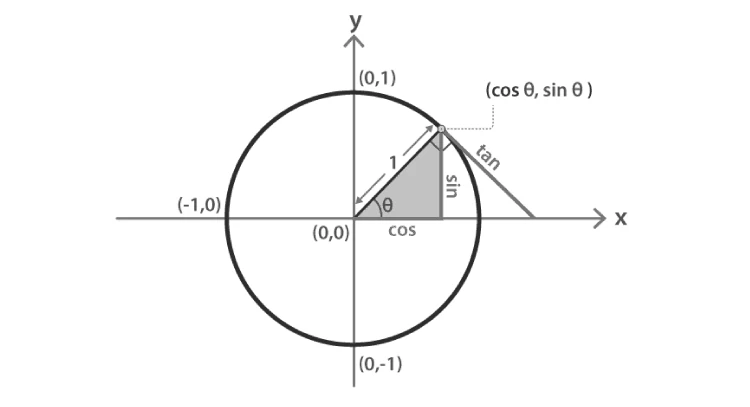
The unit circle is a circle with radius 1 centered at the origin of the coordinate plane. It provides a geometric interpretation of trigonometric functions for all angles, including those beyond \(90^\circ\). For an angle \( \theta \), the coordinates of the point on the unit circle are \( (x, y) = (\cos \theta, \sin \theta) \).
Example:
Find the sine and cosine of \( 150^\circ \) using the unit circle concept.
Solution:
Since \( 150^\circ = 180^\circ - 30^\circ \),
\[ \sin 150^\circ = \sin 30^\circ = \frac{1}{2} \]
\[ \cos 150^\circ = -\cos 30^\circ = -\frac{\sqrt{3}}{2} \]
Essential Trigonometric Identities and Euler’s Formula
Fundamental Identities in Trigonometry
Trigonometric identities are equations involving trigonometric functions that hold true for all valid values of the variables. Some key identities include:
- Pythagorean Identities:
\[ \sin^2 \theta + \cos^2 \theta = 1 \]
\[ 1 + \tan^2 \theta = \sec^2 \theta \]
\[ 1 + \cot^2 \theta = \csc^2 \theta \]
- Double Angle Formulas:
\[ \sin 2\theta = 2 \sin \theta \cos \theta \]
\[ \cos 2\theta = \cos^2 \theta - \sin^2 \theta \]
\[ \tan 2\theta = \frac{2 \tan \theta}{1 - \tan^2 \theta} \]
- Sum and Difference Formulas:
\[ \sin(u \pm v) = \sin u \cos v \pm \cos u \sin v \]
\[ \cos(u \pm v) = \cos u \cos v \mp \sin u \sin v \]
\[ \tan(u \pm v) = \frac{\tan u \pm \tan v}{1 \mp \tan u \tan v} \]
Euler’s Formula and Its Trigonometric Connections
Euler’s formula links complex exponentials with trigonometric functions and is expressed as:
\[ e^{ix} = \cos x + i \sin x \]
From this, sine, cosine, and tangent can be represented as:
\[ \sin x = \frac{e^{ix} - e^{-ix}}{2i}, \quad \cos x = \frac{e^{ix} + e^{-ix}}{2}, \quad \tan x = \frac{e^{ix} - e^{-ix}}{i(e^{ix} + e^{-ix})} \]
Example:
Using Euler’s formula, express \( \sin 60^\circ \) in terms of exponential functions.
Solution:
Convert \( 60^\circ \) to radians: \( \frac{\pi}{3} \).
\[ \sin \frac{\pi}{3} = \frac{e^{i \pi/3} - e^{-i \pi/3}}{2i} \]
This expression can be evaluated using Euler’s formula for complex exponentials.
Practical Applications and Problem Solving in Trigonometry
Real-World Uses of Trigonometric Concepts
Trigonometry is widely applied in fields such as navigation, astronomy, engineering, and physics. It helps in calculating heights, distances, and angles where direct measurement is difficult.
Example Problem 1: Height Determination Using Angle of Elevation
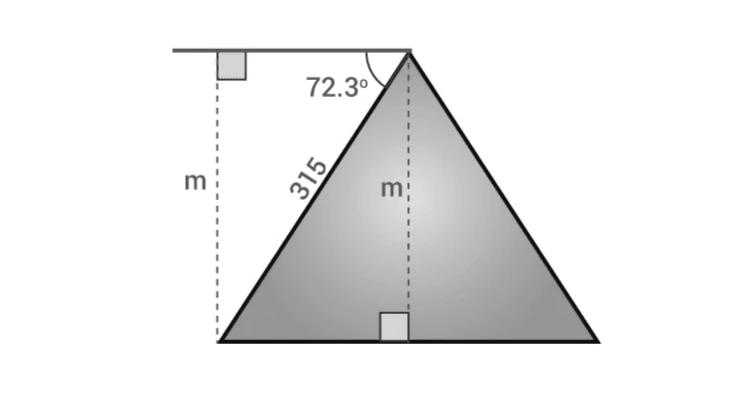
Two hikers ascend a conical hill. One climbs 320 meters and observes the angle of depression to the base as \( 70^\circ \). Find the height of the hiker above the ground.
Solution:
Let the height be \( h \) meters.
Using sine ratio:
\[ \sin 70^\circ = \frac{h}{320} \]
\[ h = 320 \times \sin 70^\circ \]
Since \( \sin 70^\circ \approx 0.940 \),
\[ h = 320 \times 0.940 = 300.8 \text{ meters} \]
The hiker is approximately 300.8 meters above the ground.
Example Problem 2: Calculating Angle of Elevation from Shadow Length
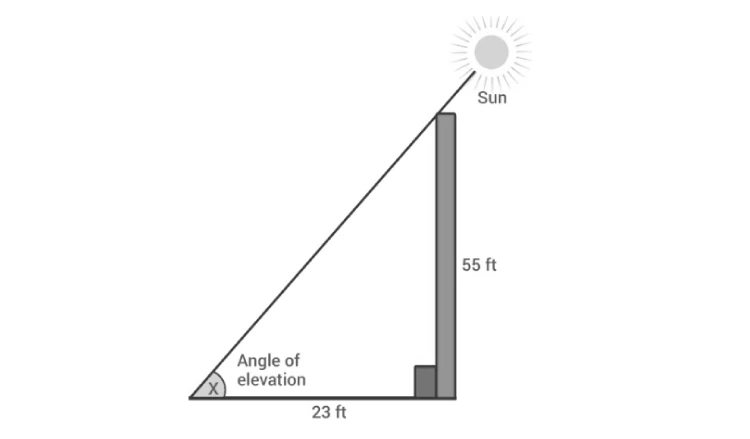
A pole 60 feet tall casts a shadow 25 feet long. Determine the angle of elevation of the sun.
Solution:
Let the angle of elevation be \( \alpha \).
Using tangent ratio:
\[ \tan \alpha = \frac{\text{Height}}{\text{Shadow length}} = \frac{60}{25} = 2.4 \]
\[ \alpha = \tan^{-1}(2.4) \approx 67.38^\circ \]
The sun’s angle of elevation is approximately \( 67.38^\circ \).
Summary Table for Quick Revision
| Concept | Definition / Formula |
|---|---|
| Sine | \( \sin \theta = \frac{\text{Opposite}}{\text{Hypotenuse}} \) |
| Cosine | \( \cos \theta = \frac{\text{Adjacent}}{\text{Hypotenuse}} \) |
| Tangent | \( \tan \theta = \frac{\text{Opposite}}{\text{Adjacent}} \) |
| Cosecant | \( \csc \theta = \frac{1}{\sin \theta} \) |
| Secant | \( \sec \theta = \frac{1}{\cos \theta} \) |
| Cotangent | \( \cot \theta = \frac{1}{\tan \theta} \) |
| Pythagorean Identity | \( \sin^2 \theta + \cos^2 \theta = 1 \) |
| Double Angle (Sine) | \( \sin 2\theta = 2 \sin \theta \cos \theta \) |
| Sum Formula (Cosine) | \( \cos(u+v) = \cos u \cos v - \sin u \sin v \) |
| Euler’s Formula | \( e^{ix} = \cos x + i \sin x \) |
Glossary of Key Trigonometric Terms
| Term | Meaning |
|---|---|
| Hypotenuse | The longest side opposite the right angle in a right triangle. |
| Opposite Side | The side opposite to the angle of interest. |
| Adjacent Side | The side next to the angle of interest, excluding the hypotenuse. |
| Sine (sin) | Ratio of opposite side to hypotenuse. |
| Cosine (cos) | Ratio of adjacent side to hypotenuse. |
| Tangent (tan) | Ratio of opposite side to adjacent side. |
| Cosecant (csc) | Reciprocal of sine. |
| Secant (sec) | Reciprocal of cosine. |
| Cotangent (cot) | Reciprocal of tangent. |
| Unit Circle | A circle with radius 1 used to define trigonometric functions for all angles. |
Frequently Asked Questions on Trigonometry
What is the main focus of trigonometry?
Trigonometry studies the relationships between the angles and sides of right-angled triangles, enabling calculation of unknown sides or angles.
How many primary trigonometric functions are there?
There are six fundamental functions: sine, cosine, tangent, cosecant, secant, and cotangent.
What is the significance of the unit circle in trigonometry?
The unit circle allows evaluation of trigonometric functions for all angles, including those beyond \(90^\circ\), by relating angles to coordinates on a circle of radius 1.
Who is credited with founding trigonometry?
The Greek mathematician Hipparchus is recognized as the pioneer of trigonometry.
Where is trigonometry applied in real life?
Trigonometry is used in fields such as navigation, astronomy, engineering, physics, and even in calculating heights and distances in surveying.