Practical Applications of Trigonometry in Measuring Heights and Distances
Fundamentals of Angles in Height and Distance Problems
Understanding Key Concepts: Line of Sight, Elevation, and Depression
In trigonometry, the terms related to heights and distances are crucial for solving real-world problems. The line of sight is the straight line drawn from the observer's eye to the point being observed on an object. When this line forms an angle above the horizontal plane, it is called the angle of elevation. Conversely, if the angle is below the horizontal, it is known as the angle of depression.
These angles help in determining unknown heights or distances by applying trigonometric ratios. Devices such as the inclinometer or clinometer are commonly used to measure these angles accurately.
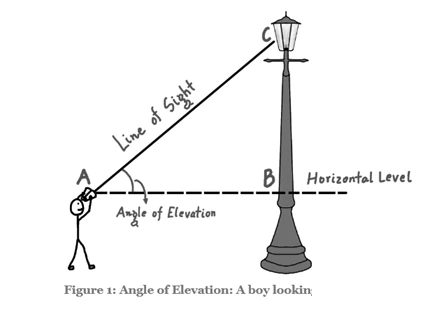
Illustration of Angle of Elevation
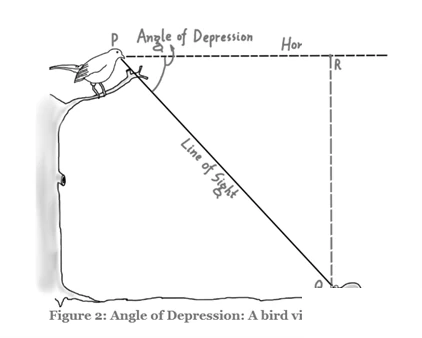
Diagram of Angle of Depression
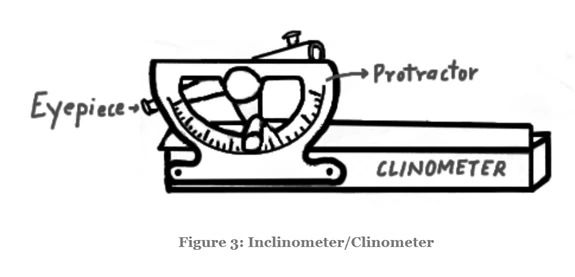
Inclinometer for Measuring Angles
Example Problem
An observer stands on level ground and looks up at the top of a tall tree. If the angle of elevation to the top of the tree is 45°, explain what the line of sight and angle of elevation represent in this context.
Solution:
The line of sight is the straight line from the observer’s eye to the top of the tree.
The angle of elevation is the 45° angle formed between the horizontal ground level and the line of sight.
These measurements allow us to apply trigonometric ratios to find the height of the tree or distance from the observer.
Applying Trigonometric Ratios to Calculate Heights and Distances
Using Standard Trigonometric Ratios in Right Triangles
To determine unknown heights or distances, trigonometric ratios such as sine, cosine, and tangent are applied to right-angled triangles formed by the object, the observer, and the ground. The key relationships are:
\[ \sin \theta = \frac{\text{Opposite side}}{\text{Hypotenuse}}, \quad \cos \theta = \frac{\text{Adjacent side}}{\text{Hypotenuse}}, \quad \tan \theta = \frac{\text{Opposite side}}{\text{Adjacent side}} \]
Here, \( \theta \) is the angle of elevation or depression, and the sides correspond to the height and distance measurements.
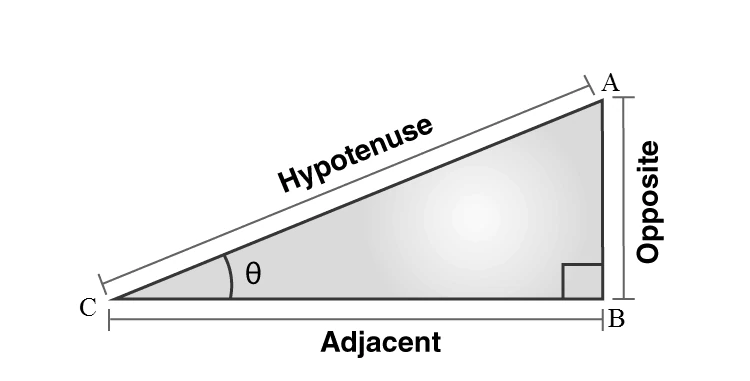
Right Triangle with Trigonometric Ratios
Example Problem
A flagpole stands vertically on level ground. An observer measures the angle of elevation to the top of the pole as 30°. If the observer is standing 20 meters from the base of the pole, find the height of the flagpole.
Solution:
Let the height of the flagpole be \( h \) meters.
Using the tangent ratio:
\[ \tan 30^\circ = \frac{h}{20} \]
Since \( \tan 30^\circ = \frac{1}{\sqrt{3}} \),
\[ \frac{1}{\sqrt{3}} = \frac{h}{20} \implies h = \frac{20}{\sqrt{3}} \approx 11.55 \text{ meters} \]
Therefore, the flagpole is approximately 11.55 meters tall.
Advanced Scenarios Involving Movement and Similar Triangles
Calculating Distances When Observer Changes Position
When an observer moves closer or farther from an object, the angle of elevation changes accordingly. The distance moved can be calculated using cotangent functions. If the observer moves from point C to D, the distance \( d \) between these points is given by:
\[ d = h \left( \cot x - \cot y \right) \]
where \( h \) is the height of the object, and \( x \) and \( y \) are the angles of elevation at points C and D respectively.
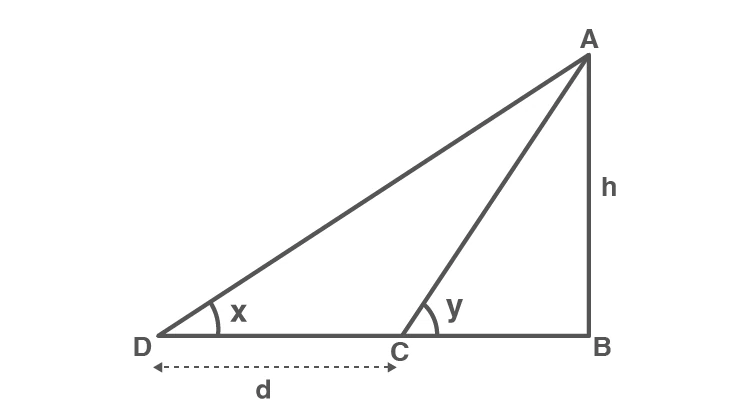
Observer Movement Affecting Angle of Elevation
Using Similar Triangles to Solve Complex Height and Distance Problems
In some cases, two triangles formed by the object and observer are similar due to parallel lines and equal angles. Using the Basic Proportionality Theorem (Thales' theorem), the ratios of corresponding sides are equal:
\[ \frac{AB}{ED} = \frac{BC}{DC} \]
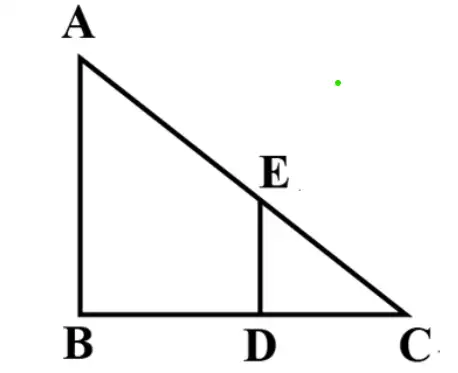
This image shows a right triangle \( \triangle ABC \) with a right angle at \( B \). There is a line segment \( DE \) inside the triangle, perpendicular to \( BC \), creating two smaller triangles inside. Step-by-step explanation: 1. Identify the right triangle \( \triangle ABC \) with \( \angle B = 90^\circ \). 2. Notice the segment \( DE \) is drawn perpendicular to \( BC \), meaning \( DE \) forms right angles with \( BC \). 3. Recognize that \( DE \) divides \( \triangle ABC \) into two smaller triangles: \( \triangle ADE \) and the triangle adjoining \( DE \). 4. These two triangles inside might be similar to each other or to the larger \( \triangle ABC \), often used to explore properties like similarity or ratios.
Example Problem
An airplane flies at a height of \( h \) meters above the ground. From a boy’s viewpoint on the ground, the angle of elevation to the plane is initially 60°. After some time, the angle reduces to 30°. Calculate the horizontal distance the plane has traveled during this interval.
Solution:
Let the initial horizontal distance from the boy to the plane's vertical projection be \( x \), and the distance traveled by the plane be \( y \).
From the first position:
\[ \tan 60^\circ = \frac{h}{x} \implies \sqrt{3} = \frac{h}{x} \implies x = \frac{h}{\sqrt{3}} \]
From the second position:
\[ \tan 30^\circ = \frac{h}{x + y} \implies \frac{1}{\sqrt{3}} = \frac{h}{x + y} \implies x + y = \sqrt{3} h \]
Subtracting the two distances:
\[ y = (x + y) - x = \sqrt{3} h - \frac{h}{\sqrt{3}} = h \left( \sqrt{3} - \frac{1}{\sqrt{3}} \right) = \frac{2h}{\sqrt{3}} \]
Thus, the plane covers a horizontal distance of \( \frac{2h}{\sqrt{3}} \) meters.
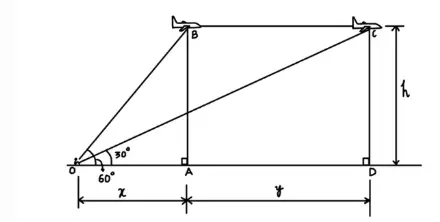
This image shows a geometric setup with points O, A, B, C, and D on a horizontal line, and two vertical heights. It includes angles of 30° and 60° from point O to points B and C, and right angles at points A and B indicating perpendicular lines. Step-by-step explanation: 1. Point O is where the angles of 30° and 60° are measured. 2. A line extends from O along the horizontal axis through points A and D. 3. From points B and C, vertical lines go upward, creating right angles with the horizontal line. 4. The heights of these vertical lines are labeled as \( h \). 5. The horizontal distances from O to A and A to D are labeled as \( x \) and \( y \). 6. Lines from O to B and C show the angles 30° and 60°, forming triangles that can be used to calculate distances or heights using trigonometry.
Summary Table for Heights and Distances
Concept | Definition/Formula | Application |
|---|---|---|
Line of Sight | Line from observer’s eye to object point | Basis for measuring angles |
Angle of Elevation | Angle between horizontal and line of sight above | Used to find height or distance |
Angle of Depression | Angle between horizontal and line of sight below | Used to calculate distances below observer |
Trigonometric Ratios | \( \sin \theta, \cos \theta, \tan \theta \) | Relate angles to sides in right triangles |
Observer Movement | \( d = h(\cot x - \cot y) \) | Distance moved by observer changing angle |
Similar Triangles | \( \frac{AB}{ED} = \frac{BC}{DC} \) | Used to solve complex height-distance problems |
Glossary of Key Terms
Term | Meaning |
|---|---|
Angle of Elevation | The angle between the horizontal and the line of sight above the observer |
Angle of Depression | The angle between the horizontal and the line of sight below the observer |
Line of Sight | The direct line from the observer’s eye to the object |
Inclinometer | Instrument used to measure angles of elevation and depression |
Trigonometric Ratios | Ratios of sides in a right triangle: sine, cosine, tangent |
Right Triangle | A triangle with one 90° angle |
Similar Triangles | Triangles with equal corresponding angles and proportional sides |
Cotangent | Reciprocal of tangent: \( \cot \theta = \frac{1}{\tan \theta} \) |
Basic Proportionality Theorem | States that a line parallel to one side of a triangle divides the other two sides proportionally |
Hypotenuse | The side opposite the right angle in a right triangle |
Frequently Asked Questions
What is the difference between angle of elevation and angle of depression?
The angle of elevation is measured upward from the horizontal line to the object, while the angle of depression is measured downward from the horizontal line to the object.
How do trigonometric ratios help in finding heights?
They relate the angles measured to the sides of right triangles, allowing calculation of unknown heights or distances using sine, cosine, or tangent functions.
What role do similar triangles play in height and distance problems?
Similar triangles allow us to set up proportional relationships between sides, which helps solve problems where direct measurement is difficult.
How does observer movement affect the angle of elevation?
Moving closer to the object increases the angle of elevation, while moving away decreases it. The distance moved can be calculated using cotangent differences.
Which instrument is used to measure angles of elevation and depression?
An inclinometer or clinometer is commonly used to measure these angles accurately.