Understanding the Geometry and Calculations of a Conical Frustum
Conceptualizing the Frustum of a Cone
Defining the Frustum and Its Formation
A frustum is the portion of a cone that remains after slicing the cone with a plane parallel to its base, effectively removing the apex. This results in a truncated cone shape where the top and bottom faces are circular and parallel. The original cone is divided into two parts: the smaller cone at the top and the frustum below it.
To visualize this, imagine an ice cream cone filled completely with ice cream. If you cut the cone horizontally near the top, the remaining lower part is the frustum of the cone.
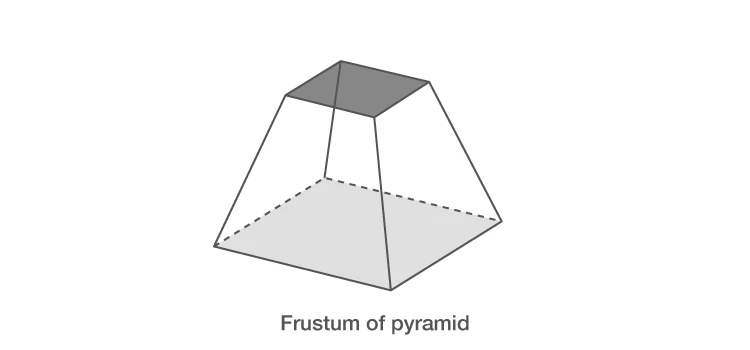
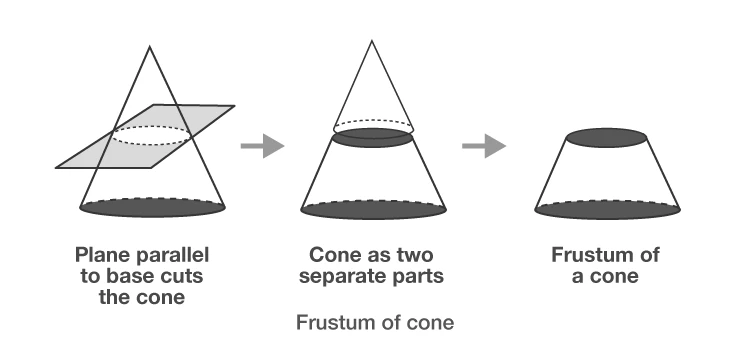
Example: Identifying a Frustum
Consider a pyramid with its apex cut off by a plane parallel to its base. What is the name of the solid that remains between the base and the cutting plane?
Answer: The remaining solid is called the frustum of the pyramid, analogous to the frustum of a cone formed by a similar cut.
- The cutting plane is parallel to the base.
- The shape retains the base but loses the apex.
- The frustum is the truncated portion left after the cut.
Calculating the Volume of a Conical Frustum
Deriving the Volume Formula Using Similar Cones
The volume of a frustum of a cone can be found by subtracting the volume of the smaller cone (cut off from the top) from the volume of the original larger cone. Let the original cone have height \( h \), radius \( r \), and slant height \( l \). The smaller cone removed has height \( h' \), radius \( r' \), and slant height \( l' \). The frustum's height is \( H = h - h' \).
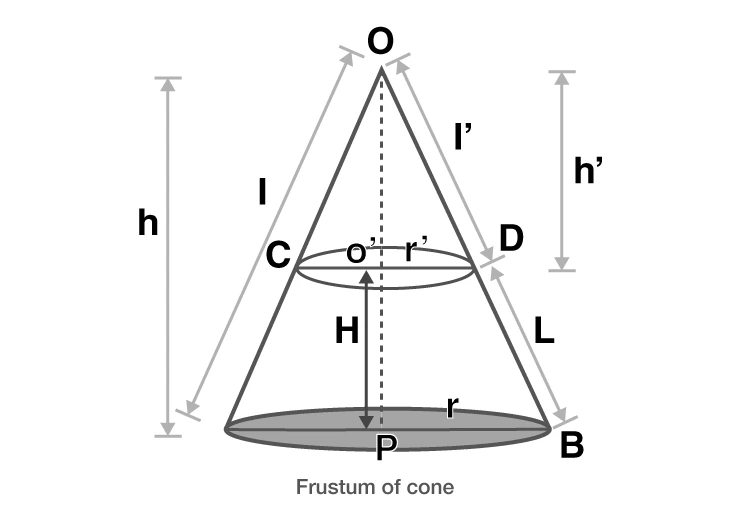
Using the similarity of triangles formed by the cone's axis and radius, the ratio of corresponding sides is:
\[ \frac{r'}{r} = \frac{h'}{h} \]
The volume of the frustum is then:
\[ V = \frac{1}{3} \pi h (r^2) - \frac{1}{3} \pi h' (r'^2) = \frac{1}{3} \pi (h r^2 - h' r'^2) \]
Expressing \( h' \) in terms of \( r' \) and \( r \) using similarity, and substituting back, the volume formula simplifies to:
\[ V = \frac{1}{3} \pi H \left( r^2 + r r' + r'^2 \right) \]
Example: Volume of a Frustum
A frustum of a cone has a lower base radius of 8 cm, an upper base radius of 5 cm, and a height of 12 cm. Calculate its volume.
Solution:
Given: \( r = 8 \text{ cm} \), \( r' = 5 \text{ cm} \), \( H = 12 \text{ cm} \)
Using the volume formula:
\[ V = \frac{1}{3} \pi \times 12 \times (8^2 + 8 \times 5 + 5^2) = 4 \pi (64 + 40 + 25) = 4 \pi \times 129 = 516 \pi \text{ cm}^3 \]
Therefore, the volume is approximately \( 516 \times 3.1416 = 1620.5 \text{ cm}^3 \).
Determining the Surface Area of a Conical Frustum
Calculating Curved and Total Surface Areas
The curved surface area (CSA) of a frustum is the difference between the curved surface areas of the original large cone and the smaller cone removed. If the slant heights of the large and small cones are \( l \) and \( l' \) respectively, then:
\[ \text{CSA of frustum} = \pi r l - \pi r' l' = \pi (r l - r' l') \]
Using similarity of triangles, the slant height of the frustum \( L = l - l' \), and the lateral surface area can also be expressed as:
\[ \text{CSA} = \pi (r + r') L \]
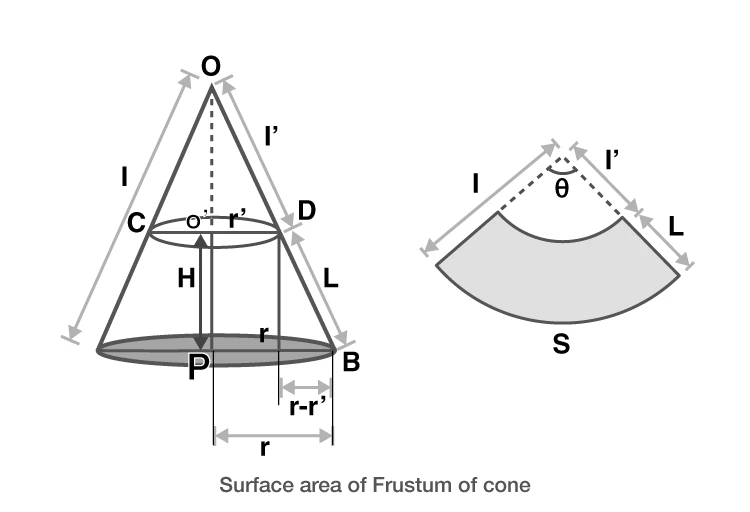
The total surface area includes the curved surface area plus the area of the two circular ends:
\[ \text{Total Surface Area} = \pi (r + r') L + \pi r^2 + \pi r'^2 \]
Example: Lateral Surface Area of a Frustum
A frustum has a top radius of 10 m, a bottom radius of 3 m, and a height of 24 m. Find its lateral surface area.
Solution:
Given: \( r_1 = 10 \text{ m} \), \( r_2 = 3 \text{ m} \), \( h = 24 \text{ m} \)
Calculate the slant height \( l \):
\[ l = \sqrt{(r_1 - r_2)^2 + h^2} = \sqrt{(10 - 3)^2 + 24^2} = \sqrt{7^2 + 576} = \sqrt{49 + 576} = \sqrt{625} = 25 \text{ m} \]
Then, lateral surface area:
\[ \text{LSA} = \pi (r_1 + r_2) l = \pi (10 + 3) \times 25 = 325 \pi \text{ m}^2 \]
Thus, the lateral surface area is approximately \( 325 \times 3.1416 = 1021.02 \text{ m}^2 \).
Summary of Key Formulas and Concepts
| Property | Formula | Explanation |
|---|---|---|
| Volume of Frustum | \( V = \frac{1}{3} \pi H (r^2 + r r' + r'^2) \) | Volume found by subtracting smaller cone volume from larger cone |
| Slant Height of Frustum | \( L = \sqrt{(r - r')^2 + H^2} \) | Distance along the side between the two circular ends |
| Curved Surface Area (CSA) | \( \text{CSA} = \pi (r + r') L \) | Sum of lateral areas of the frustum's side surface |
| Total Surface Area | \( \text{TSA} = \pi (r + r') L + \pi r^2 + \pi r'^2 \) | CSA plus areas of top and bottom circular faces |
| Radius-Height Ratio | \( \frac{r'}{r} = \frac{h'}{h} \) | Similarity ratio between smaller and larger cones |
Glossary of Important Terms
| Term | Definition |
|---|---|
| Frustum | The portion of a solid (cone or pyramid) left after slicing parallel to the base |
| Slant Height | The length of the side surface from base to top edge along the lateral surface |
| Curved Surface Area (CSA) | The area of the lateral curved surface excluding the bases |
| Total Surface Area (TSA) | The sum of the curved surface area and the areas of the two circular ends |
| Radius | Distance from the center to the edge of the circular base |
| Height | Perpendicular distance between the two parallel circular faces |
| Similarity of Triangles | Geometric property used to relate dimensions of the smaller and larger cones |
| Right Circular Cone | A cone with a circular base and an apex aligned perpendicularly above the center |
| Volume | The amount of space enclosed within the frustum |
| Base | The circular face at the bottom of the frustum |
Frequently Asked Questions (FAQs)
What exactly is a frustum of a cone?
A frustum of a cone is the truncated portion remaining after slicing the cone with a plane parallel to its base, removing the apex.
How do you calculate the volume of a conical frustum?
Use the formula \( V = \frac{1}{3} \pi H (r^2 + r r' + r'^2) \), where \( H \) is the height, and \( r \), \( r' \) are the radii of the two circular ends.
What is the formula for the lateral surface area of a frustum?
The lateral surface area is given by \( \pi (r + r') L \), where \( L \) is the slant height of the frustum.
How is the slant height of a frustum determined?
The slant height \( L \) is calculated by \( L = \sqrt{(r - r')^2 + H^2} \), combining the difference in radii and the height.
What does the total surface area of a frustum include?
It includes the curved surface area plus the areas of the two circular faces: \( \pi (r + r') L + \pi r^2 + \pi r'^2 \).