Calculating Distance Between Points in Coordinate Geometry
Understanding Coordinates and Their Representation
Defining Coordinates in the Cartesian Plane
In coordinate geometry, every point on a plane is identified by an ordered pair of numbers called coordinates. These coordinates specify the point's exact position relative to two perpendicular axes: the x-axis (horizontal) and the y-axis (vertical). A point \( P \) is represented as \( (x, y) \), where \( x \) indicates the horizontal distance from the y-axis, and \( y \) indicates the vertical distance from the x-axis.
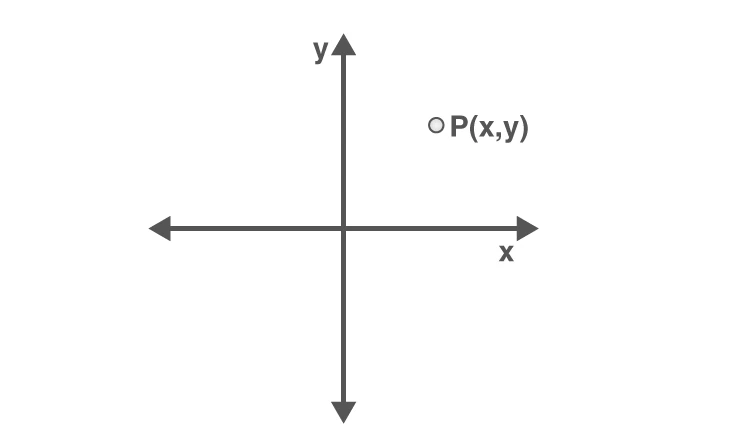
Points lying on the x-axis have coordinates of the form \( (a, 0) \), where \( a \) is the distance from the origin along the x-axis. Similarly, points on the y-axis are represented as \( (0, a) \), where \( a \) is the distance from the origin along the y-axis.
Example: Locating a Point on the Axes
Problem: Identify the coordinates of a point located 7 units to the right of the origin on the x-axis.
Solution: Since the point lies on the x-axis, its y-coordinate is zero. Being 7 units to the right means the x-coordinate is 7. Therefore, the point's coordinates are \( (7, 0) \).
Calculating Distance Using the Pythagorean Theorem
Applying the Theorem to Find Shortest Distance
When a person moves in two perpendicular directions, the shortest distance between the starting and ending points can be found using the Pythagorean theorem. For example, if someone walks 25 meters north and then 60 meters east, the direct distance between the start and end points forms the hypotenuse of a right triangle.
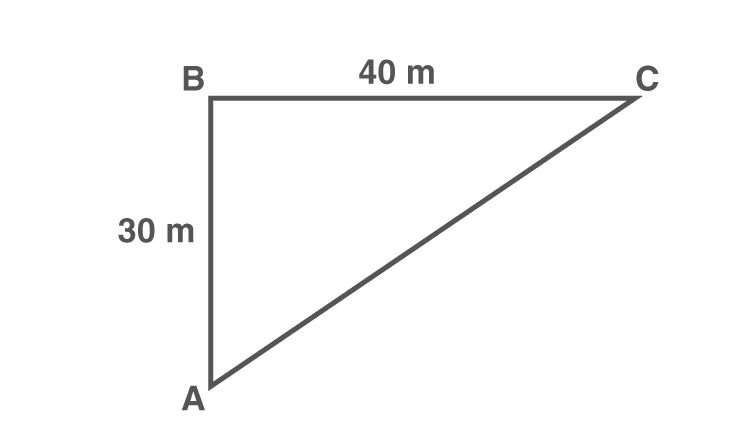
Using the Pythagorean theorem:
\[ AC = \sqrt{AB^2 + BC^2} = \sqrt{25^2 + 60^2} = \sqrt{625 + 3600} = \sqrt{4225} = 65 \text{ m} \]
This distance \( AC \) is the shortest path between the initial and final points.
Example: Determining Direct Distance
Problem: A person walks 15 meters east and then 20 meters north. Calculate the straight-line distance from the starting point.
Solution: The two legs of the right triangle are 15 m and 20 m. Applying the Pythagorean theorem:
\[ \text{Distance} = \sqrt{15^2 + 20^2} = \sqrt{225 + 400} = \sqrt{625} = 25 \text{ m} \]
Thus, the shortest distance from the start to the endpoint is 25 meters.
Deriving and Using the Distance Formula in the Plane
Formulating the Distance Between Two Points
Consider two points \( P(x_1, y_1) \) and \( Q(x_2, y_2) \) in the coordinate plane. To find the distance between them, we construct a right triangle by drawing perpendiculars from these points to the x-axis. The horizontal leg corresponds to the difference in x-coordinates, and the vertical leg corresponds to the difference in y-coordinates.
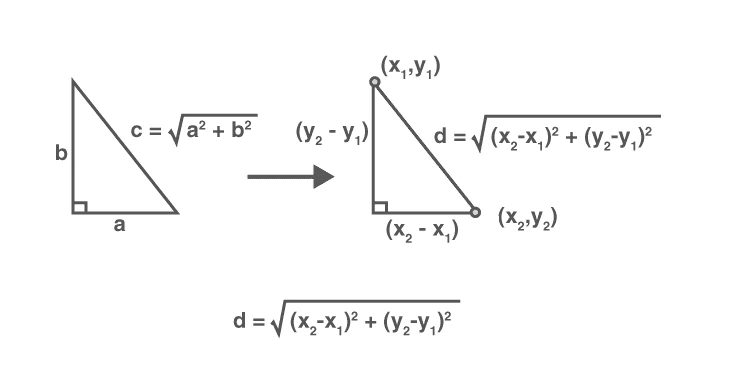
By the Pythagorean theorem, the distance \( PQ \) is:
\[ PQ = \sqrt{(x_2 - x_1)^2 + (y_2 - y_1)^2} \]
This formula holds true regardless of the quadrant in which the points lie because the squared differences are always non-negative.
Example: Finding Unknown Coordinate Using Distance
Problem: The distance between points \( A(4, -5) \) and \( B(-2, y) \) is 13 units. Find the value of \( y \).
Solution: Using the distance formula:
\[ \sqrt{(-2 - 4)^2 + (y + 5)^2} = 13 \]
Squaring both sides:
\[ (-6)^2 + (y + 5)^2 = 169 \]
\[ 36 + (y + 5)^2 = 169 \implies (y + 5)^2 = 133 \]
Taking square roots:
\[ y + 5 = \pm \sqrt{133} \]
Therefore,
\[ y = -5 \pm \sqrt{133} \]
So, \( y \) can be approximately \( 6.53 \) or \( -16.53 \).
Distance from the Origin to a Point
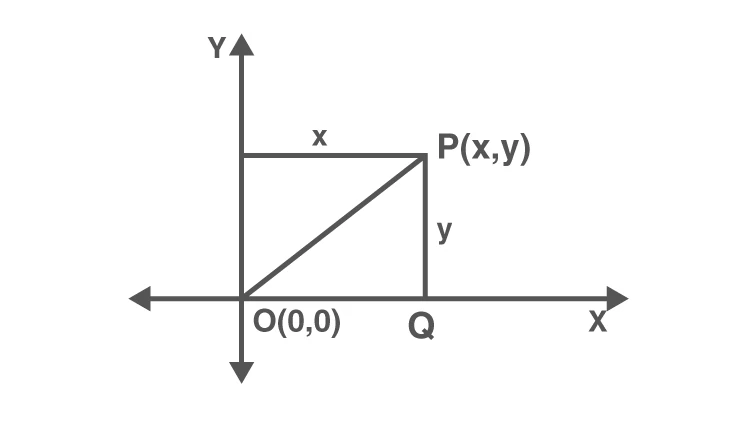
The distance of any point \( P(x, y) \) from the origin \( O(0, 0) \) is given by:
\[ OP = \sqrt{x^2 + y^2} \]
Extending Distance Calculation to Three Dimensions
Distance Formula in 3D Space
In three-dimensional geometry, points are represented as \( A(x_1, y_1, z_1) \) and \( B(x_2, y_2, z_2) \). The distance between these points is calculated by extending the Pythagorean theorem to include the z-axis:
\[ AB = \sqrt{(x_2 - x_1)^2 + (y_2 - y_1)^2 + (z_2 - z_1)^2} \]
This formula accounts for the differences along all three axes, providing the straight-line distance in space.
Example: Distance Between Two Points in 3D
Problem: Find the distance between points \( M(1, 2, 3) \) and \( N(4, 6, 8) \).
Solution: Using the 3D distance formula:
\[ MN = \sqrt{(4 - 1)^2 + (6 - 2)^2 + (8 - 3)^2} = \sqrt{3^2 + 4^2 + 5^2} = \sqrt{9 + 16 + 25} = \sqrt{50} = 5\sqrt{2} \]
The distance between \( M \) and \( N \) is \( 5\sqrt{2} \) units.
Summary of Key Distance Formulas
| Scenario | Formula | Description |
|---|---|---|
| Distance between two points in 2D | \( \sqrt{(x_2 - x_1)^2 + (y_2 - y_1)^2} \) | Calculates straight-line distance in the plane |
| Distance from origin to a point | \( \sqrt{x^2 + y^2} \) | Distance of point \( (x, y) \) from \( (0, 0) \) |
| Distance between two points in 3D | \( \sqrt{(x_2 - x_1)^2 + (y_2 - y_1)^2 + (z_2 - z_1)^2} \) | Distance in three-dimensional space |
Glossary of Important Terms
| Term | Definition |
|---|---|
| Coordinate Plane | A two-dimensional surface defined by perpendicular x and y axes |
| Coordinates | Ordered pairs \( (x, y) \) that specify a point's location |
| Origin | The point \( (0, 0) \) where the x-axis and y-axis intersect |
| Pythagorean Theorem | Relation \( a^2 + b^2 = c^2 \) in right triangles |
| Distance Formula | Formula to calculate distance between two points in coordinate geometry |
| Quadrant | One of the four sections of the coordinate plane divided by axes |
| Hypotenuse | The longest side of a right triangle opposite the right angle |
| 3D Coordinates | Triplets \( (x, y, z) \) representing points in three-dimensional space |
| Cartesian Coordinates | Coordinates based on perpendicular axes in a plane or space |
| Euclidean Geometry | Geometry based on flat planes and familiar postulates |
Frequently Asked Questions
How do you calculate the distance between two points in a plane?
Use the distance formula: \( \sqrt{(x_2 - x_1)^2 + (y_2 - y_1)^2} \), which is derived from the Pythagorean theorem.
Can the order of points be switched in the distance formula?
Yes, switching points does not affect the distance because the differences are squared, making the result positive.
Is it possible to find distance in three dimensions?
Yes, by using the 3D distance formula: \( \sqrt{(x_2 - x_1)^2 + (y_2 - y_1)^2 + (z_2 - z_1)^2} \).
What is the distance from the origin to the point \( (3, 4) \)?
It is \( \sqrt{3^2 + 4^2} = \sqrt{9 + 16} = 5 \) units.
How can I find a point equidistant from two given points?
Set the distances from the unknown point to each given point equal and solve the resulting equation for the coordinates.