Understanding the Area and Sector of a Circle
Fundamentals of Circle Area and Disk Concept
Basic Properties and Definitions of a Circle
Before exploring sectors, it is essential to understand how the area of a circle is determined. Area pertains to two-dimensional shapes, which occupy a plane. A circle is defined as the set of all points in a plane that are equidistant from a fixed point called the center. This fixed distance is known as the radius.
When considering all points inside and on the boundary of the circle, the enclosed region is called a disk. The area of the circle corresponds to the area of this disk.
The formula for the area \( A \) of a circle with radius \( r \) is:
\[ A = \pi r^2 \]
Introduction to the Sector of a Circle
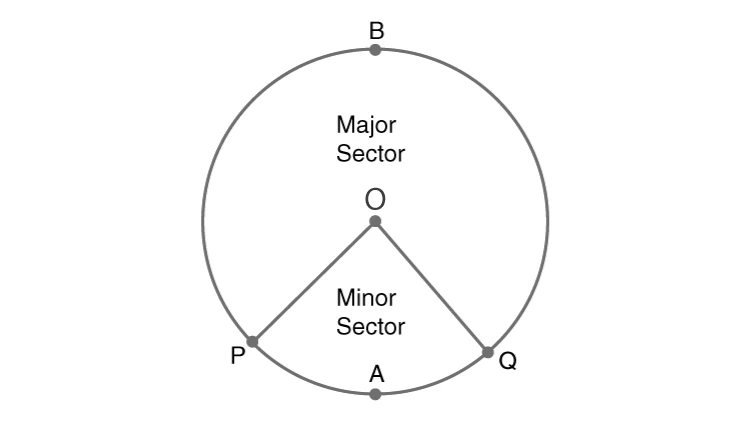
A sector is a portion of a circle enclosed by two radii and the arc between them. Common examples include semicircles and quarter circles, which are sectors with angles of 180° and 90°, respectively. In the figure below, the smaller region \( OPAQ \) is called the minor sector, while the larger region \( OPBQ \) is the major sector. The angles subtended by arcs \( PAQ \) and \( PBQ \) correspond to the angles of these sectors.
Calculating the Area of a Sector Using Degrees
Deriving the Sector Area Formula from Circle Area
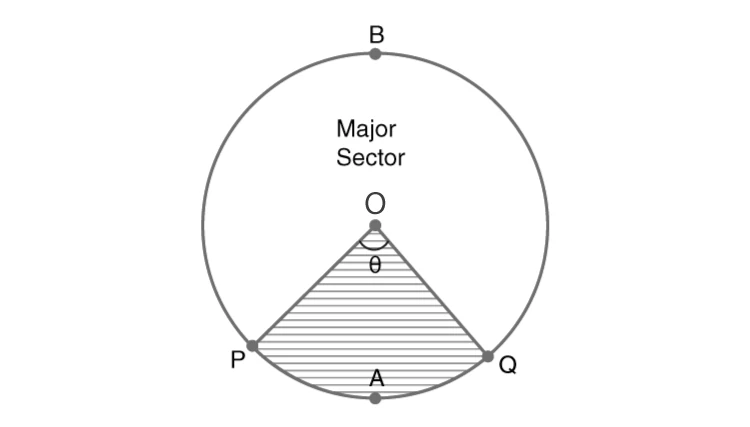
Consider a circle with radius \( r \) and center \( O \). Let the angle of the sector \( \angle POQ = \theta \) be measured in degrees. Since the full circle corresponds to 360°, the area of the sector is proportional to the fraction \( \frac{\theta}{360} \) of the entire circle's area.
Thus, the area \( A_{\text{sector}} \) of the sector is given by:
\[ A_{\text{sector}} = \frac{\theta}{360} \times \pi r^2 \]
Similarly, the length \( l \) of the arc \( PQ \) of the sector is:
\[ l = \frac{\theta}{360} \times 2 \pi r \]
Example 1: Finding Sector Area and Arc Length
Calculate the area and arc length of a sector with radius 5 units and central angle 60°.
Solution:
Given: \( r = 5 \text{ units}, \theta = 60^\circ \)
Area of sector:
\[ A = \frac{60}{360} \times \pi \times 5^2 = \frac{1}{6} \times \pi \times 25 = \frac{25\pi}{6} \approx 13.09 \text{ square units} \]
Length of arc:
\[ l = \frac{60}{360} \times 2 \pi \times 5 = \frac{1}{6} \times 10 \pi = \frac{10\pi}{6} = \frac{5\pi}{3} \approx 5.24 \text{ units} \]
Sector Area Calculation Using Radians and Arc Length
Relating Arc Length to Sector Angle in Radians
If the length of the arc \( l \) is known instead of the angle, the sector area can be found differently. For a circle of radius \( r \), an arc length equal to \( r \) subtends an angle of 1 radian at the center. Therefore, an arc length \( l \) corresponds to an angle \( \theta = \frac{l}{r} \) radians.
Using radians, the area of the entire circle is \( \pi r^2 \), and the full angle is \( 2\pi \) radians. The area of the sector with angle \( \theta \) radians is:
\[ A_{\text{sector}} = \frac{\theta}{2\pi} \times \pi r^2 = \frac{\theta r^2}{2} \]
Substituting \( \theta = \frac{l}{r} \), the area becomes:
\[ A_{\text{sector}} = \frac{l}{r} \times \frac{r^2}{2} = \frac{l r}{2} \]
Example 2: Sector Area from Arc Length
Find the area of a sector if the arc length is 7 units and the radius of the circle is 14 units.
Solution:
Given: \( l = 7 \text{ units}, r = 14 \text{ units} \)
Area of sector:
\[ A = \frac{l r}{2} = \frac{7 \times 14}{2} = \frac{98}{2} = 49 \text{ square units} \]
Summary of Key Formulas and Concepts
| Concept | Formula | Notes |
|---|---|---|
| Area of Circle | \( \pi r^2 \) | Where \( r \) is the radius |
| Area of Sector (Degrees) | \( \frac{\theta}{360} \times \pi r^2 \) | \( \theta \) in degrees |
| Arc Length (Degrees) | \( \frac{\theta}{360} \times 2 \pi r \) | \( \theta \) in degrees |
| Area of Sector (Radians) | \( \frac{\theta r^2}{2} \) | \( \theta \) in radians |
| Sector Area from Arc Length | \( \frac{l r}{2} \) | \( l \) is arc length |
Glossary of Important Terms
| Term | Definition |
|---|---|
| Circle | Set of points equidistant from a fixed center point in a plane. |
| Radius | Distance from the center of the circle to any point on its circumference. |
| Disk | The region enclosed by a circle, including its interior. |
| Sector | A portion of a circle bounded by two radii and the arc between them. |
| Arc | A continuous portion of the circumference of a circle. |
| Central Angle | The angle subtended at the center of the circle by two radii. |
| Minor Sector | The smaller sector formed by two radii and the arc between them. |
| Major Sector | The larger sector formed by two radii and the arc between them. |
| Radian | Unit of angular measure where 1 radian equals the angle subtended by an arc equal in length to the radius. |
| Arc Length | The distance along the curved line making up the arc of a circle. |
Frequently Asked Questions
What is the formula to find the area of a sector?
The area of a sector with central angle \( \theta \) degrees and radius \( r \) is \( \frac{\theta}{360} \times \pi r^2 \).
How do you calculate the length of an arc in a sector?
The arc length \( l \) is given by \( \frac{\theta}{360} \times 2 \pi r \), where \( \theta \) is in degrees.
What is the area of a sector when the angle is 1 radian?
When the angle is 1 radian, the sector area is \( \frac{r^2}{2} \).
How can the area of a sector be found if only the arc length is known?
If the arc length \( l \) and radius \( r \) are known, the sector area is \( \frac{l r}{2} \).
What distinguishes a minor sector from a major sector?
A minor sector has a smaller area and angle compared to the major sector, which covers the larger portion of the circle.