Calculating Areas of Composite Plane Figures
Fundamental Area Formulas for Basic Plane Shapes
Essential Area Calculations for Common Figures
In geometry, plane figures are flat, two-dimensional shapes that possess measurable area and perimeter. Familiar examples include squares, rectangles, circles, triangles, parallelograms, and trapeziums. Understanding their individual area formulas is crucial before tackling composite shapes.
Here are the standard formulas for these shapes:
Square: Area \(= a^2\), where \(a\) is the length of a side.
Rectangle: Area \(= l \times b\), where \(l\) is length and \(b\) is breadth.
Circle: Area \(= \pi r^2\), where \(r\) is the radius.
Triangle: Area \(= \frac{1}{2} \times b \times h\), where \(b\) is base and \(h\) is height.
Parallelogram: Area \(= b \times h\), where \(b\) is base and \(h\) is vertical height.
Trapezium: Area \(= \frac{1}{2} (a + b) \times h\), where \(a\) and \(b\) are parallel sides and \(h\) is height.
Mastering these formulas lays the foundation for calculating areas of more complex figures formed by combining these shapes.
Determining Areas of Composite Figures: Methodology and Practice
Approach to Calculating Areas of Combined Plane Figures
Composite plane figures are formed by joining or overlapping basic shapes. To find their total area, we often add or subtract areas of individual components. The key is to identify the shapes involved, calculate their areas separately, and then combine them appropriately.
Let's explore this with detailed examples that illustrate the step-by-step process.
Example 1: Area of a Square with Four Circles Inside
Calculate the shaded area in a square \(ABCD\) with side length 16 cm, where four identical circles are inscribed such that each touches two sides of the square.
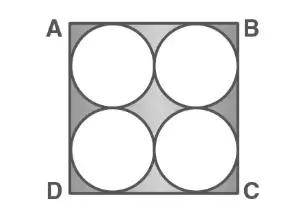
This image shows four identical circles inside a square. The circles are arranged in a 2x2 pattern, touching each other and the sides of the square. Step-by-step explanation: 1. There is a square labeled with corners A, B, C, and D. 2. Four equal circles fit inside the square, arranged in two rows and two columns. 3. Each circle touches its neighboring circles horizontally and vertically. 4. Each circle also touches the sides of the square, showing that they are tightly packed. 5. This picture is often used to study how circles fit inside squares and calculate areas or dimensions.
Solution:
Given: Side of square \(a = 16 \text{ cm}\).
Area of square:
\[ A_{\text{square}} = a^2 = 16^2 = 256 \text{ cm}^2 \]
Each circle's diameter is half the side length of the square:
\[ d = \frac{16}{2} = 8 \text{ cm} \]
Radius of each circle:
\[ r = \frac{d}{2} = \frac{8}{2} = 4 \text{ cm} \]
Area of one circle:
\[ A_{\text{circle}} = \pi r^2 = \frac{22}{7} \times 4^2 = \frac{22}{7} \times 16 = \frac{352}{7} \approx 50.29 \text{ cm}^2 \]
There are 4 such circles, so total area of circles:
\[ 4 \times 50.29 = 201.16 \text{ cm}^2 \]
Area of shaded region (square area minus total circle areas):
\[ 256 - 201.16 = 54.84 \text{ cm}^2 \]
Final answer: The shaded area is approximately \(54.84 \text{ cm}^2\).
Advanced Composite Areas Involving Semicircles and Squares
Calculating Shaded Regions with Semicircles on Square Sides
When semicircles are drawn on the sides of a square, the shaded area can be found by subtracting the areas of these semicircles from the square's area. This requires careful partitioning of the figure and summing or subtracting areas accordingly.
Example 2: Shaded Area in a Square with Semicircles on Each Side
Find the shaded area in a square \(ABCD\) with side length 12 cm, where semicircles are constructed on each side using the side as the diameter. Use \(\pi = 3.14\).
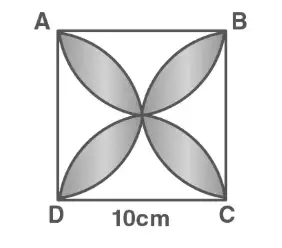
The image shows a square labeled ABCD with each side measuring 10 cm. Inside the square, four curved shapes created by arcs from the circle quarters overlap, forming a flower-like pattern in the middle. Step-by-step explanation for high school students: 1. Identify the square ABCD with side length 10 cm. 2. Four arcs are drawn inside the square. Each arc is part of a circle centered at one corner of the square. 3. Each circle has a radius equal to the side of the square (10 cm). 4. The arcs intersect inside the square, creating four petal-shaped regions. 5. The overlapping arcs form a symmetrical flower pattern in the center of the square.
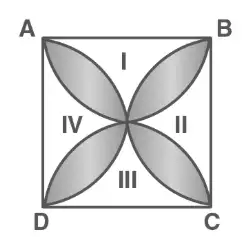
This image shows a square divided into four leaf-shaped sections labeled I, II, III, and IV. Each leaf section is formed by curves that meet at the center of the square. Step-by-step explanation: 1. The big shape is a square named ABCD. 2. Four curved shapes (leaves) are drawn inside the square. 3. Each leaf touches the center and two corners of the square. 4. These curved shapes divide the square into four parts labeled I, II, III, and IV. 5. Notice how the curves create symmetrical sections inside the square.
Solution:
Side length of square \(a = 12 \text{ cm}\).
Area of square:
\[ A_{\text{square}} = 12^2 = 144 \text{ cm}^2 \]
Radius of each semicircle (half of side length):
\[ r = \frac{12}{2} = 6 \text{ cm} \]
Area of one semicircle:
\[ A_{\text{semicircle}} = \frac{1}{2} \pi r^2 = \frac{1}{2} \times 3.14 \times 6^2 = 0.5 \times 3.14 \times 36 = 56.52 \text{ cm}^2 \]
There are 4 semicircles, so total area of semicircles:
\[ 4 \times 56.52 = 226.08 \text{ cm}^2 \]
However, the semicircles overlap inside the square, so the shaded area is calculated by subtracting the combined unshaded parts (regions I, II, III, IV) from the square's area.
Sum of areas I and III:
\[ 144 - 2 \times 56.52 = 144 - 113.04 = 30.96 \text{ cm}^2 \]
Sum of areas II and IV is the same:
\[ 30.96 \text{ cm}^2 \]
Total unshaded area:
\[ 30.96 + 30.96 = 61.92 \text{ cm}^2 \]
Therefore, shaded area:
\[ 144 - 61.92 = 82.08 \text{ cm}^2 \]
Final answer: The shaded region measures approximately \(82.08 \text{ cm}^2\).
Practice Exercises on Composite Plane Figures
Try These Problems to Strengthen Your Understanding
Apply the concepts learned by solving the following problems involving composite figures with circles and semicircles inside squares.
Problem 1
Determine the shaded area in a square \(ABCD\) with side length 18 cm, where semicircles are drawn on two adjacent sides \(APD\) and \(BPC\).
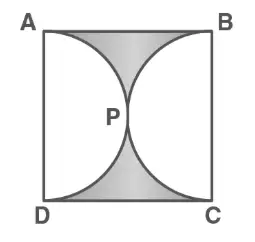
The image shows a square ABCD with two arcs inside it. Each arc connects two opposite corners: one arc from A to B, and another from D to C. These arcs intersect at a point labeled P. The shaded area is the region outside the arcs but inside the square. Step-by-step explanation: 1. Start with a square named ABCD. 2. Draw a curved line (arc) from corner A to corner B inside the square. 3. Draw another arc from corner D to corner C, crossing the first arc inside the square. 4. The two arcs intersect at point P inside the square. 5. The shaded area is the part of the square that lies outside the arcs.
Problem 2
Calculate the shaded area in a square \(ABCD\) of side 18 cm, where four circles are drawn with centers at \(A, B, C,\) and \(D\), each touching two of the other circles.
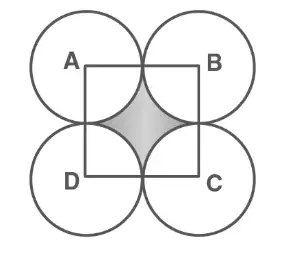
This image shows four circles labeled A, B, C, and D around a square. The circles overlap with each other and the square, creating a shaded diamond shape in the center where they all intersect. Step-by-step explanation: 1. Draw a square. 2. Place four circles, one near each corner of the square. 3. Position the circles so they touch each other and the square's sides. 4. The area where all four circles overlap inside the square forms a shaded diamond shape. 5. This shape highlights the common area shared by all four circles.
Summary Table: Key Area Formulas and Composite Calculations
Shape | Area Formula | Notes |
|---|---|---|
Square | \(a^2\) | \(a\) = side length |
Rectangle | \(l \times b\) | \(l\) = length, \(b\) = breadth |
Circle | \(\pi r^2\) | \(r\) = radius |
Triangle | \(\frac{1}{2} b h\) | \(b\) = base, \(h\) = height |
Parallelogram | \(b h\) | \(b\) = base, \(h\) = vertical height |
Trapezium | \(\frac{1}{2} (a + b) h\) | \(a, b\) = parallel sides, \(h\) = height |
Composite Figures | Sum or difference of component areas | Identify shapes, calculate areas, then add or subtract accordingly |
Glossary of Terms Related to Plane Figures
Term | Definition |
|---|---|
Plane Figure | A flat, two-dimensional shape with length and width. |
Area | The measure of the surface enclosed within a figure. |
Perimeter | The total length around the boundary of a figure. |
Radius | Distance from the center to any point on a circle. |
Diameter | A line segment passing through the center of a circle with endpoints on the circle. |
Semicircle | Half of a circle formed by cutting along the diameter. |
Composite Figure | A shape made by combining two or more basic plane figures. |
Base | The side of a figure on which it is assumed to rest or is measured. |
Height | The perpendicular distance from the base to the opposite side or vertex. |
Parallel Sides | Sides of a figure that are always the same distance apart and never meet. |
Frequently Asked Questions on Areas of Plane Figures
What defines a plane figure in geometry?
A plane figure is a two-dimensional shape where all points lie on a flat surface, having measurable length and width but no thickness.
Can you list some common examples of plane figures?
Common plane figures include squares, rectangles, circles, triangles, parallelograms, and trapeziums.
How does a plane figure differ from a solid figure?
Plane figures are two-dimensional with only length and width, whereas solid figures have three dimensions including height or depth.
Is a circle considered a plane figure?
Yes, a circle is a plane figure because it lies entirely on a flat surface and has two dimensions.
Is a cuboid a plane figure?
No, a cuboid is a three-dimensional solid figure and not a plane figure.